 EN
EN


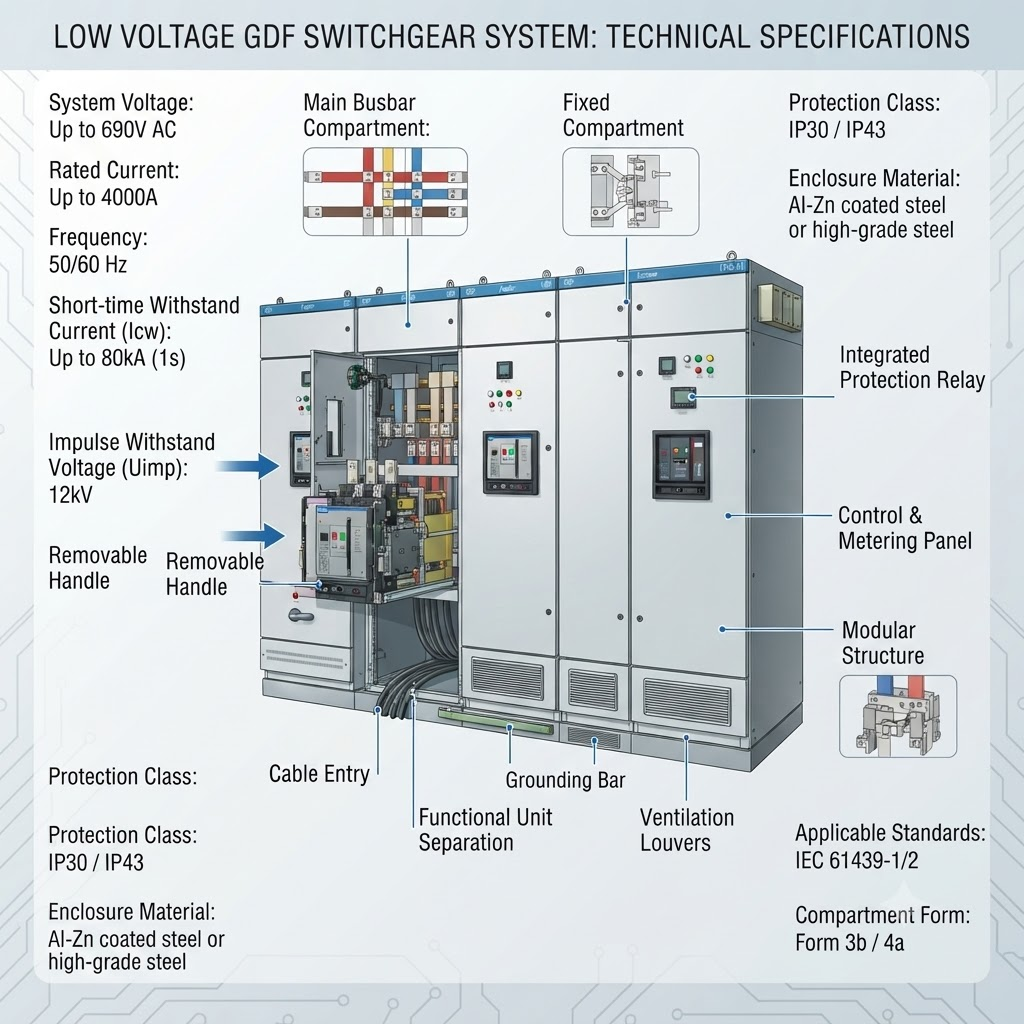
In modern industrial facilities, high-rise buildings, and data centers where power continuity is critical, electrical system reliability directly impacts personnel safety and asset protection. In fire protection backup power and emergency power distribution systems, single-source power supplies or basic switching architectures can no longer meet stringent safety standards.
A three-tier redundant power supply architecture—combining two dual-utility power sources with two independent diesel generator sets—paired with high-safety GDF fixed-separator switchgear, delivers uninterruptible power during extreme operating conditions. This article analyzes the architecture design, enclosure separation technology, component coordination, and application selection for this industrial low-voltage power distribution system.
Key Takeaways
1) Three-Tier Redundant Power Supply System: Integrates two independent 10kV utility power lines with two independent diesel generator sets to form a multi-layer power defense with utility backup and diesel generator coverage.
2) Fixed-Separator Design: Uses internal metallic or insulating barriers to isolate busbars, circuit breakers, and outgoing cable connections, effectively blocking internal arc propagation and protecting maintenance personnel.
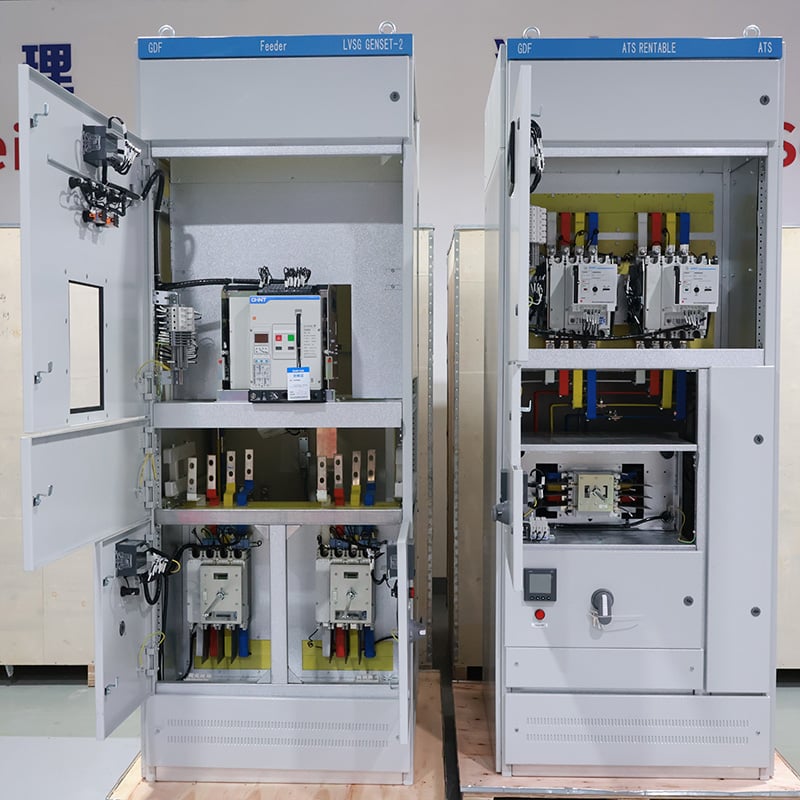
3) Dedicated Fire Protection ATS & Feeder Response: Features dedicated red ATS (Automatic Transfer Switch) cabinets and fire pump power feeder cabinets to ensure priority switching for fire loads during emergency response.
4) Modular & Maintenance Flexibility: Combines the structural rigidity of fixed switchgear with the maintenance safety of compartmented enclosures, minimizing outage scope during servicing.
What Is a Three-Tier Redundant Fire Power Supply System?
A three-tier redundant power supply architecture connects high-voltage utility power and self-provided emergency power in a multi-stage physical and logical series configuration to eliminate Single Points of Failure (SPOF) and mitigate regional power grid failures.
Tier 1 (Primary Power Source): The first 10kV utility power line handles normal daily power supply for the facility or building.
Tier 2 (Backup Utility Power): The second 10kV utility line originates from a different substation or independent bus section. If the primary utility power experiences power loss, undervoltage, or failure, the bus tie or incoming breaker automatically switches to backup utility power.
Tier 3 (Emergency Backup Power): Two independent diesel generator sets. When both utility lines fail simultaneously (such as during a widespread grid outage), the generator sets receive an auto-start signal, synchronize or energize in steps within seconds, and connect to the low-voltage emergency distribution system.
In this architecture, low-voltage switchgear must receive power from utility transformers and generator outputs while utilizing electrical and mechanical interlocking alongside automatic transfer logic to ensure safe power transitions.
Core Differences:
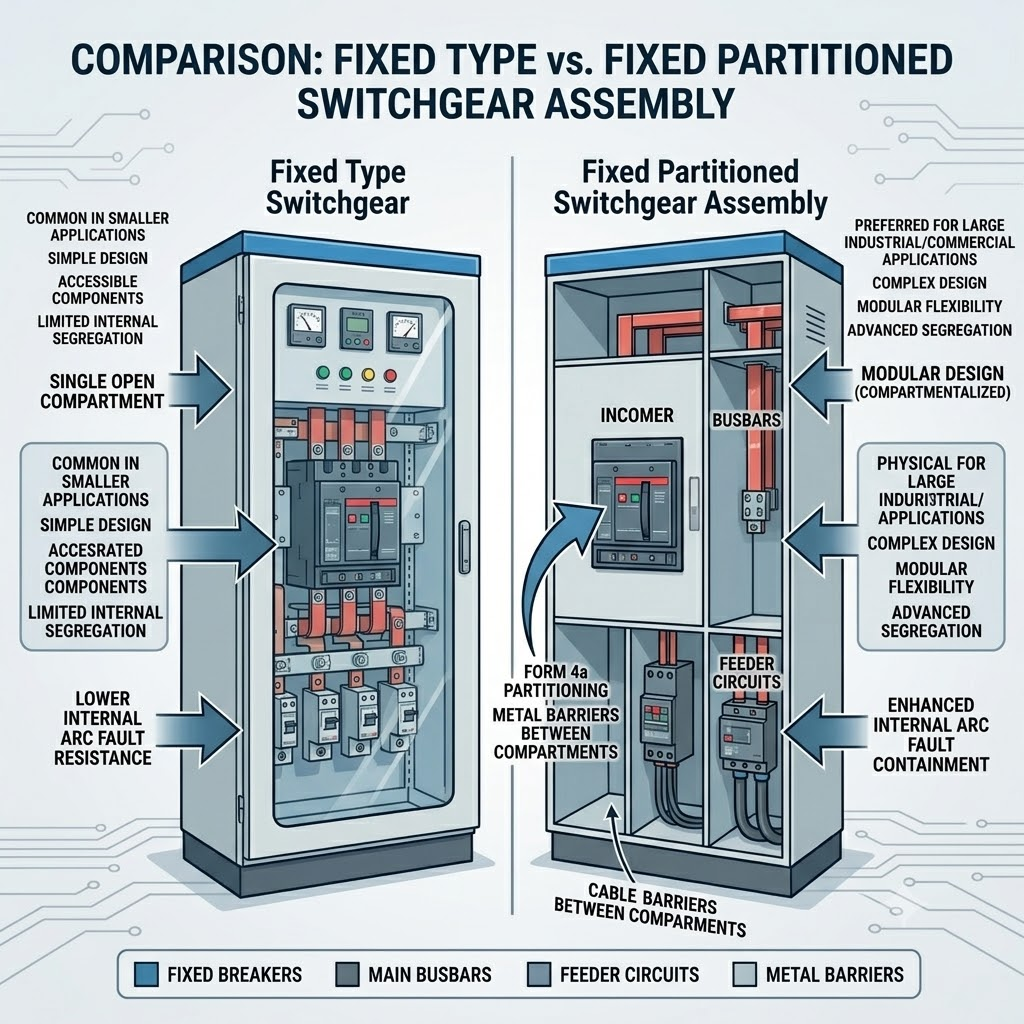
Comparison: Standard Fixed Switchgear vs.Fixed-Separator Switchgear
Comparison Dimension |
Standard Fixed Switchgear |
Fixed-Separator Switchgear (Form 3b / Form 4) |
Internal Separation Form |
Form 1 (Unseparated open compartment) |
Form 3b / Form 4 (Separated into independent compartments) |
Arc Mitigation Capability |
Very low; internal arc faults easily spread across the entire cabinet |
Very high; fault arcs are confined within a single compartment |
Maintenance Outage Scope |
Widespread; requires de-energizing the entire cabinet or bus section |
Localized; enables circuit-level power outages for servicing |
Operator Safety |
Lower; opening cabinet doors risks contact with live busbars |
Very high; insulating or metallic barriers shield live components |
Short-Circuit Withstand |
Standard; constrained by open-space support structures |
Very high; compact compartment barriers enhance busbar stability |
Primary Application Scenarios |
Standard low-voltage distribution; cost-sensitive projects |
High-reliability emergency power; heavy-duty fire protection dual-power systems |
Specialized Design and Response Logic of Fire Protection Switchgear
In a three-tier redundant architecture, power supply to fire pump rooms and critical firefighting equipment holds top priority. The system incorporates dedicated red fire ATS cabinets and fire pump power feeder cabinets:
Visual Warning and Regulatory Compliance: Fire protection cabinets use bright red coatings (or red-labeled doors) to meet mandatory fire safety identification standards, allowing emergency responders to identify and operate equipment quickly.
Dedicated ATS (Automatic Transfer Switch) Switching:
Equips CB-class or PC-class fire-dedicated dual-power transfer switches.
Supports priority switching logic between dual utility lines and diesel generators. When triggered by a Fire Alarm System (FAS) signal, the ATS locks onto the fire power supply source, ignoring load-shedding logic applied to standard loads.
"Overload Alarm Only, No Tripping" Protection: Circuit breakers for specialized fire loads, such as fire pumps, configure overload trip units to generate alarm signals rather than trip automatically. This maintains the principle that power continuity takes precedence over equipment protection during fire rescues.
Selection and Engineering Planning Guide for Fixed-Separator Switchgear
When planning and procuring low-voltage emergency switchgear, engineering teams should evaluate key parameters and standards:
1) Ingress Protection (IP Rating): Select IP30 or IP40 for standard indoor electrical rooms. Choose IP42 or IP54 with anti-condensation heaters for basements, areas near pump rooms, or humid environments.
2) Cable Entry & Termination Space: Confirm top/bottom entry or rear entry configurations for fixed-separator enclosures, leaving sufficient cable bending radius and space for zero-sequence current transformers.
3) Electrical & Mechanical Interlocking: Implement reliable interlocks (such as "two-out-of-three" schemes or key/mechanical interlocks combined with electrical interlocks) between dual utility feeders and bus ties to prevent unsynchronized paralleling between utility grid lines or generator supplies.
FAQ
Q1: What is fixed-separator switchgear, and how does it differ from standard fixed switchgear?
A1: Fixed-separator switchgear uses metallic or insulating barriers to divide its interior into independent compartments (Form 3 or Form 4), whereas standard fixed switchgear uses a single open compartment. The separated structure prevents arc propagation and improves maintenance safety.
Q2: How does the ATS handle power transitions across a three-tier supply system?
A2: The system uses intelligent controllers paired with multi-stage ATS units. It switches to backup utility power if the primary line fails. If both utility lines fail, the system signals the diesel generators to start, build voltage, and transfer power via the ATS, prioritizing fire protection loads.
Q3: Why are fire protection ATS feeder cabinets painted red, and why are they configured to alarm without tripping on overload?
A3: The red finish ensures compliance with mandatory fire equipment identification standards. Configuring overloads to alarm without tripping maintains power to fire pumps during emergencies, prioritizing life safety over equipment protection.
Q4: How does fixed-separator switchgear compare to withdrawable (draw-out) switchgear?
A4: Fixed-separator switchgear features bolted main circuit connections, offering higher short-circuit resistance, lower heat generation, and better cost-efficiency. While replacing a damaged breaker takes longer than swapping a draw-out module, internal barriers keep the outage scope localized.
Q5: How do I select the right IP rating for an emergency power distribution cabinet?
A5: Use IP30 or IP40 for standard indoor electrical rooms. For fire pump rooms or humid underground locations, select IP42 to IP54 and install anti-condensation heaters to protect internal insulation.
Conclusion
In summary, implementing a robust multi-tier power architecture backed by high-safety fixed-separator switchgear is essential for modern critical facilities seeking to eliminate single points of failure. By integrating advanced internal compartmentation, short-circuit resistance, and dedicated emergency fire protection controls, facility managers can achieve maximum operational uptime and uncompromised safety. Ultimately, investing in engineered low-voltage distribution systems ensures long-term power reliability, regulatory compliance, and ultimate protection for both personnel and vital assets.
Table of Contents
- Key Takeaways
- What Is a Three-Tier Redundant Fire Power Supply System?
- Core Differences:
- Specialized Design and Response Logic of Fire Protection Switchgear
- Selection and Engineering Planning Guide for Fixed-Separator Switchgear
-
FAQ
- Q1: What is fixed-separator switchgear, and how does it differ from standard fixed switchgear?
- Q2: How does the ATS handle power transitions across a three-tier supply system?
- Q3: Why are fire protection ATS feeder cabinets painted red, and why are they configured to alarm without tripping on overload?
- Q4: How does fixed-separator switchgear compare to withdrawable (draw-out) switchgear?
- Q5: How do I select the right IP rating for an emergency power distribution cabinet?
- Conclusion