 EN
EN


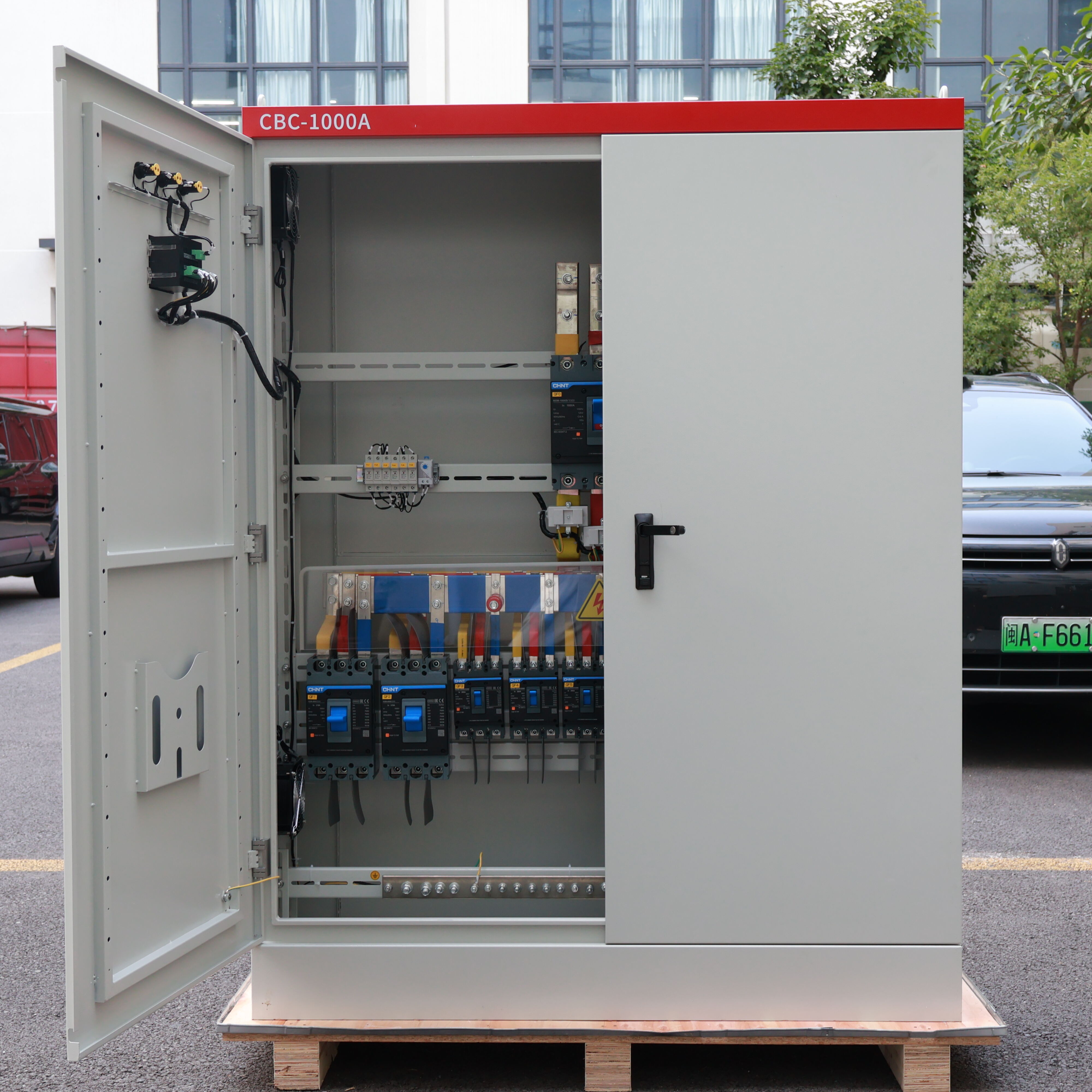
In modern industrial production, whether it is a plastic product plant with large injection molding and extrusion machines, or a mechanical processing plant, chemical workshop, or building materials production base relying on intensive CNC machine tools and stamping equipment, a stable and safe power supply is the cornerstone for maintaining highly efficient operations. As the primary power electrical core of a plant or large workshop, the 1000A power distribution cabinet plays a critical role in connecting the upper and lower power grids, precise power distribution, and strict protection. It acts like the "heart" of the factory's entire power system, continuously, safely, and intelligently delivering low-voltage high current output from high-voltage transformers to various production lines.
Why Do Large Industrial Production Lines Need a 1000A Primary Power Distribution Cabinet?
In AC low-voltage power distribution systems, when the total load of an independent workshop or an entire production line reaches hundreds of kilowatts (kW), ordinary secondary distribution boxes or low-current switchgears cannot withstand the extremely high continuous working currents and the massive inrush currents generated during instantaneous start-ups.High-power industrial equipment places extremely high demands on the power supply system during start-up and operation. For example, large injection molding machines in plastic product plants generate periodic load peaks during heating and mold-clamping stages. Heavy stamping machines and CNC machine tools in mechanical processing plants draw surge currents several times their rated currents from the grid at the moment of start-up. Without a scientifically designed primary power distribution cabinet for unified management, the factory's electrical system faces multiple hidden hazards:
Aggravated Overload and Short-Circuit Hazards, Prone to Nuisance Tripping: If the short-circuit breaking capacity of the front-end master control equipment is insufficient or the protection characteristic curves do not match, a local short circuit in a branch circuit can easily cause the upstream circuit breaker to trip. This leads to large-scale power outages across the workshop or even the entire plant. Such unplanned downtime not only damages molds and wastes raw materials but also severely disrupts production scheduling.
Difficult Workshop Cable Management, Skyrocketing Line Losses and Safety Risks: The lack of a centralized high-current distribution node prevents the neat connection of low-voltage high currents drawn from external transformers. If multiple small cables are directly used in a scattered and disordered manner, it not only creates clutter in cable trenches or bridges but also easily causes localized overheating due to inconsistent contact resistance, drastically increasing line losses and burying electrical fire hazards.
Blind Electricity Usage, Lacking Digital Monitoring of Operational Status: Without centralized metering from a primary power cabinet, management personnel cannot master real-time metrics like the three-phase voltage balance, total power factor, and current fluctuation range of the entire workshop. When production lines expand or equipment aging leads to power anomalies, the lack of data support makes early warning of faults impossible.
Introducing a 1000A industrial power distribution cabinet, equipped with built-in high-capacity, high-breaking-capacity molded case circuit breakers (MCCBs), precise multi-functional smart meters, and strict three-phase indication systems, enables centralized primary control and smooth multi-circuit branching of power derived from transformers, constructing a rock-solid electrical safety barrier for the factory.
Core Differences:
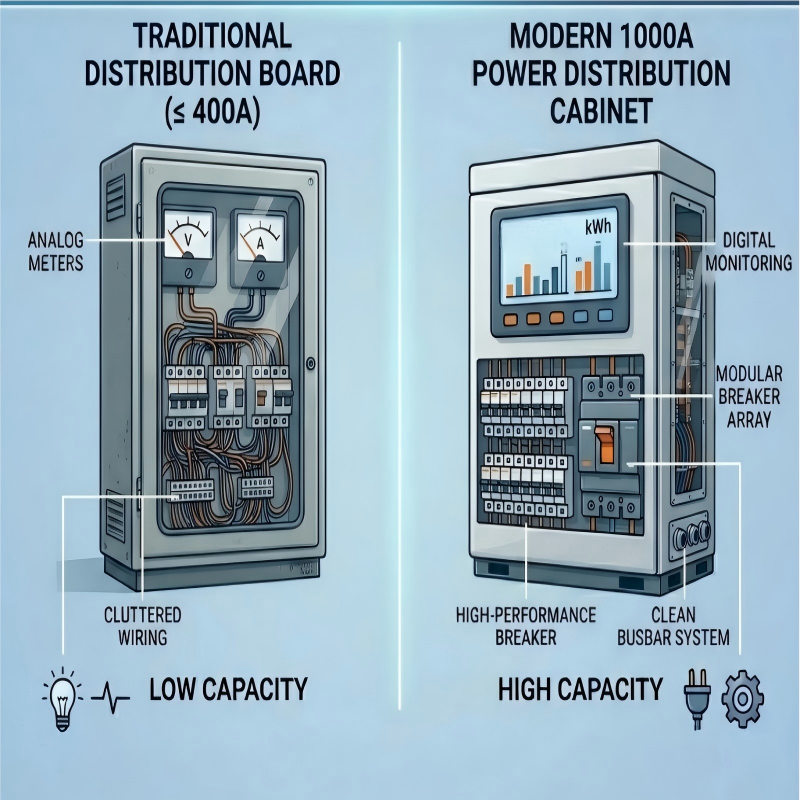
Comparison: Traditional Cabinet vs 1000A Power Cabinet
Traditional Cabinet |
1000A Power Cabinet |
Insufficient busbar margin; hard to add lines. |
Reserved loops & wide busbars; seamless expansion. |
Low breaking capacity; branch faults cause total blackout. |
Precise cascaded protection; millisecond fault isolation. |
Relies on natural convection; severe internal heat. |
Anti-dust louvers & fans; automatic thermal exhaust. |
Only analog pointer meters; no real-time monitoring. |
Smart network meters; cloud data integration. |
Weak electrodynamic resistance; prone to deformation. |
Tinned copper busbars; high short-circuit resistance. |
Unorganized single-phase load; frequent unbalanced tripping. |
Balanced phase wiring; real-time imbalance alerts. |
System Architecture and Synergistic Protection Mechanism of Core Components
A rigorously designed and standardized industrial low-voltage high-current power distribution cabinet is not a simple stacking of components, but a safety network systematically assembled from multiple functional electrical modules working in synergy:
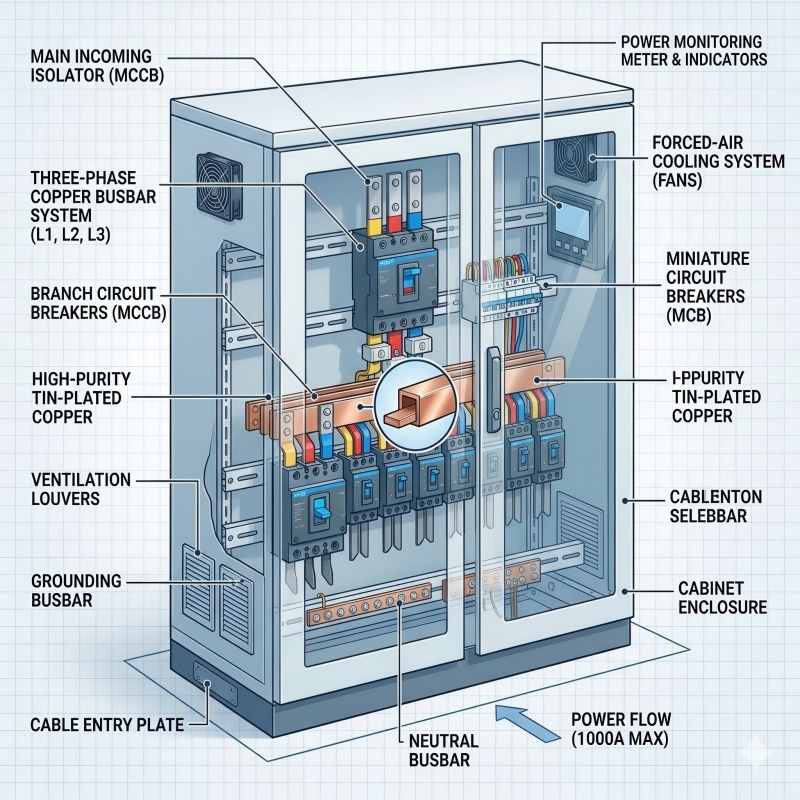
Smart Monitoring and Three-Phase Indication System: The cabinet door is equipped with high-brightness yellow, red, and green LED indicators to display phase loss or open-phase anomalies in real time. The multi-functional smart meter precisely collects voltage, current, active power, reactive power, and electrical energy dynamics. Operators can intuitively assess the current load status of the production line through the door panel instruments without opening the cabinet.
High-Capacity Main Incoming Circuit Breaker: Serving as the flow control core of the entire cabinet, a circuit breaker with ultra-high breaking capacity is selected as the 1000A main control switch. Equipped with an intelligent trip unit, it not only monitors long-term overload temperature rises but also implements millisecond-level instantaneous cut-offs during sudden ultra-large short-circuit currents, locking down transient impacts and protecting the insulation safety of all downstream equipment.
High-Specification Main Busbars and Premium Branch Copper Bars: The "blood vessels" running horizontally and vertically inside the cabinet utilize high-conductivity tinned or wide rectangular copper busbars, arranged strictly according to the three-phase five-wire system (L1, L2, L3, N, PE) specification. The copper surfaces are tinned to prevent oxidation, and the overall span and insulation supports are verified by strict electrodynamic calculations, ensuring that the temperature rise remains within safety limits when carrying kilo-ampere-level continuous large currents, and resisting huge electrodynamic impacts during short circuits.
Refined Branch Molded Case Circuit Breakers: Downstream of the main busbar, multiple branch circuit breakers of various capacities (such as 200A, 315A, 400A, etc.) are installed. These circuit breakers are precisely matched according to the actual rated current of each production area, heavy crane, or high-energy-consumption main machine. They operate independently without interfering with each other, achieving refined shunting control and secondary protection.
Smart Auxiliary Temperature Control & Exhaust System: Considering the inherent heat generation of electrical components when large currents pass through, the sides of the cabinet are specifically engineered with large-volume, dust-proof ventilation louvers. Inside the enclosure, high-speed, long-life forced-air-cooling axial fans cooperate with high-sensitivity temperature control instruments and independent protection fuses. When the internal cabinet temperature exceeds a preset threshold (e.g., 40°C), the fans automatically start to force-exhaust heat, ensuring core components always operate at their optimal temperature, delaying equipment aging.
FAQ
Q1: Why does a 1000A power distribution cabinet emphasize "Primary Power"? What is its difference from a secondary distribution box?
A1: The primary cabinet connects directly to the transformer to handle total workshop currents over 1000A with high breaking capacity. A secondary box branches from the primary cabinet, handles sub-400A currents, and only controls specific local equipment or terminal machinery.
Q2: In factory environments with high temperatures and heavy dust, how should daily maintenance be performed?
A2: Regularly clean/replace louver dust filters and check fan operation. Periodically de-energize the system to tighten all busbar and terminal bolts with torque wrenches, preventing loose connections from causing localized overheating or electrical accidents under heavy vibration.
Q3: How does the power cabinet prevent faults or tripping caused by "Three-Phase Imbalance"?
A3: Engineers evenly distribute single-phase loads (lighting/heating) across A, B, and C phases during installation. Operators must monitor the smart meter regularly; if the current imbalance exceeds 15%, downstream load phase sequences must be adjusted.
Q4: What is the significance of "Frame Current (Inm)" and "Rated Current (In)" of a circuit breaker during selection?
A4: Frame Current (Inm) is the structural current and breaking limit the breaker shell can handle. Rated Current (In) is the maximum continuous current allowed by the trip unit. This cabinet uses a "large frame, small trip" design for superior safety.
Q5: How can this power distribution cabinet be utilized when factories adopt energy management or ERP systems?
A5: The built-in smart meters support RS485 Modbus-RTU communication. Factories can daisy-chain the meters directly to an Energy Management System (EMS) or ERP, acquiring real-time power metrics and peak-valley ratios to optimize shift schedules and cut costs.
Conclusion
Table of Contents
- Why Do Large Industrial Production Lines Need a 1000A Primary Power Distribution Cabinet?
- Core Differences:
- System Architecture and Synergistic Protection Mechanism of Core Components
-
FAQ
- Q1: Why does a 1000A power distribution cabinet emphasize "Primary Power"? What is its difference from a secondary distribution box?
- Q2: In factory environments with high temperatures and heavy dust, how should daily maintenance be performed?
- Q3: How does the power cabinet prevent faults or tripping caused by "Three-Phase Imbalance"?
- Q4: What is the significance of "Frame Current (Inm)" and "Rated Current (In)" of a circuit breaker during selection?
- Q5: How can this power distribution cabinet be utilized when factories adopt energy management or ERP systems?
- Conclusion