 EN
EN


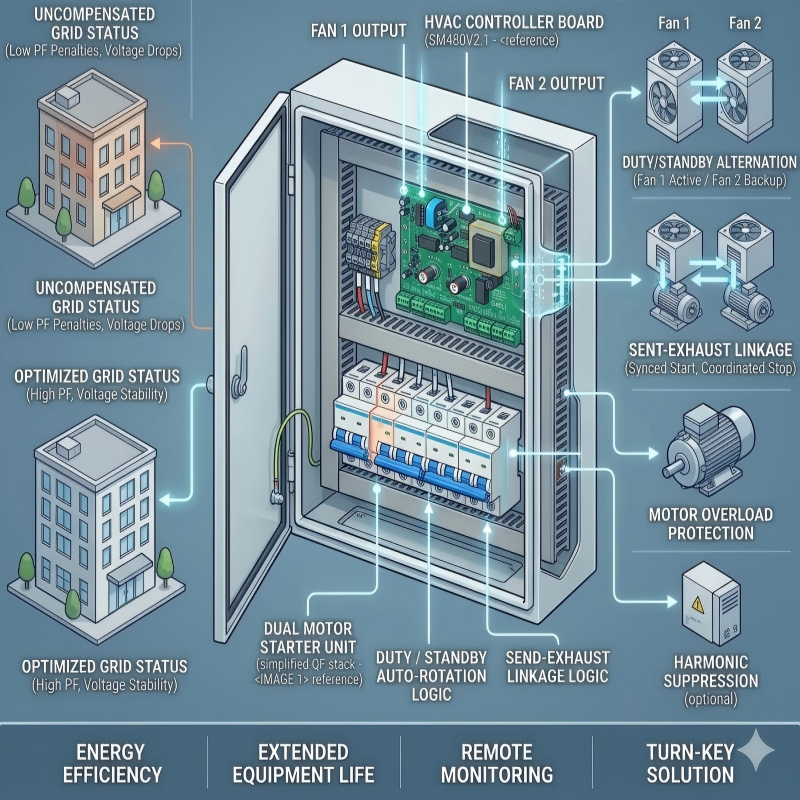
Innovation plays a vital role in the daily operation of Heating, Ventilation, and Air Conditioning (HVAC) systems. Modern commercial buildings and industrial environments demand advanced air circulation and precise thermal management. While high-performance supply and exhaust fans are crucial, the true operational efficiency relies on the "nerve center" behind them—the Dual Fan Control Cabinet.
Whether linking supply and exhaust air, rotating master and standby units for industrial cooling, or integrating with building automation, these specialized control enclosures serve as essential electrical solutions to guarantee system safety, energy efficiency, and operational continuity.
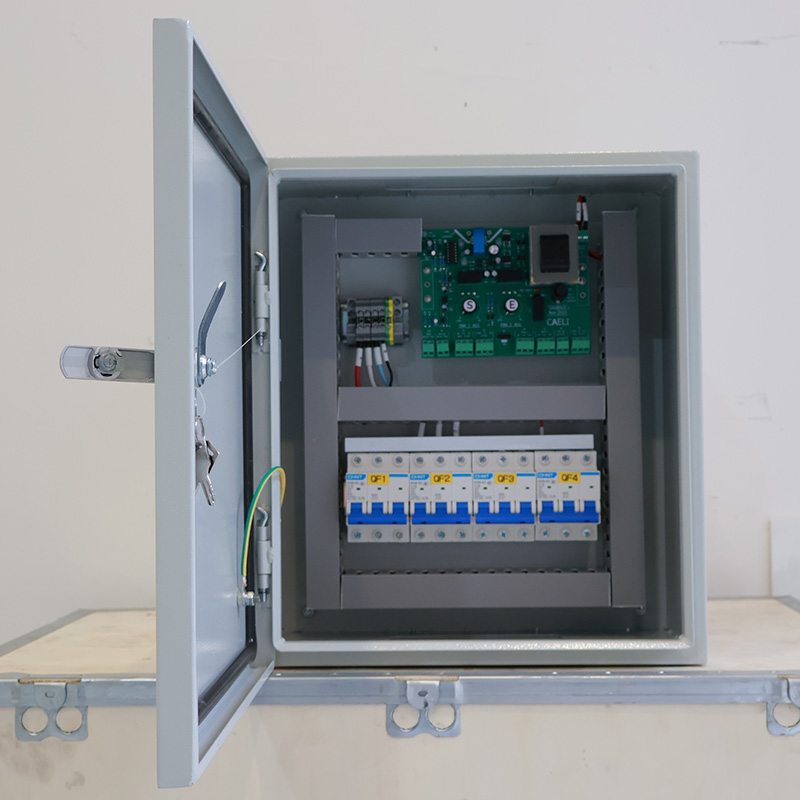
Why Do HVAC Ventilation and Cooling Systems Require Dedicated Dual Fan Control?
In standard power distribution layouts, operating ventilation fans through basic manual switches or isolated circuit breakers falls short of meeting modern HVAC logic. Dual fan systems—whether configured as supply/exhaust pairs, duty/standby configurations, or parallel units—require synchronized execution to address complex engineering hurdles:
Mitigating Severe Motor Inrush Currents: Industrial fans experience massive current spikes during direct-on-line (DOL) starting, which can draw 5 to 7 times the rated current. This stresses local power lines and accelerates cable insulation wear.
Establishing Interlocking Logic: In combined supply and exhaust systems, if an exhaust fan fails while the supply fan remains fully operational, it causes severe indoor air pressure imbalances, compromising fire door operations and safety protocols.
Balancing Equipment Wear: In duty/standby cooling setups, the absence of an automated alternation mechanism causes the primary fan to degrade rapidly from over-exhaustion, while the idle backup unit deteriorates from moisture and stagnation.
A dedicated HVAC dual fan control panel eliminates these vulnerabilities by blending robust power distribution with customized circuit board control logic.
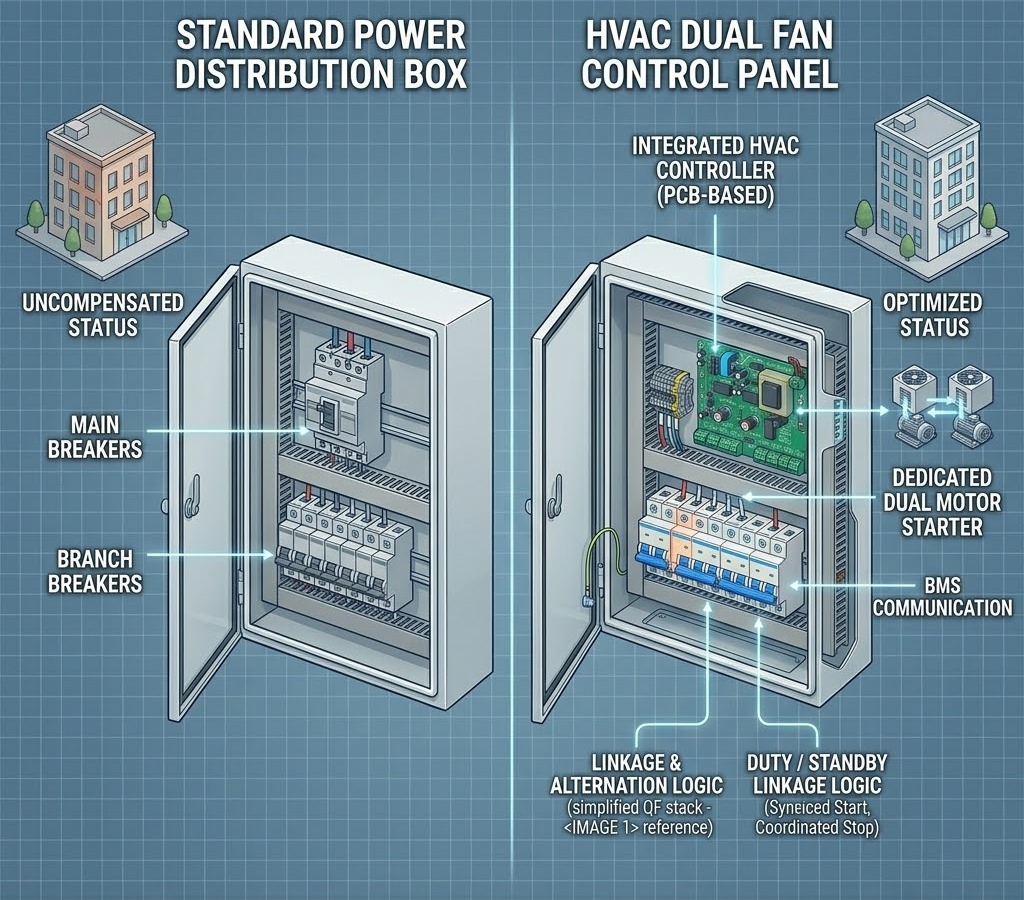
Core Differences:
Comparison: Standard Power Box vs. HVAC Dual Fan Control Cabinet
Metric |
Standard Power Box |
HVAC Dual Fan Control Cabinet |
Logic |
Manual independent startup; no interlocking |
Automatic supply/exhaust linkage; duty/standby rotation |
BMS |
No automation interfaces |
Built-in 0-10V/4-20mA and Modbus interfaces |
Protection |
Basic overload and short-circuit protection only |
Phase-loss, motor overload, and fault-linkage trips |
Wear |
Manual switching; uneven runtime |
Automated timers for balanced wear |
Housing |
General utility rating; unsealed |
Compact industrial build; dust and moisture sealed |
Tuning |
Fixed parameters; requires manual rewiring |
On-board dials for rapid local calibration |
System Architecture and Operational Mechanism
An engineered dual fan control panel segregates its layout into distinct power delivery and low-voltage control layers:
Smart HVAC Controller Board: The central brain that processes system status, external sensors, and BMS inputs to execute startup, shutdown, interlocking, or speed regulation commands.
Main Circuit Breakers: Provides primary electrical isolation alongside overarching short-circuit and overload protection for the entire internal framework.
Branch Miniature Circuit Breakers (MCBs): Delivers isolated overcurrent protection to each individual fan and the control circuit, ensuring a single branch fault does not compromise the alternate fan.
On-Board Adjustment Terminals: Features localized dials on the control board to calibrate fan startup delays, rotation intervals, or base operating frequencies during commissioning.
The System in Action (Supply and Exhaust Linkage Mode): When indoor air quality sensors detect elevated $CO_2$ levels or excessive ambient heat, the building management system sends an enablement command to the control panel. The smart controller initiates the exhaust fan first to stabilize duct pressure before starting the supply fan in a precise sequence. If the exhaust fan encounters a mechanical jam or electrical failure, the controller detects the fault instantly, cuts power to the linked supply fan within milliseconds, and relays an emergency alert to the control room to avoid pressure hazards.
FAQ
Q1: How does the duty/standby automatic rotation feature actually work within the panel?
A1:The controller utilizes an embedded timing algorithm to shift operations between the primary and secondary fans at predefined intervals, preventing component stagnation and ensuring uniform mechanical wear. If the active fan trips due to an overload or phase failure, the system instantly bypasses the timer and automatically forces the standby fan online to preserve continuous airflow and cooling.
Q2: What methods does the control panel use to communicate with a Building Management System (BMS)?
A2: The system incorporates integrated dry contacts for binary tracking such as run status, stop status, and fault alarms, alongside analog inputs like 0-10V or 4-20mA lines to receive dynamic fan speed commands based on real-time environmental demands.
Q3: Which essential electrical protection features should be prioritized for HVAC fan applications?
A3: The panel must include short-circuit protection through high-interrupting MCBs, motor overload protection to prevent stator insulation from burning during mechanical binding, phase-loss detection to keep three-phase motors from burning out under single-phase conditions, and dedicated control loop fusing to protect the electronic board from field wiring faults.
Q4: What is the primary purpose of the adjustment dials located directly on the internal circuit board?
A4: These localized potentiometers allow commissioning technicians to manually calibrate critical system parameters directly inside the enclosure, such as setting precise interlock delay windows, defining the exact duty/standby rotation schedule, or establishing baseline fan frequencies without needing external programming software.
Q5: What routine maintenance practices are necessary to maximize the operational lifespan of the control panel?
A5: Long-term reliability depends on quarterly power-down inspections to tighten electrical terminals against vibration-induced loose connections, verifying the integrity of the enclosure gaskets to block moisture or dust ingress, and tracking branch operational currents with a clamp meter to detect early signs of motor degradation.
Conclusion
In conclusion, for modern commercial and industrial HVAC projects, the dual fan control panel has evolved beyond a simple assembly of circuit breakers into an essential hub for efficient, intelligent, and stable system operation
Table of Contents
- Why Do HVAC Ventilation and Cooling Systems Require Dedicated Dual Fan Control?
- Core Differences:
- System Architecture and Operational Mechanism
-
FAQ
- Q1: How does the duty/standby automatic rotation feature actually work within the panel?
- Q2: What methods does the control panel use to communicate with a Building Management System (BMS)?
- Q3: Which essential electrical protection features should be prioritized for HVAC fan applications?
- Q4: What is the primary purpose of the adjustment dials located directly on the internal circuit board?
- Q5: What routine maintenance practices are necessary to maximize the operational lifespan of the control panel?
- Conclusion