 EN
EN


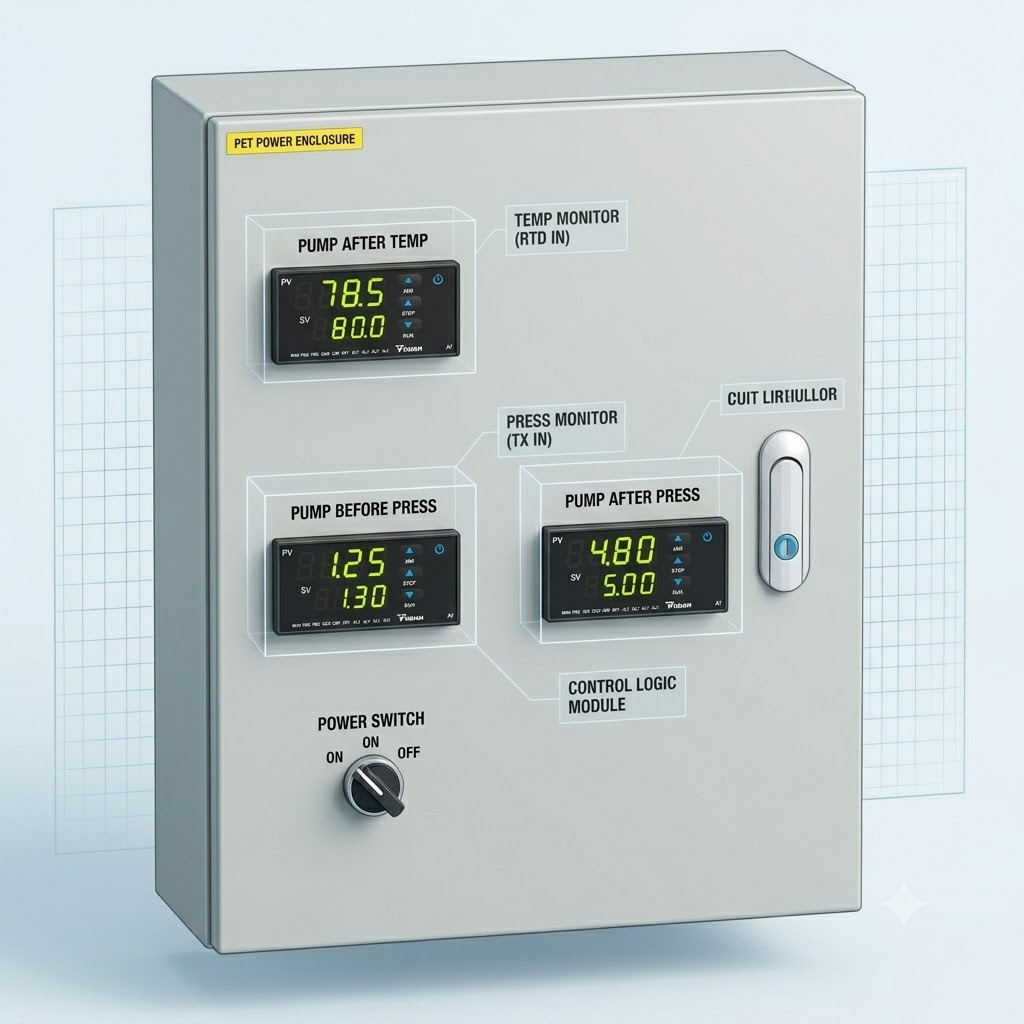
In modern industrial manufacturing—particularly in automated production lines for polymer processing, PET (polyester) flake extrusion, injection molding, and blow molding—pump systems carry out the high-precision transport of high-temperature, high-pressure melts or high-viscosity liquids. Faced with intense, continuous manufacturing, how to ensure the stable operation of pump units and precisely control process parameters is a critical challenge every factory manager must address to optimize production quality and control operational costs.
To achieve highly efficient and centralized equipment management, the PET Pump System Monitoring and Control Box has become an indispensable customized electrical integration solution in modern industrial plants. Acting as the intelligent "central brain" behind the scenes, it monitors pump system operating parameters in real time, manages power connectivity, and provides a robust safety barrier in complex industrial environments.
Why Do Industrial Production Lines Need PET Pump System Monitoring and Control Boxes?
In industrial fluid delivery and molding processes, the stable operation of pump units (such as melt gear pumps and high-pressure delivery pumps) directly determines the quality of the final product. However, because working conditions involve high temperatures and high pressures, traditional scattered and manual monitoring has long failed to meet the demands of smart factories.
The Direct Risks of a Lack of Centralized Monitoring and Control:
Process Anomalies Leading to Batch Scrap: PET melts are extremely sensitive to temperature and pressure during delivery. Even a minor fluctuation in pre-pump or post-pump pressure, or a melt temperature that strays outside the processing window, can lead to uneven product wall thickness, increased black spots, or even large-scale product scrapping.
Physical Overpressurization and Equipment Damage: If downstream pipelines or molds experience a blockage while the upstream pump unit continues to push material blindly, system pressure will skyrocket instantly. This can easily lead to damaged pump bodies, ruptured pipelines, or major safety accidents.
Maintenance Blind Spots and Delayed Fault Response: Traditional distributed meters are scattered across various locations in the plant. Manual inspection is not only time-consuming and labor-intensive, but it also fails to provide millisecond-level responses when motors overload, drop a phase, or experience out-of-bounds parameters.
Severe Electromagnetic Signal Degradation: High-power industrial equipment (such as heating elements and large frequency inverters) creates massive electromagnetic noise. Without a centralized enclosure to shield and isolate weak sensor signals, data readings can jitter wildly, leading to false alarms or system failures.
The PET Pump System Monitoring and Control Box is engineered precisely to resolve these pain points. It highly integrates multi-channel sensor signals, power control, and protective components into a single unit. Through high-precision digital control meters or PLC systems, it centrally displays core process parameters—such as pre-pump pressure, post-pump pressure, and post-pump temperature—enabling comprehensive, fine-grained operational management.
Core Differences:
Comparison: Traditional Monitoring And Control Cabinet vs. Integrated Monitoring & Control Box
Evaluation Metric |
Traditional Monitoring And Control Cabinet |
Integrated Monitoring & Control Box |
Production Quality |
Scattered parameters; high defect rates |
Precise tracking; consistent process quality |
Equipment Safety |
High risk of overpressurization and damage |
Instant alarms; automated shutdown protection |
Signal Stability |
Disorganized wiring; prone to interference |
Centralized terminal blocks; strong shielding |
Downtime Minimization |
Time-consuming line troubleshooting |
Digital fault codes; second-level diagnostics |
Space Efficiency |
Scattered components occupy massive wall space |
Modular enclosure; highly compact footprint |
Data Accessibility |
Manual, decentralized data checking |
Centralized display; instant parameter visibility |
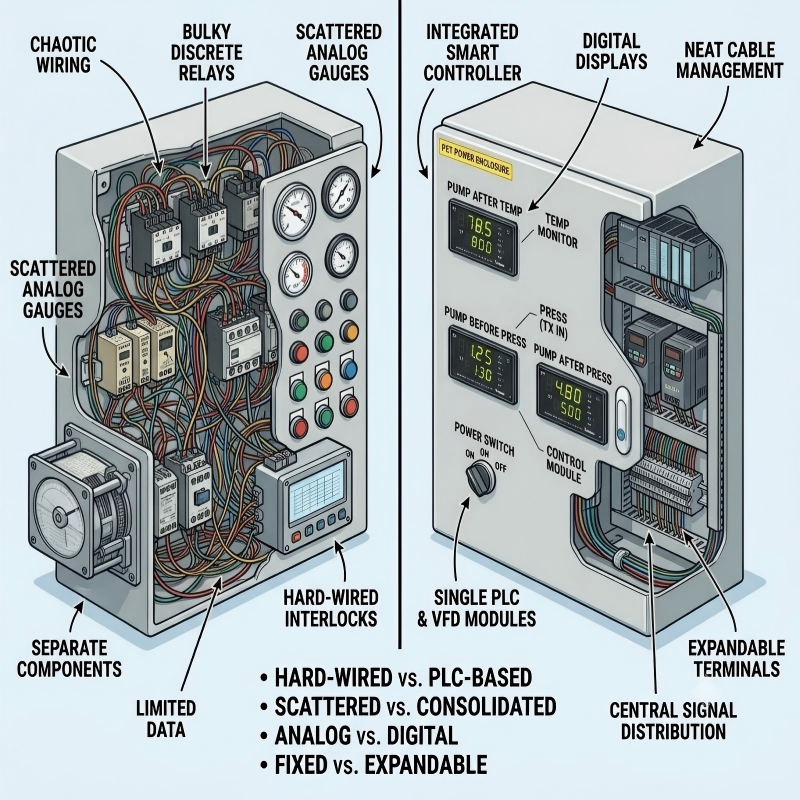
System Architecture and Operational Mechanism of Intelligent Monitoring Boxes
A well-engineered and neatly structured industrial-grade monitoring and control box is systematically assembled from several core electrical modules:
Core Monitoring Meters / Main Control Unit: Positioned prominently on the enclosure door, these units display high-precision real-time data and determine threshold limits by receiving feedback from on-site temperature sensors (such as Pt100) and pressure transmitters (such as 4-20mA signals). They feature adjustable setpoints for multi-stage alarming.
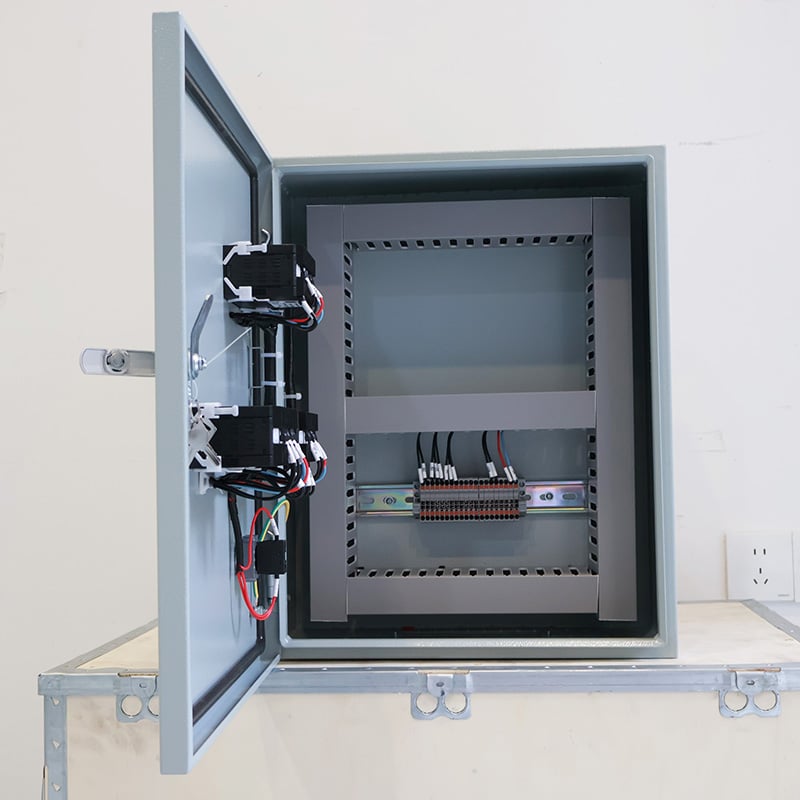
High-Reliability Terminal Block System: The core of fine-grained management inside the control box. All external sensor signal lines and control interlock wiring are centrally distributed and numbered here, ensuring multi-channel signals are stable and free from mutual interference. This structure also isolates low-voltage DC sensor signals from high-voltage AC control loops.
Main Power Control Switch / Rotary Knob: Manages the power connectivity for the entire control box and the external control loops of the associated pump units, providing an intuitive physical disconnection point for maintenance crews.
Branch Protection & Isolation Components: Built-in miniature circuit breakers or surge protectors safeguard the power supply circuits of each monitoring meter and sensor against short circuits, overloads, and electrical surges.
Integrated Internal Wire Ducts: Heavy-duty, flame-retardant slotted wiring ducts run along the inner perimeter, grouping wires systematically by function. This clean physical routing prevents wire tangling and stress-induced snapping, ensuring long-term connection integrity.
In actual operation, once the PET pump system starts up, the control box enters a continuous monitoring state. If processing conditions are normal, the meters smoothly display real-time parameters. However, if the post-pump pressure hits a preset safety upper limit due to process fluctuations, the monitoring box will not only trigger distinct audio-visual alarms but will also quickly send a shutdown command to the main control system via internal relay contacts, nipping potential accidents in the bud.
FAQ
Q1: What is the difference between using independent digital intelligent meters and a complete PLC control system in a control box?
A1: Independent digital intelligent meters (such as dedicated temperature controllers and pressure indicators) focus on data collection and alarming for a single channel. They offer excellent cost-effectiveness, an intuitive physical interface, and simple maintenance, making them ideal for localized monitoring of single or small groups of pump units. A PLC control system, on the other hand, is suited for automated production lines requiring large-scale data networking, complex closed-loop PID adjustments, and coordinated logic control across multiple pump units.
Q2: Why is it mandatory to monitor both "pre-pump pressure" and "post-pump pressure" in PET pump control systems?
A2: Pre-pump pressure primarily reflects the stability of the upstream melt supply or material feed, preventing issues like pump cavitation or running empty. Post-pump pressure directly corresponds to the resistance of downstream dies, or pipelines. By comparing the differential pressure between the front and back of the pump, operators can accurately evaluate the pump's volumetric efficiency and the clogging level of the screen filter, which serves as a core indicator for filter changes and preventing system overpressurization.
Q3: What practical operational benefits does the "centralized terminal block distribution" inside the box provide?
A3: Industrial sites are harsh environments where pump units run under high-frequency vibration and electromagnetic interference. Using high-quality terminal blocks for standardized wiring ensures that wire cold-pressed terminals are tightly secured, preventing loose contacts caused by operational vibrations. Additionally, it structurally isolates strong-current control from weak-current signals, making it easy for plant technicians to perform seamless expansions, modifications, and routine diagnostic testing later on.
Q4: Does ambient temperature affect the lifespan of these monitoring and control boxes? What should be considered during installation?
A4: Yes, significantly. Although these boxes use industrial-grade enclosures with excellent ingress protection ratings, the internal precision monitoring meters and electronic components remain highly sensitive to heat. Therefore, the control box should be installed away from high-temperature heat sources (such as directly above uninsulated extruder barrels or high-temperature piping). Choosing a well-ventilated area with minimal vibration for wall-mounting or bracket installation will greatly extend the lifespan of the meters.
Q5: How do you perform routine maintenance and care on an industrial pump system monitoring and control box?
A5: Maintenance should follow a three-step principle: "Inspect, Tighten, and Clean":
Inspect: Regularly check if the external digital displays show any flickering or error codes (such as open-circuit prompts), and verify if the enclosure's sealing strips are aging.
Tighten: During scheduled power-down maintenance, regularly use a screwdriver to tighten the wiring terminals on the terminal blocks and switches to prevent wires from loosening due to thermal expansion/contraction or vibration, which can pose fire risks.
Clean: Clean off industrial dust accumulation from the top of the enclosure in a timely manner. If the unit features internal cooling fan filters, clean or replace them regularly to ensure smooth heat dissipation for the electronic components inside.
Conclusion
Implementing an industrial-grade PET pump system monitoring and control box is a crucial step toward achieving a truly automated and optimized polymer production plant. By centralizing sensitive pressure and temperature indicators, isolating fragile signals from electrical noise, and providing automated safety interlocks, this centralized solution protects heavy-duty machinery from catastrophic overpressurization while minimizing costly product defects. Investing in high-quality enclosure integration not only streamlines routine field maintenance but also empowers facilities with the real-time data visibility required to sustain peak manufacturing efficiency and long-term operational safety.
Table of Contents
- Why Do Industrial Production Lines Need PET Pump System Monitoring and Control Boxes?
- Core Differences:
- System Architecture and Operational Mechanism of Intelligent Monitoring Boxes
-
FAQ
- Q1: What is the difference between using independent digital intelligent meters and a complete PLC control system in a control box?
- Q2: Why is it mandatory to monitor both "pre-pump pressure" and "post-pump pressure" in PET pump control systems?
- Q3: What practical operational benefits does the "centralized terminal block distribution" inside the box provide?
- Q4: Does ambient temperature affect the lifespan of these monitoring and control boxes? What should be considered during installation?
- Q5: How do you perform routine maintenance and care on an industrial pump system monitoring and control box?
- Conclusion