 EN
EN


In modern industrial manufacturing, factories across various sectors—such as mechanical processing, plastic injection molding, textiles, and hardware production—consume massive amounts of electricity daily. However, when faced with complex power demands for large-scale equipment, many factory managers overlook a fundamental requirement: a reliable, hierarchical power distribution infrastructure.
To ensure grid stability and optimize production safety, the customized industrial power distribution cabinet system has become an indispensable turn-key electrical solution in modern industrial facilities. Acting as the "power traffic controller" for the entire factory, it coordinates electrical loads, improves power reliability, and protects critical production machinery.
Why Do Industrial Power Distribution Systems Need Customized Hierarchy?
In an industrial AC power grid, equipment loads vary significantly in power consumption, voltage requirements, and, crucially, startup characteristics. A poorly planned, generic distribution system cannot handle these varied loads, often leading to voltage drops (brownouts), equipment damage, safety risks, and costly unscheduled downtime. Customized industrial distribution cabinets solve this by organizing power flow and establishing a safe, customized hierarchy:
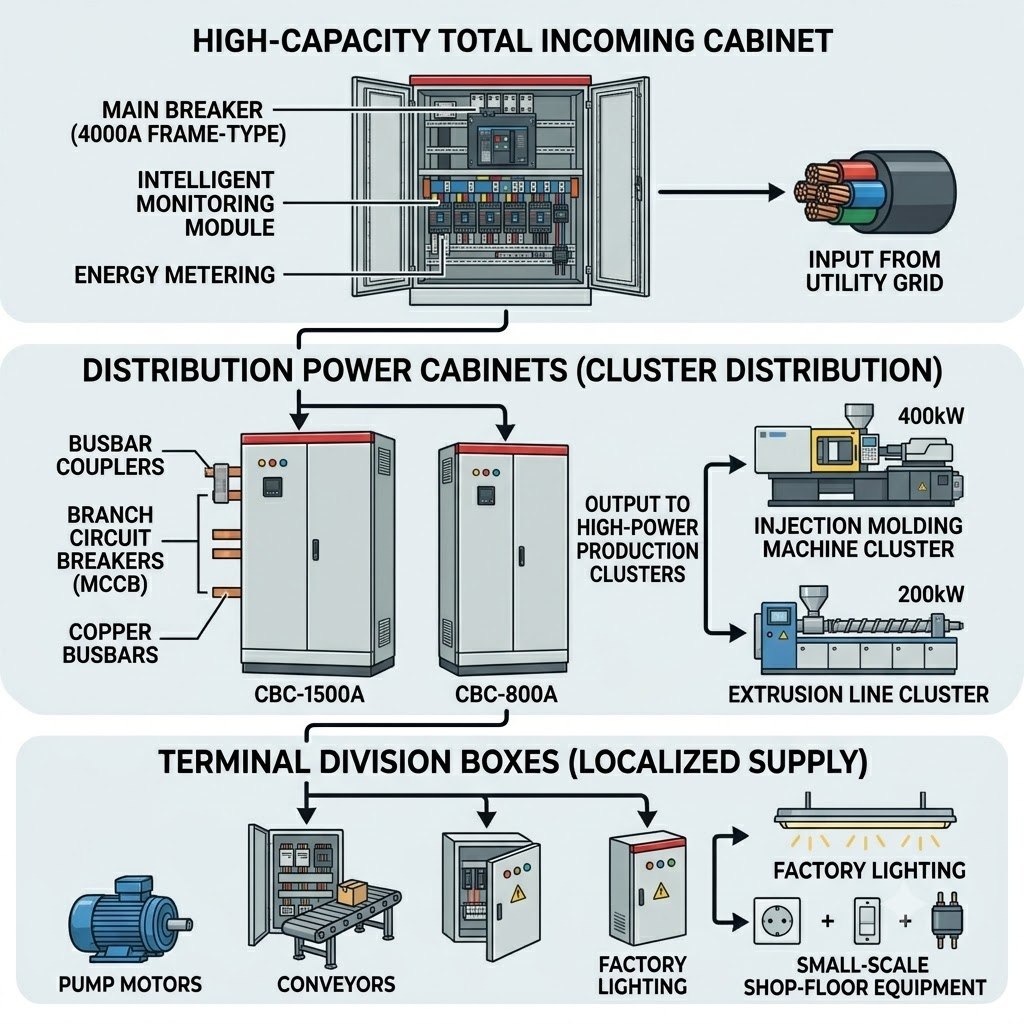
Total Incoming Distribution (The Factory Gateway)
This is the primary power entry point and unified management hub for the entire factory's electrical load.
Capacity: Custom-built frame-type distribution cabinets, typically ranging from 2500A to 4000A, receive large-scale service.
Function: This section handles the critical task of primary incoming power management, main metering, fault protection, and initial distribution to secondary systems. It coordinates total demand to stay within utility transformer capacities.
Cluster Power Distribution (The Production Engine)
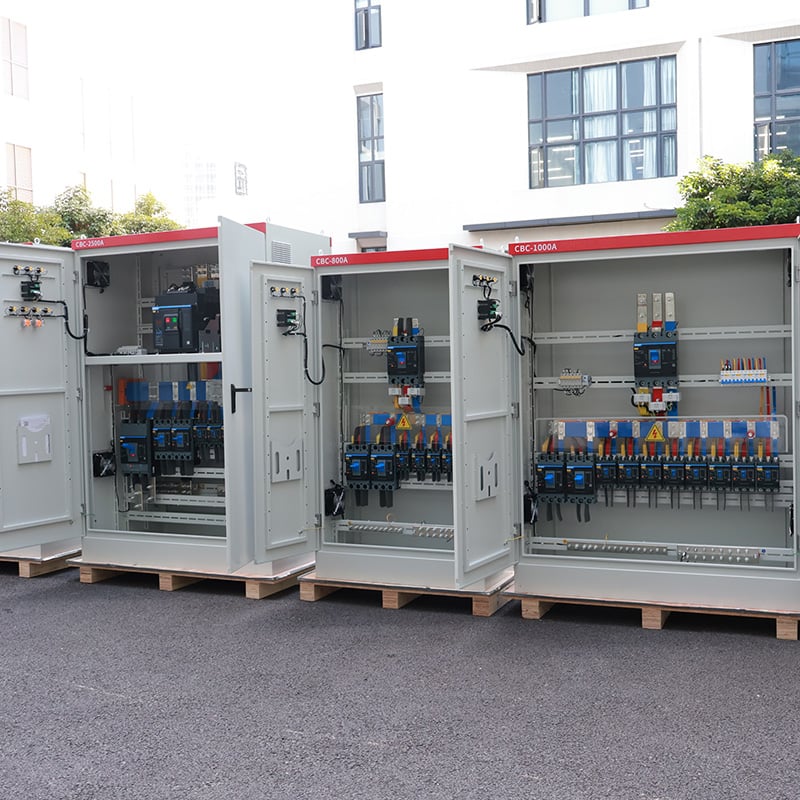
These specialized power cabinets (range: 800A to 4000A) are the workhorses dedicated to high-power machine groups.
Tailored Engineering: They are engineered for stable, high-current supply to specific high-demand production areas, such as injection molding machines, heavy-duty mixers, or large-scale extrusion lines. Customization here accounts for high inrush currents during the large-motor startups typical in these processes, preventing secondary breakers from nuisance tripping.
Terminal Power Distribution (Localized Supply)
This is the localized distribution. Small distribution boxes are strategically placed to allow for convenient power access for smaller shop-floor equipment.
Purpose: These units manage power for conveyors, localized lighting, cooling fans, or auxiliary motors, ensuring that a fault in one small piece of equipment doesn't cascade through the cluster cabinet and trip an entire line.
Customizing this hierarchical architecture ensures electrical current is managed safely and efficiently at every level. This precision prevents transformer overloading and, significantly, minimizes electrical interference between sensitive logic-control systems (like PLCs) and heavy-duty, electrically 'noisy' machinery.
Core Differences:
Comparison: Standardized vs.Customized Distribution Systems
Evaluation Metric |
Generic/Unstructured Grid |
Customized Distribution System |
Operational Stability |
Frequent unplanned shutdowns |
High reliability and consistency |
Transformer Load |
Risk of overheating/overload |
Optimized load management |
Energy Efficiency |
High line losses |
Minimized resistance losses |
Voltage Quality |
Severe flicker during startup |
Stable output for precision tools |
Expansion Flexibility |
Requires major system overhaul |
Modular design for easy integration |
Maintenance Effort |
High due to hidden faults |
Low with proactive monitoring |
System Architecture and Operational Mechanism
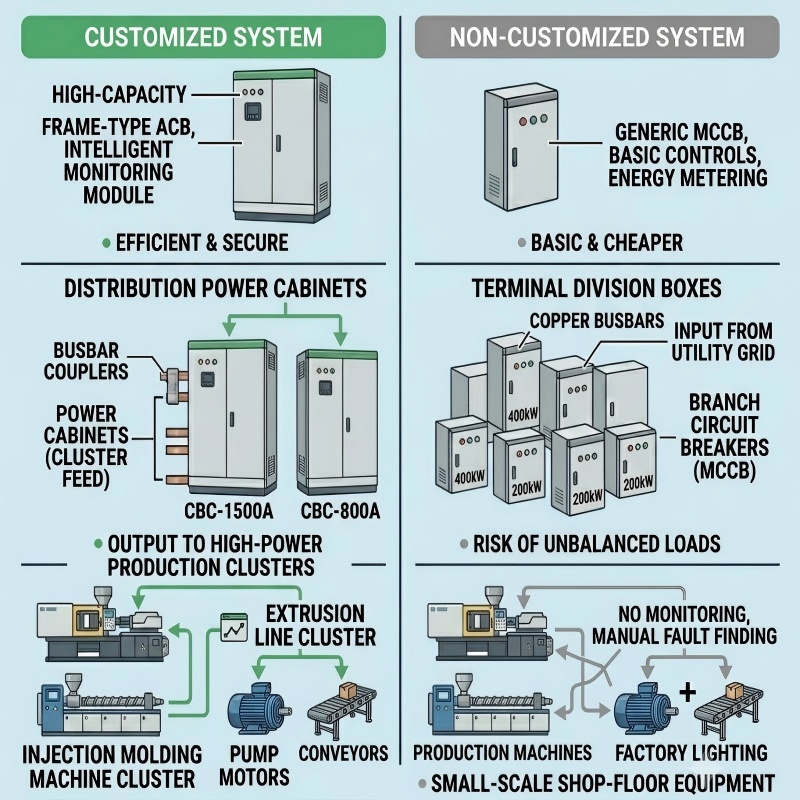
A well-engineered industrial distribution system is an integrated assembly of high-specification components, systematically organized to manage the safe and logical flow of electricity for years of continuous operation. Beyond simple circuit-breaking, the operational mechanism relies on these critical, customized core systems:
Custom-Tuned Main Incoming Circuit Breaker (ACB): Not just an isolation switch; this heavy-duty Air Circuit Breaker is the facility's primary defense. Customization includes programmable trip units precisely matched to the plant's total transformer capacity and maximum fault level, providing optimized selective coordination to prevent nuisance tripping of the entire facility.
Integrated Intelligent Monitoring and Automation: This is the 'brain' that transforms a cabinet from passive hardware to a dynamic tool. Customized modules are integrated for real-time tracking of voltage, current, power factor, and individual branch harmonics. Beyond monitoring, these systems enable automated features like sequential load restarting after a power outage to prevent total demand-surge penalties.
High-Conductivity Copper Busbar System: The physical 'arteries' that carry massive currents. This critical custom system involves the precise engineering of copper bar thickness, width, and plating (usually tin or silver to prevent oxidation) to minimize resistance, prevent hotspots, and safely manage the mechanical stresses of high fault-current conditions.
Optimized Ventilation and Protection System (IP Rating): Standard boxes overheat under heavy load. Specialized cooling systems are custom-designed, integrating heat sinks, specialized fan units, and tailored airflow paths. Crucially, customized units are sealed to specific Ingress Protection (IP) levels to prevent oil mist, metallic dust, and humidity—common in mechanical processing and plastic molding shops—from causing arcing or corrosion.
FAQ
Q1: Why is customized distribution better than using pre-made electrical boxes?
A1: Pre-made boxes rarely match the specific load requirements of high-power equipment like injection molding machines. Customized systems are engineered to handle the exact current, startup surges, and environmental conditions of your specific facility, ensuring safety and compliance.
Q2: How does a customized system prevent voltage drops during equipment startup?
A2: By correctly sizing busbars and incoming feeder cables for the specific high-current demands of your machinery, customized distribution systems reduce impedance and voltage drop, ensuring that equipment startup does not impact other machinery on the same grid.
Q3: Is it possible to integrate energy monitoring into these customized cabinets?
A3: Yes. Modern customized systems are built to include digital metering, allowing facility managers to monitor voltage, current, and total energy consumption, which is critical for identifying non-productive downtime or energy-wasting equipment.
Q4: Can these systems be expanded if the factory adds more machinery?
A4: Yes. A customized, modular design allows for future-proofing; cabinets are built with extra space and capacity, making it significantly easier and cheaper to integrate additional circuits later compared to replacing a fixed, generic system.
Q5: What critical maintenance does an industrial power distribution system require?
A5: Maintenance focuses on four key areas: regular inspection of ventilation and cooling fans; checking for signs of overheating or discoloration; periodically de-energizing the system to tighten all electrical terminations to prevent fire risks from loose connections; and performing thermographic testing to detect hidden hotspots before they cause failure.
Conclusion
In an increasingly competitive manufacturing landscape, the infrastructure supporting production is as vital as the machines themselves. Industrial manufacturing, with its massive daily power consumption, cannot rely on genetic electrical boxes to support complex, large-scale equipment demands. A customized industrial power distribution system is not merely an expense; it is a critical investment in a reliable, hierarchical infrastructure. By serving as the dynamic 'power traffic controller'—from the customized 4000A incoming cabinets down to the last specialized machine-cluster power supply—this system delivers high reliability, optimized load management, and the flexibility needed for future expansion.
Table of Contents
- Why Do Industrial Power Distribution Systems Need Customized Hierarchy?
- Core Differences:
- System Architecture and Operational Mechanism
-
FAQ
- Q1: Why is customized distribution better than using pre-made electrical boxes?
- Q2: How does a customized system prevent voltage drops during equipment startup?
- Q3: Is it possible to integrate energy monitoring into these customized cabinets?
- Q4: Can these systems be expanded if the factory adds more machinery?
- Q5: What critical maintenance does an industrial power distribution system require?
- Conclusion