 EN
EN


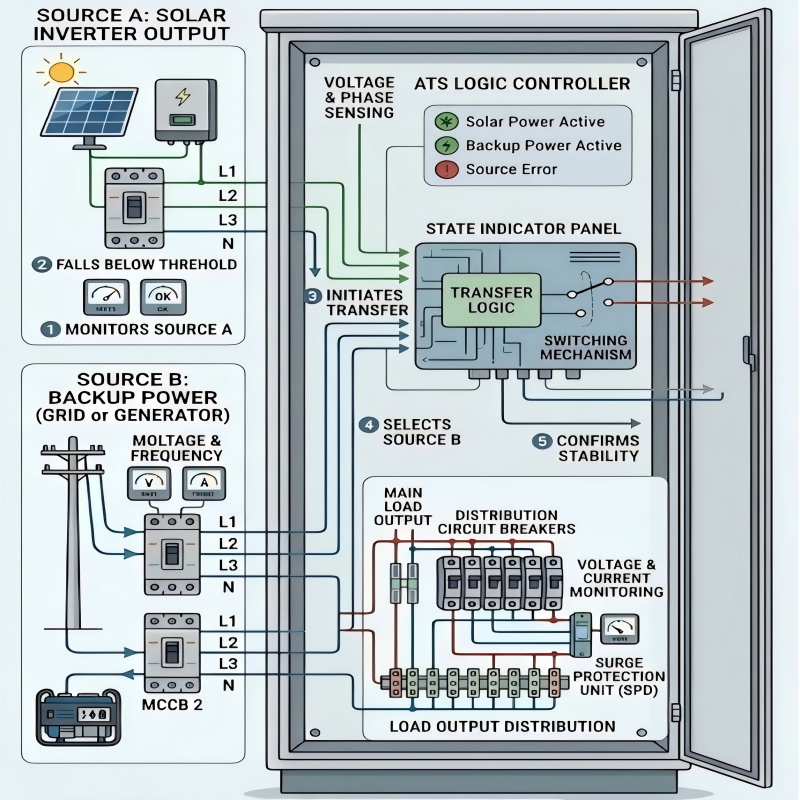
In modern energy architecture, solar photovoltaic (PV) systems have become a backbone of green power. However, solar generation is intermittent and uncontrollable.How can we ensure that power loads—such as industrial production lines, data centers, and medical equipment—remain as steady as a rock amidst energy fluctuations?
This is where the Dual Power Automatic Transfer Switch (ATS) Distribution Cabinet plays a vital role. As the "commander" within a PV system, it effectively optimizes energy management and guarantees power continuity.
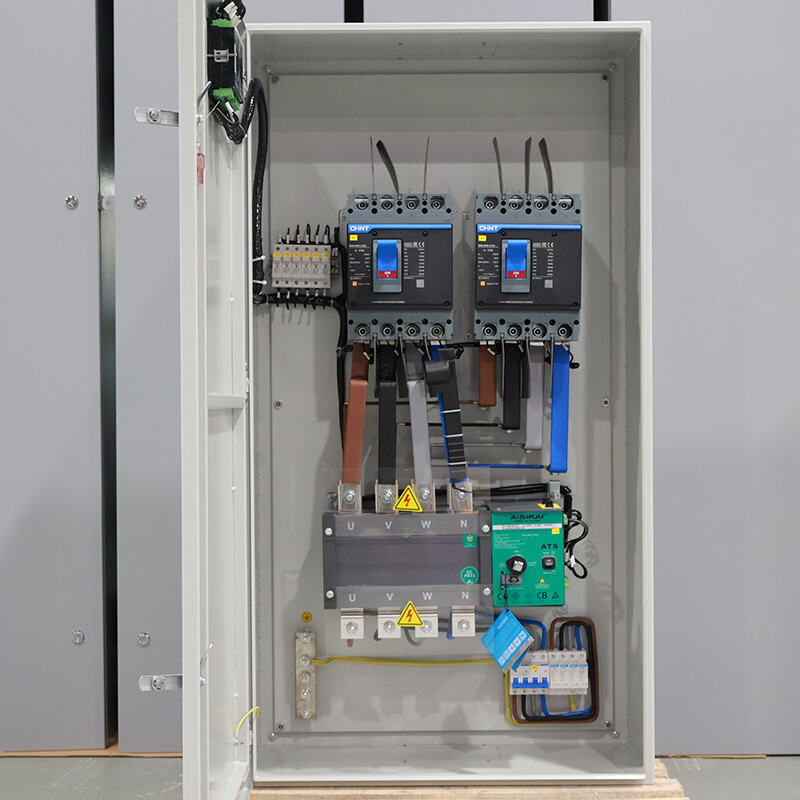
Deep Dive: What is a Power Distribution Box?
The Dual Power Automatic Transfer Switch Distribution Cabinet, or ATS Cabinet, is the "intelligent command center" of a power distribution system. Its core function is to establish an automatic switching mechanism between two independent power sources—typically a solar PV system and a backup utility grid or generator.
Unlike ordinary distribution boxes, an ATS cabinet integrates voltage sampling, logic control, mechanical/electrical interlocking, and high-current actuators. It monitors the primary power status at microsecond frequencies. Once solar power drops below a threshold due to faults or environmental conditions, the ATS cabinet follows a "break-before-make" logic to switch the load to backup power in a very short time, solving the pain point of solar energy instability.
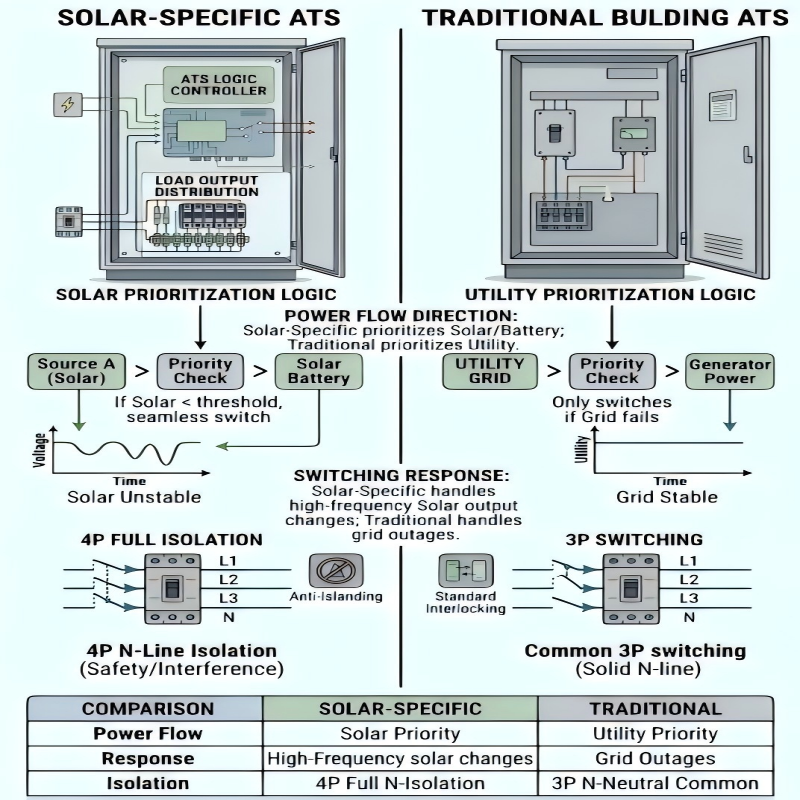
Core Differences:
Solar-Specific vs. Traditional Building ATS
Dimension |
Solar-Specific ATS |
Traditional Building ATS |
Priority |
Solar Priority: Maximizes self-consumption |
Utility Priority: Conventional emergency backup |
Isolation |
4P Full Isolation: Eliminates N-line interference |
3P Switching: Focuses on phase disconnection |
Durability |
Fluctuation Response: Handles frequent switching |
Outage Response: Handles occasional failures |
Safety |
Anti-Islanding: Prevents power backfeed |
Basic Interlocking: Prevents source clashing |
Load |
Inverter Optimized: Supports inductive loads |
General Standard: Supports civil loads |
Protection |
Industrial Grade: Enhanced heat dissipation |
Indoor Standard: Basic dust/temp control |
Core Components and Industrial Design Logic
Intelligent Logic Controller (The Brain): It monitors power quality in real-time. When the primary source is abnormal, the controller issues commands based on preset parameters (such as a 0.5s to 2s delay) to avoid transient fluctuation interference.
Actuators (The Muscle): These typically use Molded Case Circuit Breakers (MCCB) with high breaking capacity. For industrial applications, such as 315A specifications, they ensure reliable arc-extinguishing and an extremely long mechanical life even under heavy inductive loads.
Multi-Layer Safety Protection: This integrates short-circuit, overload, and Surge Protective Devices (SPD). Professional corrosion-resistant metal enclosures ensure protection ratings (such as IP54 or IP65) meet the strict requirements of outdoor PV stations or industrial plants.
Efficient Wiring Craftsmanship: Internal power transmission utilizes high-purity T2 copper busbars to reduce contact resistance and heat loss. A clear identification system is also used to facilitate later inspections and troubleshooting.
FAQ
Q1: What is the typical switching time for a Dual Power Automatic Transfer Switch?
A: Industry standards are usually between 50ms and 200ms. For general lighting or power equipment, this interruption is almost imperceptible; precision equipment is recommended to be used with a UPS.
Q2: Why is 4P switching emphasized in solar scenarios?
A: Solar systems and backup grids often have different grounding points. 4P switching cuts three phase lines and the neutral line (N-line) simultaneously, effectively isolating the two systems and preventing malfunctions or interference caused by neutral potential differences.
Q3: How do I switch between "Auto" and "Manual" modes?
A: Normal operation should be locked in "Auto" mode for unattended service. Manual mode is used only for commissioning or maintenance, using a physical handle to forcibly lock the power source and ensure personnel safety.
Q4: Where is the best installation location for an ATS distribution cabinet?
A: It is typically installed after the PV inverter output and before the load circuits. It should be as close to the load center as possible to reduce voltage drop and improve response speed.
Q5: How to choose an ATS cabinet for extreme environments?
A: High altitudes or extreme temperature differences affect heat dissipation and insulation. "Derating" (reduced capacity use) must be considered, along with weather-resistant enclosures and auxiliary temperature control components to ensure the equipment operates within safe parameters.
Conclusion
The Dual Power Automatic Transfer Switch (ATS) Distribution Cabinet is not just a safety line; it is the technical hub for the efficient utilization of solar energy. Choosing a well-designed,masterfully crafted ATS cabinet is a critical investment in ensuring the long-term, stable operation of global solar projects.
Table of Contents
- Deep Dive: What is a Power Distribution Box?
- Core Differences:
- Core Components and Industrial Design Logic
-
FAQ
- Q1: What is the typical switching time for a Dual Power Automatic Transfer Switch?
- Q2: Why is 4P switching emphasized in solar scenarios?
- Q3: How do I switch between "Auto" and "Manual" modes?
- Q4: Where is the best installation location for an ATS distribution cabinet?
- Q5: How to choose an ATS cabinet for extreme environments?
- Conclusion