 EN
EN


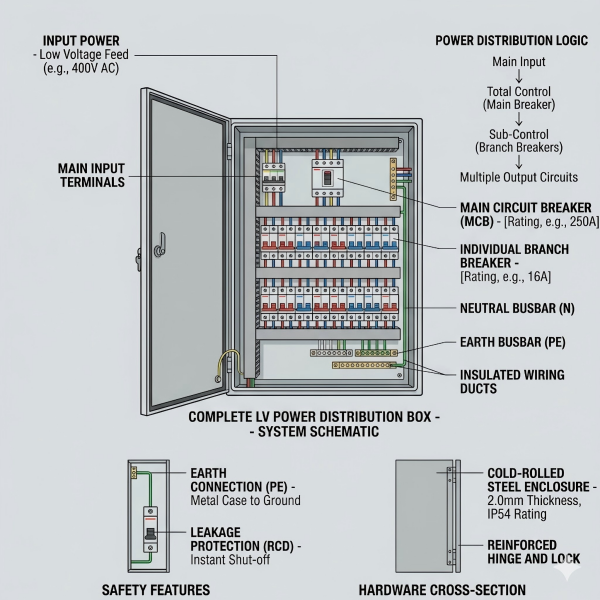
In factory workshops, commercial buildings, or data center power rooms, these rugged gray metal enclosures stand silently as the critical infrastructure of modern power supply systems. Built with sturdy metal shells and professional internal structural design, they serve as the reliable "first line of defense" for overall electrical safety, effectively isolating circuit faults, preventing electric leakage, and protecting both equipment and personnel from potential electrical hazards in complex operational environments.
Every industrial and commercial scenario demands stable and safe power distribution support, making qualified low-voltage distribution enclosures indispensable for daily operation. Today, we will take this Low Voltage Complete Power Distribution Box as a typical example, breaking down its internal working principles, operational logic, and core performance advantages. Meanwhile, we will sort out practical and professional selection criteria in simple, easy-to-understand terms, helping you quickly grasp the key points for model selection and application matching in actual engineering projects.
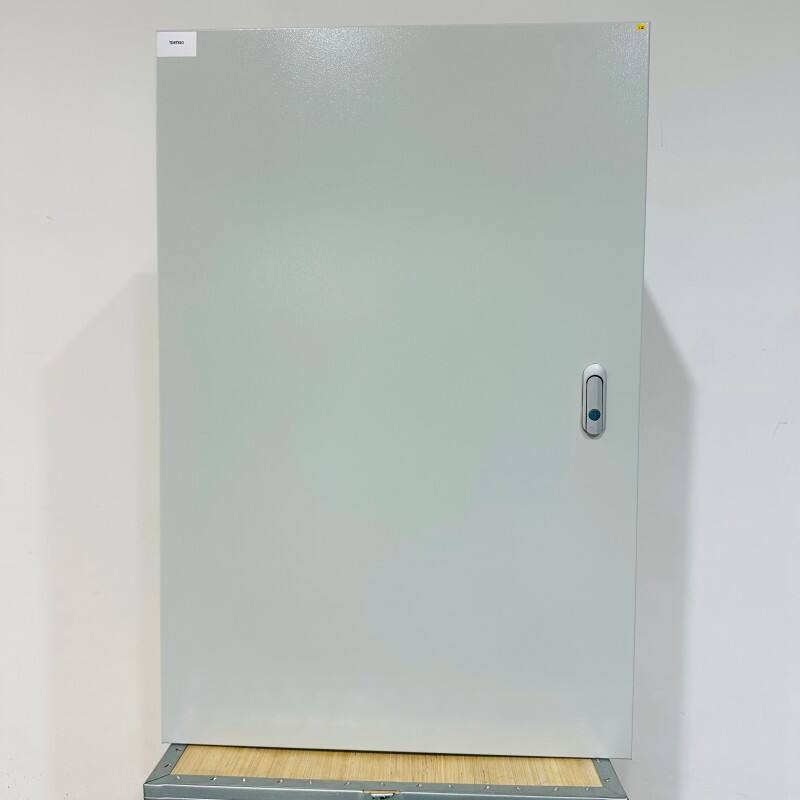
Deep Dive: What is a Power Distribution Box?
If the external power grid is compared to a city’s main water supply network, then the distribution box is the "power hub" of the entire building. It is responsible for receiving low-voltage electricity and distributing it safely and as needed to motors, production lines, or HVAC systems.
This complete power distribution box is not just a container; it is a precision-engineered electrical system:Robust Physical Barrier — Cold-Rolled Steel Enclosure: Unlike household plastic breaker boxes, industrial-grade power boxes use high-quality cold-rolled steel. This material provides excellent mechanical strength to resist physical impacts common in workshops. The surface is treated with an electrostatic powder coating, which not only prevents corrosion and rust but also acts as a physical shield in the event of extreme internal arc faults, preventing the spread of fire and protecting operators.
Precision Control Brain — Component Integration: Inside the box, circuit breakers are neatly arranged. The high-capacity breaker at the top is the "Main Switch," responsible for the overall power supply; the rows of smaller breakers below are the "Sentinels," monitoring the current dynamics of each branch circuit. This "Main-Sub" structure makes power flow controllable and monitorable.
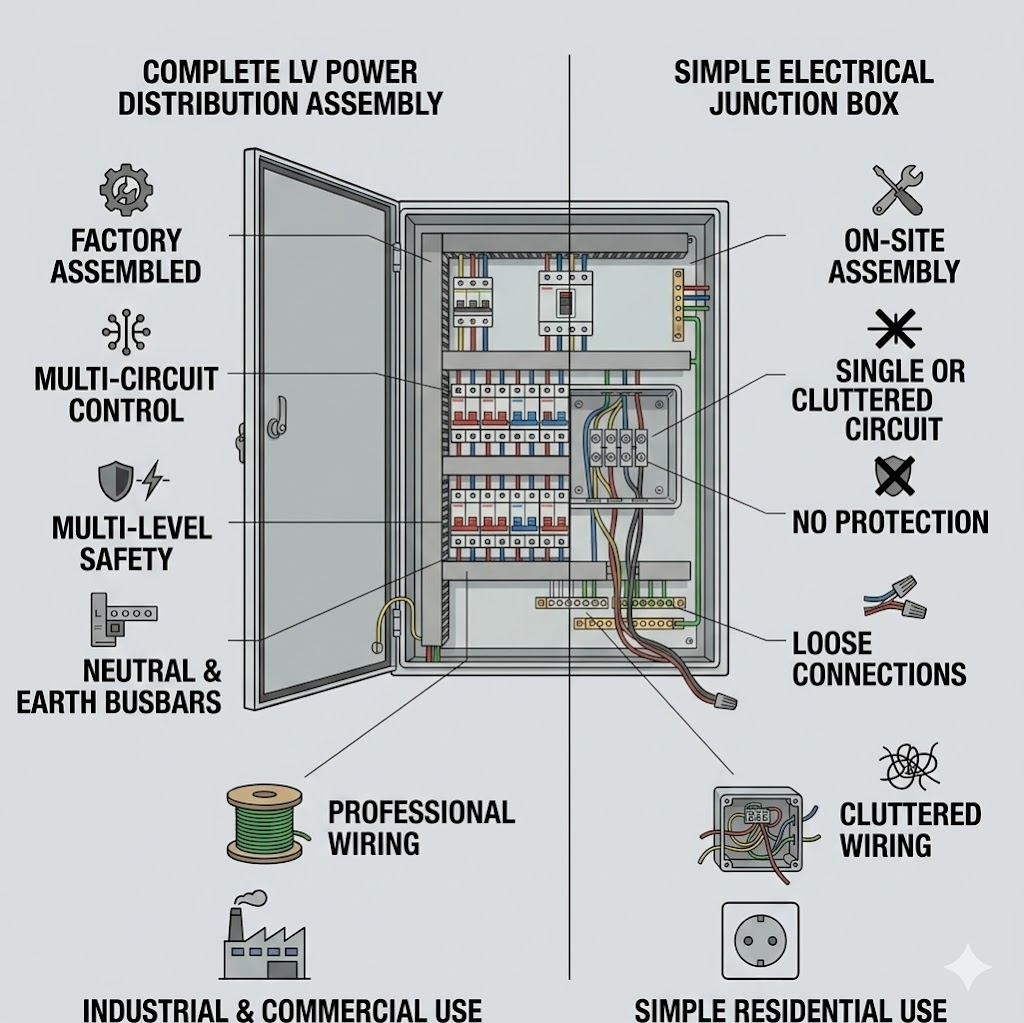
Orderly Power Veins — Busbar System and Wiring: As shown in the images, the complete box features standardized Neutral and Earth Busbars (N/PE). The Neutral bar handles the working return circuit, while the Earth bar acts as the safety lifeline. Combined with professional wiring ducts, all wires are kept orderly. This design is not just for aesthetics; it reduces electromagnetic interference between cables during high-power operation and allows heat to dissipate quickly.
Core Comparison: Complete Assemblies vs. Simple Enclosures
Dimension |
Complete Power Distribution Box |
Simple Electrical Junction Box |
Circuit Protection |
Overload, short-circuit, and leakage protection |
Only for transit; no protection functions |
Fault Isolation |
Local trips do not affect overall operation |
One fault leads to a total power outage |
Thermal Logic |
Spacious with natural air convection |
Cramped space; prone to heat buildup/fire |
Maintenance |
Din-rail wiring; high standardization |
Messy wiring; difficult troubleshooting |
Safety Guard |
Dedicated Earth busbar; anti-shock |
Many exposed nodes; high risk of shock |
Adaptability |
Professional IP rating; corrosion resistant |
Poor sealing; easily affected by environment |
Industry Insights: Key Selection Metrics (In-Depth)
When searching on Google or B2B platforms, mastering these "hot words" will help you accurately locate high-performance products:IP Rating (Ingress Protection): Measures the enclosure's ability to resist dust and water. For example, IP54—"5" stands for dust protection and "4" for protection against splashing water. In dusty woodworking shops or damp basements, a high IP rating is essential to prevent internal component failure due to contamination.
Short-Circuit Breaking Capacity (Icu): A critical safety metric. At the moment of a short circuit, current surges; the breaker must be able to cut this current safely without physical destruction. High-quality complete boxes use components with higher Icu values to ensure reliability under extreme conditions.
Certified Assemblies & IEC Standards: "Complete" means the unit has passed factory tests for temperature rise, insulation resistance, and dielectric properties. Compared to "DIY" boxes assembled on-site, standardized assemblies can withstand more frequent switching operations and long-term full-load running.
FAQ
Q1: Why are there so many small switches in the box?
A1: This is to achieve "Selective Protection." If a specific water pump motor overloads, only its branch circuit will trip. The factory's ventilation and lighting systems continue to function. This "local fault, local solution" logic prevents minor issues from causing a total production shutdown.
Q2: What is the fundamental difference between a simple enclosure and a "Complete" box?
A2: A simple enclosure is just a hollow shell. A "Complete" box is a systematic product that includes the enclosure, breakers, busbars, internal wiring, and factory testing. It solves professional issues like heat dissipation, creepage distances, and electromagnetic compatibility (EMC), making it a "ready-to-use" finished product.
Q3: What do the "Neutral Bar" and "Earth Bar" do?
A3: They are the "double insurance" of electricity. The Neutral Bar (N) handles current return to keep the equipment running. The Earth Bar (PE) is the lifeline. If internal insulation fails and the metal shell becomes energized, the current flows through the Earth bar into the ground and triggers the protector to trip, preventing electric shock to workers.
Q4: Why is "regular tightening" the best maintenance?
A4: Industrial environments often have machine vibrations, which can loosen wiring terminals over time. Loose connections cause increased contact resistance and generate high heat—the most common cause of electrical fires. We recommend a power-off tightening check every six months to eliminate 90% of electrical hazards.
Q5: How do I evaluate the capacity I need?
A5: Follow the "Power Margin + Space Reservation" principle. The main switch capacity should be approximately 1.25 times the actual total load current. Additionally, at least 20%-30% of the din-rail space should be left as Spare Space, allowing for future production line expansions without replacing the entire box.
Conclusion
Although the Low Voltage Complete Power Distribution Box is a "behind-the-scenes hero," its quality determines the stability of your entire system. As demonstrated in the images, neat wiring, solid materials, and a logical component layout are the hallmarks of an industrial-grade box. Choosing professional complete equipment is a long-term insurance policy for your production continuity.