 EN
EN


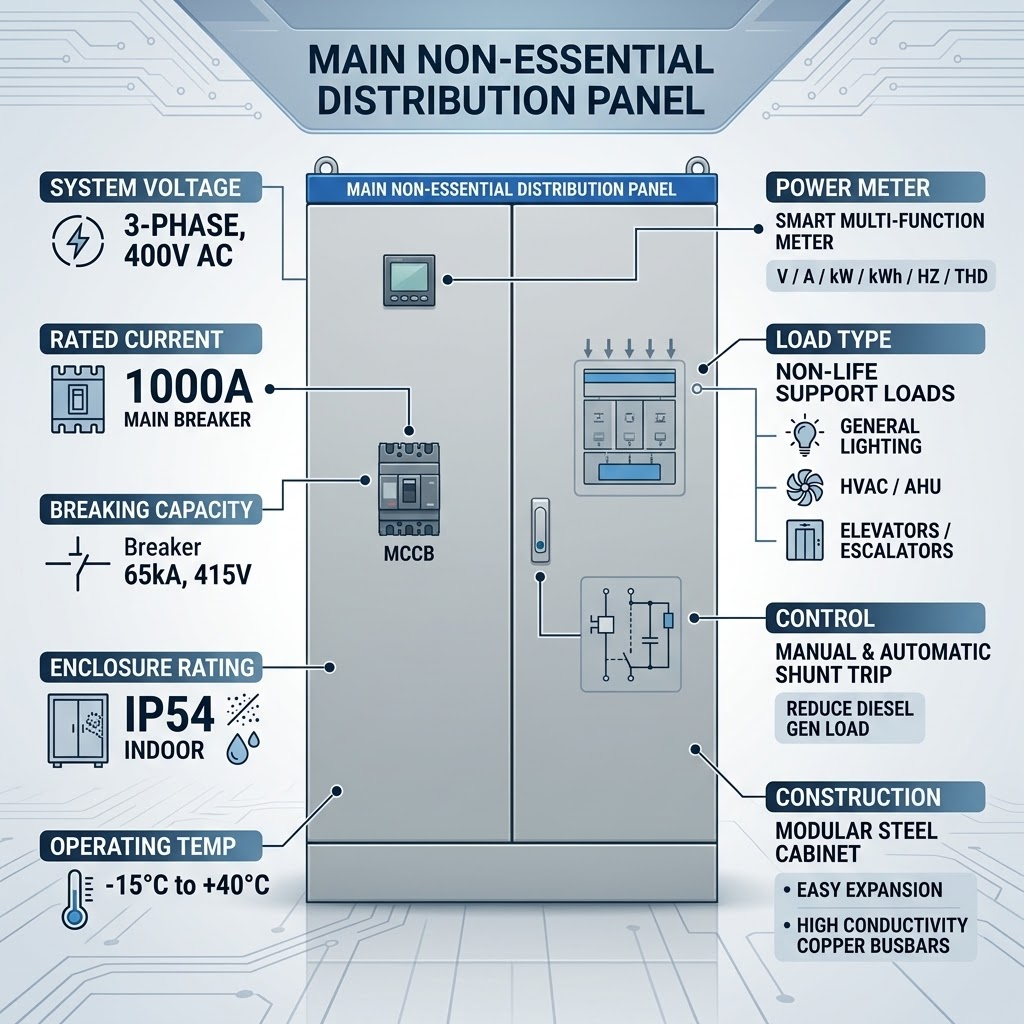
In modern hospital electrical design, overall power reliability relies heavily on a tiered, load-classified system architecture. Hospital electrical loads are strictly categorized at the main distribution source to guarantee uninterrupted operation for critical medical equipment, such as life-support systems in operating rooms and intensive care units (ICUs). The Hospital Main Non-Essential Distribution Panel (Tablero General No Esencial) serves as the primary distribution center for normal, non-life-support electrical loads. Fed directly by the main utility high-voltage or medium-voltage transformers, it distributes power downstream to various sub-distribution panels, power monitoring boards, and regional branch enclosures.
This main panel coordinates electricity for general hospital lighting, heating, ventilation, and air conditioning (HVAC) units, comfort ventilation fans, office equipment, escalators, and general public building infrastructure. During a primary grid power failure, the automated control system initiates a load-shedding protocol. Because these non-life-support loads can tolerate temporary power loss, the non-essential panel disconnects immediately. This action sheds high-consumption secondary loads to protect standby diesel generators or battery energy storage systems (BESS), reserving critical emergency power exclusively for essential healthcare operations.
Key Application Scenarios in Healthcare Infrastructure
Centralized Normal Power Distribution: Consolidates main utility feeds and routes bulk power to floor distribution panels, air handler units (AHUs), water pumps, escalators, and non-critical administrative zones.
Automated Emergency Load Shedding: Integrates directly with Automatic Transfer Switches (ATS), power management systems (PMS), and shunt-trip circuit breakers to shed heavy loads within milliseconds of a grid power failure.
Power Quality Monitoring & Energy Auditing: Houses digital multi-function power meters that record real-time three-phase voltage, current, active power, reactive power, power factor, and total harmonic distortion (THD) across all secondary feeders.
Electrical System Isolation & Fault Containment: Acts as a safety buffer between the main utility entrance and downstream sub-panels, isolating localized short circuits or earth faults before they can affect upstream transformer switchgear.
Core Internal Components and Mechanical Architecture
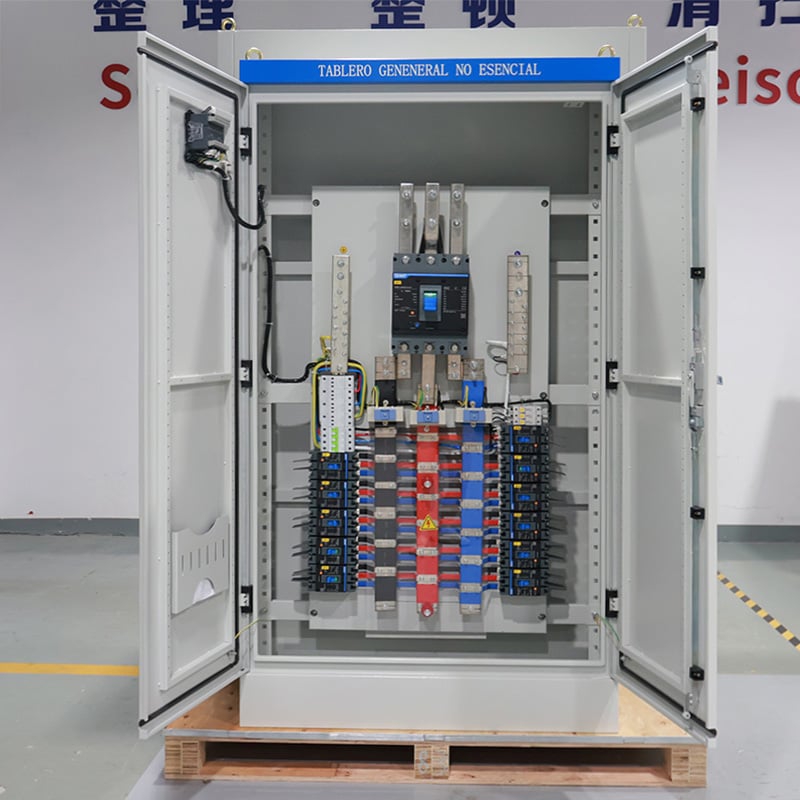
The interior of a heavy-duty main non-essential distribution panel is built for high breaking capacity, low thermal rise, and long operational life under heavy continuous load. Its primary internal modules include:
Molded Case Circuit Breakers (MCCBs): High-interrupting capacity industrial breakers equipped with adjustable thermal-magnetic or electronic trip units. These supply precise overload and short-circuit protection for all outgoing branch circuits.
Insulated High-Conductivity Busbar System: Main phase bars (L1, L2, L3), neutral (N), and protective earth (PE) bars manufactured from high-purity tinned copper. They are wrapped with color-coded heat-shrinkable insulation tubing to prevent phase-to-phase arcing, lower operating temperatures, and guard against accidental touch.
Surge Protective Devices (SPDs): Type 2 surge arresters paired with dedicated backup fuse disconnectors. They clamp transient overvoltage spikes caused by lightning hits, utility switching operations, or inductive load switching.
Modular Branch Circuits & DIN-Rail Controls: A structured internal framework that houses smaller auxiliary breakers, control fuse blocks, signaling relays, and terminal blocks. Clear terminal markings, line labels, and phase barriers simplify long-term maintenance and future circuit expansion.
Enclosure Frame & Cable Entry Systems: Heavy-gauge cold-rolled steel or galvanized steel cabinet structures painted with anti-corrosive epoxy powder coating. They support flexible top or bottom cable entry via gland plates to accommodate heavy armored power cables.
Feature Comparison: Main Non-Essential Panel vs. Medical Critical (IT System) Panel
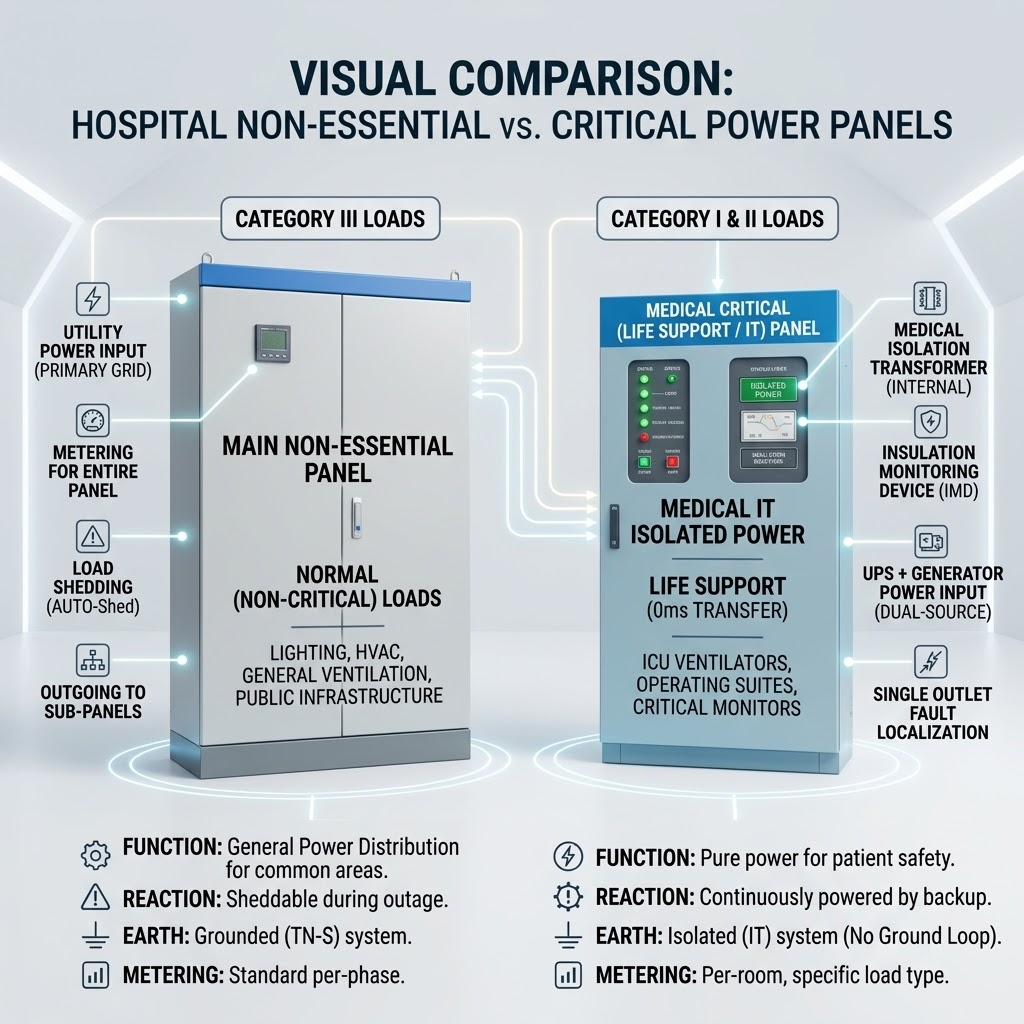
The table below contrasts the technical characteristics and architectural differences between a hospital's Main Non-Essential Distribution Panel and a Medical Critical (Isolated Power / IT System) Panel:
Comparison Feature |
Main Non-Essential Distribution Panel |
Medical Critical (Life Support / IT) Panel |
Load Classification |
Category III / Normal loads; permits immediate disconnection upon grid blackout |
Category I / Critical loads; requires uninterruptible power or 0 ms transfer time |
Earthing / Grounding Design |
TN-S or TN-C-S Grounded System with solid neutral ground connection |
Ungrounded Medical IT System (Isolated Power Supply via isolation transformer) |
Upstream Power Supply |
Single or dual main utility feeds from primary transformers |
Utility feed + Emergency Diesel Generator + Redundant UPS / Battery Storage |
Served Facilities & Equipment |
General area lighting, HVAC compressors, exhaust fans, elevators, administrative PCs |
Operating room surgical lights, ICU ventilators, anesthesia machines, patient monitors |
Fault Action & Tripping |
Automatic tripping on overload, short circuit, or earth leakage fault |
Insulation monitoring only; first fault triggers alarm without automatic power interruption |
System Monitoring Integration |
Standard Digital Power Meter / RS485 Modbus / Energy Management System |
Insulation Monitoring Device (IMD), load current transformer, and fault locator panel |
Key Selection, Sizing, and Installation Considerations
1.Short-Circuit Interrupting Capacity
Engineers must perform detailed short-circuit calculations based on upstream transformer impedance and cable length. Main incoming circuit breakers must feature adequate ultimate and service short-circuit breaking capacities to clear severe electrical faults without damaging the enclosure.
2.Thermal Management & Busbar Ampacity
Because non-essential panels manage heavy continuous loads (such as large air handling units and chillers), internal busbars must be sized with ample current margin. Enclosure designs should include natural louvered ventilation or forced cooling fans, while all busbar joints require Belleville spring washers torqued to spec to prevent thermal expansion looseness.
3.Selective Coordination & Cascading Protection
Time-current characteristic (TCC) curves between main incoming breakers and downstream branch breakers must be fully coordinated. Proper adjustment of short-time delay and instantaneous pick-up thresholds prevents minor downstream faults from tripping the main incoming breaker.
4.Cable Routing and Enclosure Protection (IP Rating)
Depending on the electrical room layout, panels must support incoming power from top cable tray bridges or bottom concrete trenches. Enclosure ingress protection ratings should be selected according to environmental conditions-typically IP30 or IP40 for clean indoor switchrooms, and IP54 for humid or dusty basement utility areas.
FAQ
Q1: Why must the main non-essential distribution panel be disconnected during a hospital utility blackout?
A1: Disconnecting heavy non-critical loads during power outages prevents emergency generators from overloading. This automatic shedding protocol preserves limited backup power exclusively for vital life-support systems and surgical rooms.
Q2: Does a non-essential distribution panel connect to emergency backup generators?
A2: No, standard designs connect non-essential panels exclusively to primary utility power feeds. During grid failures, these panels remain de-energized unless specifically assigned to secondary delayed-restoration steps.
Q3: How are the trip units on the main MCCBs calibrated for non-essential healthcare loads?
A3: Overload pick-up is calibrated to 1.0-1.1 times total calculated load current. Short-time and instantaneous thresholds are adjusted to accommodate motor inrush currents while maintaining selective downstream coordination.
Q4: What role does the internal Surge Protective Device (SPD) play in panel safety?
A4: The SPD clamps transient voltage spikes caused by lightning or switching operations. By diverting surge currents to ground, it protects digital power meters and control electronics from damage.
Q5: What routine maintenance does GGD require?
A5: Technicians should apply conductive grease, torque joints using Belleville washers during installation, and perform periodic infrared thermographic inspections under peak loads to catch localized heating early.
Conclusion
The main non-essential distribution panel is vital for maintaining hospital electrical efficiency and operational stability. By managing general utility loads separately, it ensures high-power equipment operates smoothly while enabling rapid load shedding during outages. This structural separation prevents generator overloads, protects sensitive equipment, and reserves emergency power for critical healthcare environments. Investing in proper panel sizing, robust busbar design, and routine thermal maintenance ultimately guarantees safety, energy compliance, and uninterrupted hospital facility management.
Table of Contents
- Key Application Scenarios in Healthcare Infrastructure
- Feature Comparison: Main Non-Essential Panel vs. Medical Critical (IT System) Panel
- Key Selection, Sizing, and Installation Considerations
-
FAQ
- Q1: Why must the main non-essential distribution panel be disconnected during a hospital utility blackout?
- Q2: Does a non-essential distribution panel connect to emergency backup generators?
- Q3: How are the trip units on the main MCCBs calibrated for non-essential healthcare loads?
- Q4: What role does the internal Surge Protective Device (SPD) play in panel safety?
- Q5: What routine maintenance does GGD require?
- Conclusion