 EN
EN


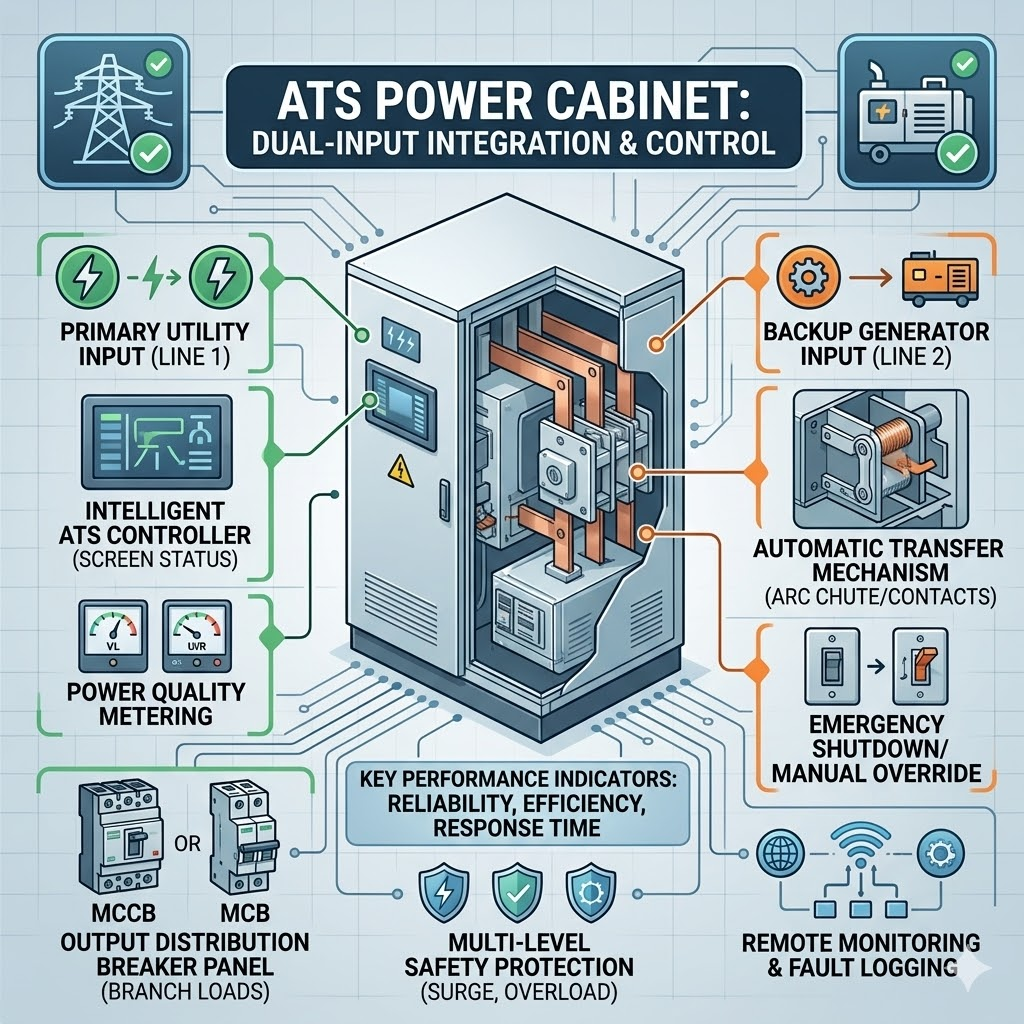
In modern industrial manufacturing, high-tech zones, and large-scale public facilities, electricity is far more than just the motive force driving production—it is the vital lifeline that keeps the entire system functioning. Whether dealing with precision semiconductor production lines, large cold-chain logistics hubs, data centers, or medical facilities, any momentary power interruption or severe voltage fluctuation can lead to damaged production equipment, catastrophic data loss, or massive financial setbacks.
To ensure "zero-interruption" power continuity and safe electrical isolation during grid anomalies or blackouts, the Low-Voltage Automatic Transfer Switch (ATS) Main Distribution Cabinet serves as the primary service entrance distribution hub. It stands as the critical power core and safety barrier within low-voltage distribution systems for modern industrial parks.
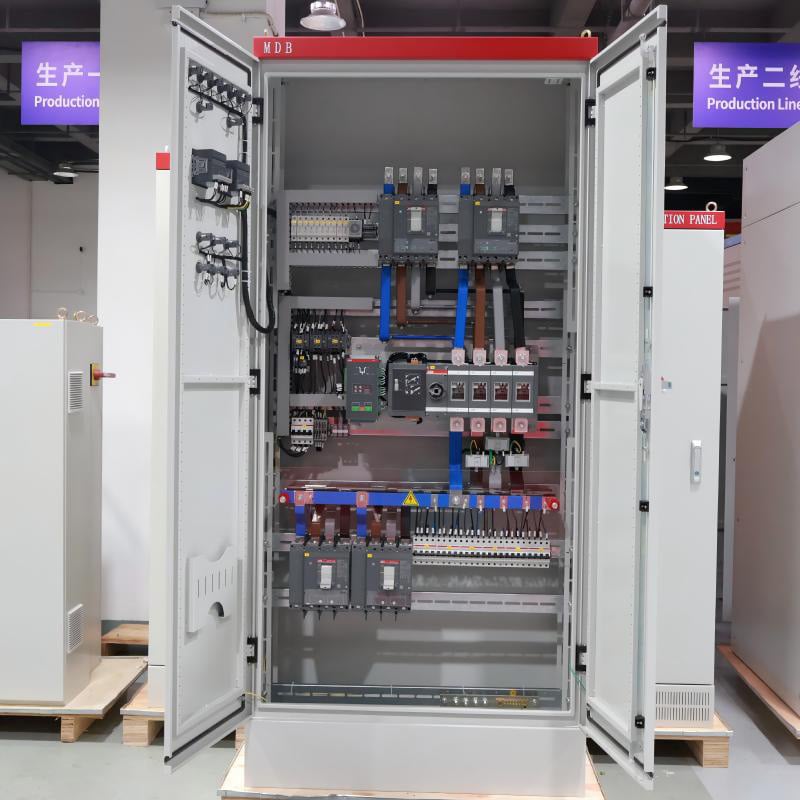
Why Must Modern Industrial Parks and Factories Deploy ATS Main Distribution Panels?
In traditional industrial power grids, most enterprises rely solely on a single utility grid line. However, when faced with uncontrollable risks such as natural disasters, sudden line faults, peak summer load shedding, or grid voltage instability, the vulnerability of a single power source becomes glaringly obvious. Consequently, a dual-circuit power architecture comprising "Utility Main Power + Backup Generator Set Second Utility Source" has become the definitive industry standard. To enable two independent power sources to coordinate seamlessly on-site, a smart ATS main distribution panel is absolutely indispensable.
The Deep-Seated Hazards of Power Interruptions to Enterprises:
Production Stagnation and Material Scrap: In continuous manufacturing sectors like plastic injection molding, chemical compounding, and metallurgy, a sudden mid-process power failure does not just halt operations—it immediately scraps the active batch of raw materials. It can also cause equipment to jam or clog, leading to severe mechanical damage.
Catastrophic Consequences of Parallel Grid Collision: Without professional interlocking and automatic switching mechanisms, any human operational error that causes the utility grid and a self-provided generator set to parallel connect simultaneously will trigger a highly destructive short-circuit fault, burn out large sections of busbars, and threaten the safety of the public utility grid.
Management Vacuum and Manual Lag: Relying on on-duty electricians to manually switch to backup power typically takes anywhere from several minutes to tens of minutes. In modern production scheduling where every second counts, such high-latency, high-risk manual switching fails completely to meet emergency power needs.
Core Differences:
Conventional Panels vs. Intelligent ATS Panels
Evaluation Metric |
Conventional Single-Circuit Panel |
Intelligent ATS Dual-Power Panel |
Circuit Support |
Single line input; zero redundancy. |
Two independent lines for mutual backup. |
Switching Speed |
Manual lever operation; takes minutes to hours. |
Millisecond detection; automatic transfer in seconds. |
Power Continuity |
Instant total blackout; high risk of downtime. |
Seamless energy changeover; continuous line operation. |
Operational Safety |
Manual arc flash hazards; risks grid collision. |
Rigid dual-interlocks prevent misoperation. |
O&M Overhead |
Demands 24/7 on-site monitoring shifts. |
Digital remote controls cut patrol burdens. |
Park Advantage |
Low reliability; dampens tenant appeal. |
Premium power infrastructure drives investment. |
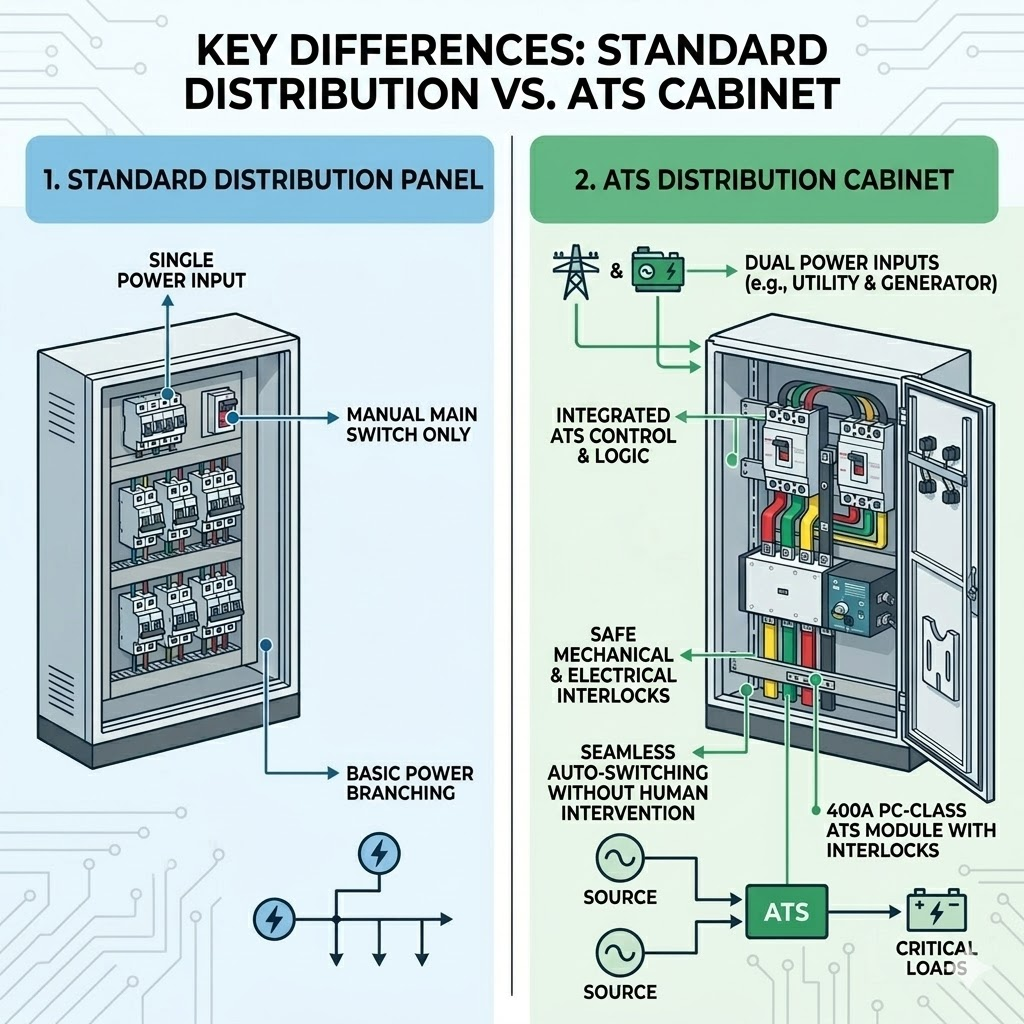
System Architecture and Core Operating Mechanisms of the ATS Panel
A highly reliable, service-entrance-grade ATS main distribution panel is not a solitary switch; it is an intelligent, integrated control system where multiple high-specification electrical components operate in synergy:
Core Intelligent ATS Controller: The "brain" of the entire panel. It samples three-phase voltage and frequency data from both incoming lines in real time. Built with highly sensitive logical processing capabilities, it manages automatic switching, manual overrides, source priority staging, and adjustable switching time delays.
High-Breaking-Capacity Main Circuit Breakers / Disconnector Switches: Positioned at the upper end of the dual incoming lines or serving directly as the switching actuators. They provide high-spec overload protection, instantaneous short-circuit protection, and electrical isolation, ensuring safe interruption even under extreme fault currents.
Mechanical and Electrical Dual Interlocking Mechanisms: The ultimate safety baseline of the system. The mechanical interlock utilizes robust physical linkage bars or steel cables to ensure that both switches are physically incapable of closing at the same time. The electrical interlock utilizes auxiliary contacts within the control circuit to provide secondary enforcement, completely eliminating the possibility of dual-source parallel connection and reverse power feeding.
Multi-Functional Power Metering and Monitoring Instruments: Digitally display real-time dual-circuit electrical parameters—such as current, voltage, active power, reactive power, power factor, and accumulated energy—on the front door panel, allowing operations teams to conduct energy efficiency management and load monitoring.
Distribution Outgoing and Multi-Level Protection Units: Once the secure power source is selected via the ATS, the electricity is routed through the main copper busbars down to various branch molded case circuit breakers (MCCBs) or miniature circuit breakers (MCBs). This ensures precise, safe delivery of power to factory power cabinets, lighting panels, and individual production workshops.
Dynamic Closed-Loop Control Flow:
During routine operations, the system remains in "Utility Priority" mode. When a utility anomaly is detected, the controller first verifies that the main circuit breaker is fully tripped (entering a safe neutral position) and transmits a remote automatic start signal to the backup generator set. Once the generator starts and reaches its rated voltage and frequency, the controller verifies that the safety interlocks are clear and drives the backup-side switch to close, restoring power to the facility. The entire process runs in an automated closed loop, minimizing the unpredictability of human intervention.
FAQ
Q1: What are the primary switching modes for an ATS panel, and how should an industrial facility choose?
A1: Systems support automatic-recovery (auto-reverts when utility stabilizes, ideal for main entrance feeds), manual-recovery (stays on backup until manually cleared, preventing line surge shocks), or mutual-backup (selects whichever line hits quality metrics first).
Q2: How can a facility prevent momentary power interruptions from disrupting precision equipment during an ATS transition?
A2: ATS switches have a brief "break-before-make" transition gap. While standard motor loads handle this easily, precision loads like PLC cabinets or servers require an upstream online UPS to cover the millisecond gap, forming a perfectly uninterrupted network.
Q3: Why must a service-entrance-grade dual-power panel feature dual "mechanical and electrical" interlocking?
A3: Electrical noise or welded contacts can breach electrical logic and cause catastrophic grid short-circuits. A mechanical interlock acts as a rigid physical barrier via levers or cables, geometrically preventing both switches from closing simultaneously to guarantee plant safety.
Q4: Should a 3-Pole (3P) or 4-Pole (4P) switch be selected for an ATS distribution panel?
A4: Use 4P switches when sources originate from different transformers or generators requiring neutral line isolation to block circulating currents or back-feeding. A 3P switch works if sources share a permanently bonded public grounding network.
Q5: What are the best practices for the routine maintenance of an industrial park's ATS main distribution panel?
A5: Run routine infrared thermal imaging under load to detect and fix loose, overheating connections. Execute manual simulation tests semi-annually to exercise static actuators, and use dry compressed air regularly to clean out conductive dust and moisture.
Conclusion
In summary, the low-voltage intelligent ATS dual-power main distribution panel acts as the definitive "uncompromising safety line" for modern industrial facilities, combining millisecond-level anomaly detection with rigid mechanical and electrical dual-interlocks to achieve a seamless, secure energy transfer that keeps critical production lines running during sudden blackouts. By integrating two independent lines for multi-source backup and paring perfectly with an upstream UPS to deliver zero-interruption protection for precision loads, this fully automated solution drastically eliminates the steep downtime losses, material scrap, and human error risks associated with manual single-circuit enclosures. Backed by simple preventive upkeep like routine thermal imaging and semi-annual simulation drills, adopting this advanced infrastructure not only slashes daily O&M staffing overhead but also establishes a top-tier, high-reliability power environment that serves as a powerful magnet for attracting premium industrial investment.
Table of Contents
- Why Must Modern Industrial Parks and Factories Deploy ATS Main Distribution Panels?
- Core Differences:
- System Architecture and Core Operating Mechanisms of the ATS Panel
-
FAQ
- Q1: What are the primary switching modes for an ATS panel, and how should an industrial facility choose?
- Q2: How can a facility prevent momentary power interruptions from disrupting precision equipment during an ATS transition?
- Q3: Why must a service-entrance-grade dual-power panel feature dual "mechanical and electrical" interlocking?
- Q4: Should a 3-Pole (3P) or 4-Pole (4P) switch be selected for an ATS distribution panel?
- Q5: What are the best practices for the routine maintenance of an industrial park's ATS main distribution panel?
- Conclusion