 EN
EN


When planning high-power electrical systems, electrical engineers and project managers face a critical challenge: how to ensure power continuity while balancing distribution efficiency and long-term equipment stability?
Traditional solutions often rely on simple manual switching or combinations of multiple independent distribution cabinets. However, these no longer meet the strict "zero-interruption" power requirements of modern industry, healthcare, and data centers. With the global emphasis on energy management efficiency and electrical safety standards, the XL-21 type 630A ATS (Automatic Transfer Switch) control cabinet—with its integrated design of intelligent switching and high-power distribution—is rapidly becoming the mainstream customized choice for industrial parks, high-rise buildings, and critical infrastructure.
Today, we will dive deep into the architectural advantages and technical details of this equipment to help you optimize the selection of your high-power distribution system.

Core Differences: The Evolution from "Manual Distribution" to "Intelligent Switching"
1. Rated Current Capacity and Power Management
Regular Distribution Cabinets: These usually focus on single-source power distribution. In high-load scenarios, if the power supply fluctuates, the system often lacks self-protection and the ability to quickly access alternative power paths.
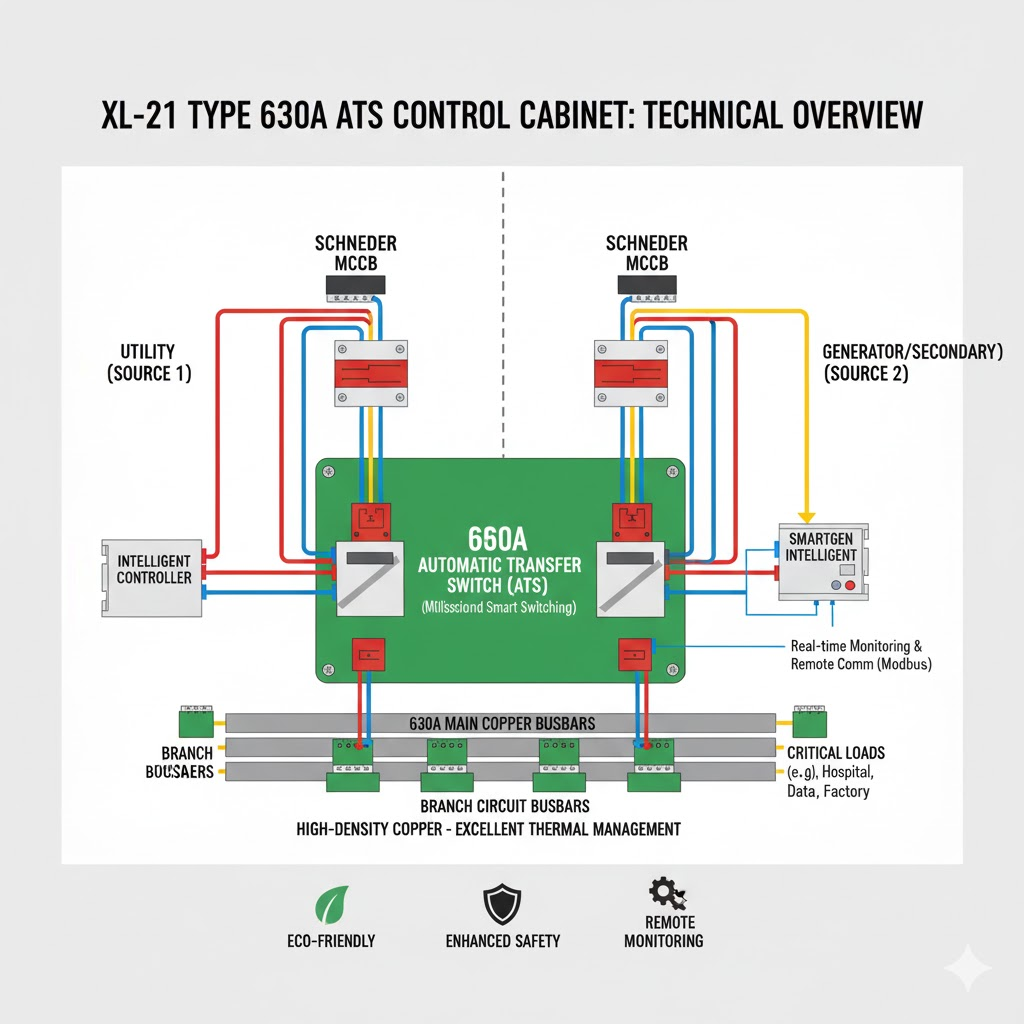
630A ATS Control Cabinet: Specifically designed for high-current industrial loads. It utilizes 630A-rated high-density copper busbars to ensure that temperature rise remains within safe limits during full-load operation. Compared to lower-current cabinets, its redundant design can more easily handle the starting current surges of large motors.
2. "Zero-Intervention" Intelligent Switching and Core Control
Our customized 630A ATS cabinets utilize a "Golden Combination" of AISIKAI/Schneider core components + SmartGen intelligent controllers:
Millisecond Response: The built-in ATS transfer module monitors the voltage and frequency of the primary power source (utility grid) in real-time. Once a power outage or undervoltage is detected, the system automatically switches to the backup power source (generator or second utility line) within milliseconds, ensuring zero downtime for critical equipment.
Full Parameter Display: Through the digital control panel integrated into the cabinet door, maintenance personnel can directly read the electrical parameters of both power sources without opening the cabinet, significantly improving operational safety.
Deep Comparison: XL-21 630A ATS Cabinet vs. Traditional Dual-Power Combinations
Comparison Dimension |
XL-21 630A ATS Integrated Cabinet |
Traditional "Breaker + Contactor" Combination |
Switching Logic |
Intelligent chip control with electrical and mechanical interlocking for maximum safety. |
Relies on relay control; slow switching speed with risks of overlapping closure. |
Integration |
ATS switching and load distribution integrated into one cabinet, saving 40% space. |
Requires multiple cabinets or wall-mount boxes; complex wiring and large footprint. |
Maintenance Ease |
Modular design; ATS modules can be serviced independently; supports manual/auto modes. |
Cumbersome wiring with many points of failure; requires large-scale power-offs for maintenance. |
Intelligence |
Supports remote signal output and seamless integration with Building Management Systems (BMS). |
Provides only basic open/close feedback; low intelligence level. |
Why Choose Our Customized 630A ATS Control Cabinet?
1. Solving "Complex Load" Pain Points
In scenarios with inductive loads like elevators, fire pumps, or high-power production lines, unstable switching can damage equipment. We optimize the controller's switching delay to effectively eliminate the impact of back-electromotive force (EMF) during the transition, protecting your core assets.
2. Balancing Standardization and Customization
While the XL-21 has a standardized frame, we support 1:1 deep customization based on your site environment (e.g., side entry, bottom entry) and component brand preferences (ABB, Schneider, Chint, etc.), ensuring the equipment fits perfectly into existing electrical room layouts.
3. High Reliability and Environmental Defense
The XL-21 series is renowned for its robust structure and maintenance convenience. In our 630A ATS solution, we have further strengthened its environmental defense:
Physical Isolation and Safety Protection: The internal layout strictly follows industrial specifications, with clear isolation between primary and secondary control circuits. The cabinet undergoes a powder-coating process for excellent anti-corrosion performance, making it suitable for humid or dusty industrial environments.
Optimized Thermal Management: To handle the heat generated by 630A high currents, the cabinet features efficient ventilation systems on the sides or top. Coupled with high-grade insulating supports, this effectively extends the Mean Time Between Failures (MTBF) of electrical components.
FAQ: Frequently Asked Questions about 630A ATS Control Cabinets
Q1: Can this 630A ATS control cabinet handle inductive loads (like large motors)?
A: Yes. The XL-21 type 630A cabinet is designed for high-power industrial loads. The built-in ATS switch has high breaking capacity (AC-33A or AC-33B category), capable of withstanding the high inrush currents during motor starts. Additionally, the preset delay in the SmartGen controller avoids the impact of back-EMF during switching.
Q2: Will the ATS switch immediately if the grid experiences a momentary voltage dip (flicker)?
A: This depends on the controller settings. Our system supports a "Delay Confirmation" function. You can customize the detection time (e.g., 1-5 seconds). The system only issues a switch command if the undervoltage or power loss persists beyond the set duration, preventing unnecessary wear caused by grid "jitter."
Q3: Does this 630A specification cabinet support remote monitoring?
A: Yes. The integrated intelligent controller typically comes with an RS485 communication interface supporting the Modbus protocol. You can easily connect it to a Building Management System (BMS) or a plant-wide monitoring center to remotely read voltage, current, frequency, and switch status.
Q4: Why choose the XL-21 enclosure as the carrier for a 630A ATS?
A: The XL-21 enclosure is made of thick, hot-rolled steel plates (welded or assembled). Its greatest advantage is the ample internal space and structural stability. For 630A high-current equipment, the extra space facilitates the bending radius and routing of large-spec cables while providing better airflow for heat dissipation, ensuring the system does not derate due to heat accumulation.
Q5: Can I customize specific breaker brands or add extra branch circuits?
A: Absolutely. As a provider of customized electrical solutions, we support international brands like Schneider and ABB, as well as top-tier domestic brands like Chint or Delixi. The internal layout can be customized to add secondary distribution circuits, achieving an integrated "ATS Switching + Multi-circuit Distribution" delivery.
Conclusion: Building a Solid Defense for Your Power System
Choosing an XL-21 type 630A ATS control cabinet is more than just selecting a piece of distribution equipment; it is building an intelligent defense for your business continuity. Between high-density current carrying capacity and intelligent management, this equipment finds the perfect balance.
Table of Contents
- Core Differences: The Evolution from "Manual Distribution" to "Intelligent Switching"
- Deep Comparison: XL-21 630A ATS Cabinet vs. Traditional Dual-Power Combinations
- Why Choose Our Customized 630A ATS Control Cabinet?
-
FAQ: Frequently Asked Questions about 630A ATS Control Cabinets
- Q1: Can this 630A ATS control cabinet handle inductive loads (like large motors)?
- Q2: Will the ATS switch immediately if the grid experiences a momentary voltage dip (flicker)?
- Q3: Does this 630A specification cabinet support remote monitoring?
- Q4: Why choose the XL-21 enclosure as the carrier for a 630A ATS?
- Q5: Can I customize specific breaker brands or add extra branch circuits?
- Conclusion: Building a Solid Defense for Your Power System