 EN
EN

When planning a 35kV medium-to-high voltage power system, electrical engineers and project managers face a critical decision: how to ensure insulation strength while meeting environmental requirements and equipment miniaturization?
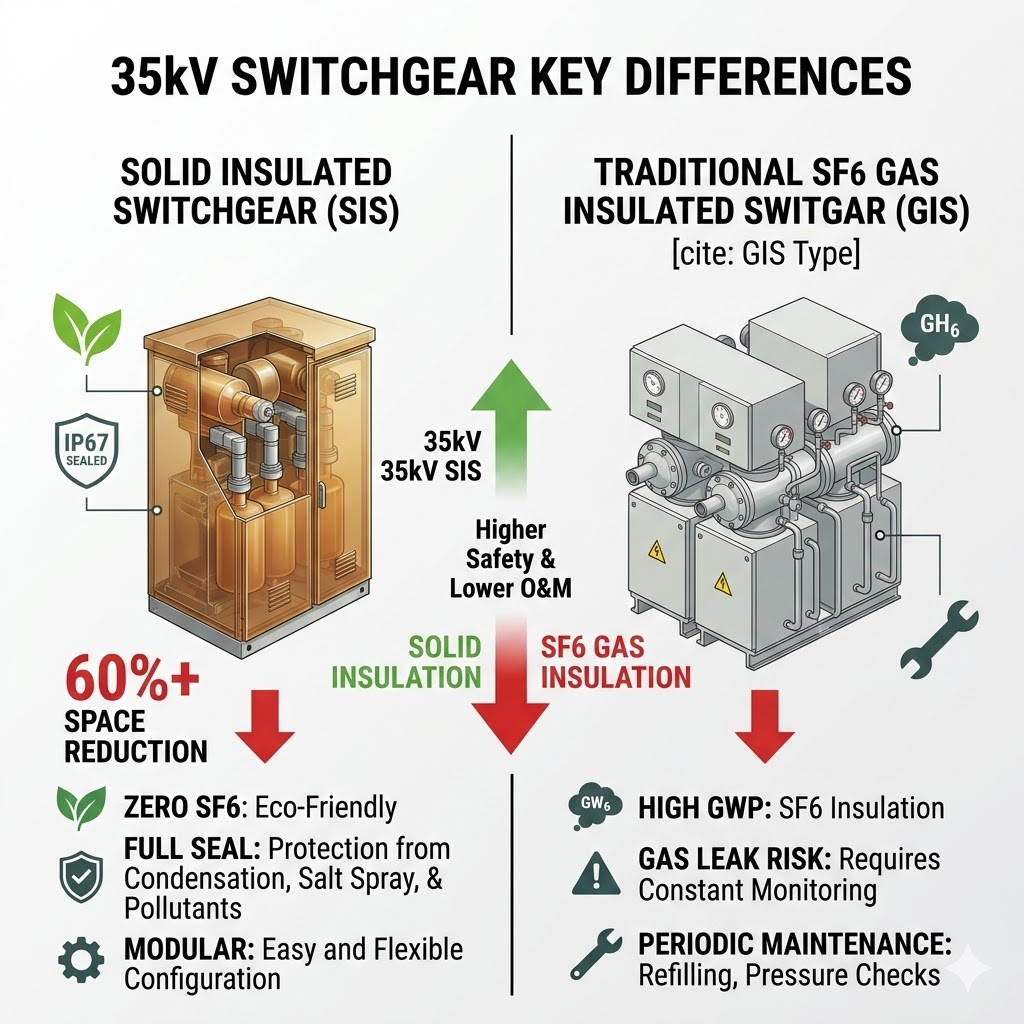
Traditionally, the preference for 35kV systems has been SF6 Gas Insulated Switchgear (GIS) or large-scale air-insulated cabinets. However, with the global implementation of "Dual Carbon" policies and strict controls on the greenhouse effect of SF6 gas, the 35kV High-Voltage Solid Insulated Switchgear—featuring epoxy resin solid-sealing technology for full insulation and total sealing—is rapidly becoming the mainstream customized choice for industrial parks, renewable energy stations, and rail transit.
Today, we will analyze the technical differences between these two solutions to help you optimize your 35kV high-voltage cabinet selection.
Core Differences: The Evolution of Insulation Logic and Environmental Adaptability
1. Insulation Medium and Volume Control
Traditional SF6 Cabinets: These rely on SF6 gas as the insulation medium. While compact, they require real-time gas pressure monitoring, and their insulation performance can be affected by pressure changes in high-altitude areas.
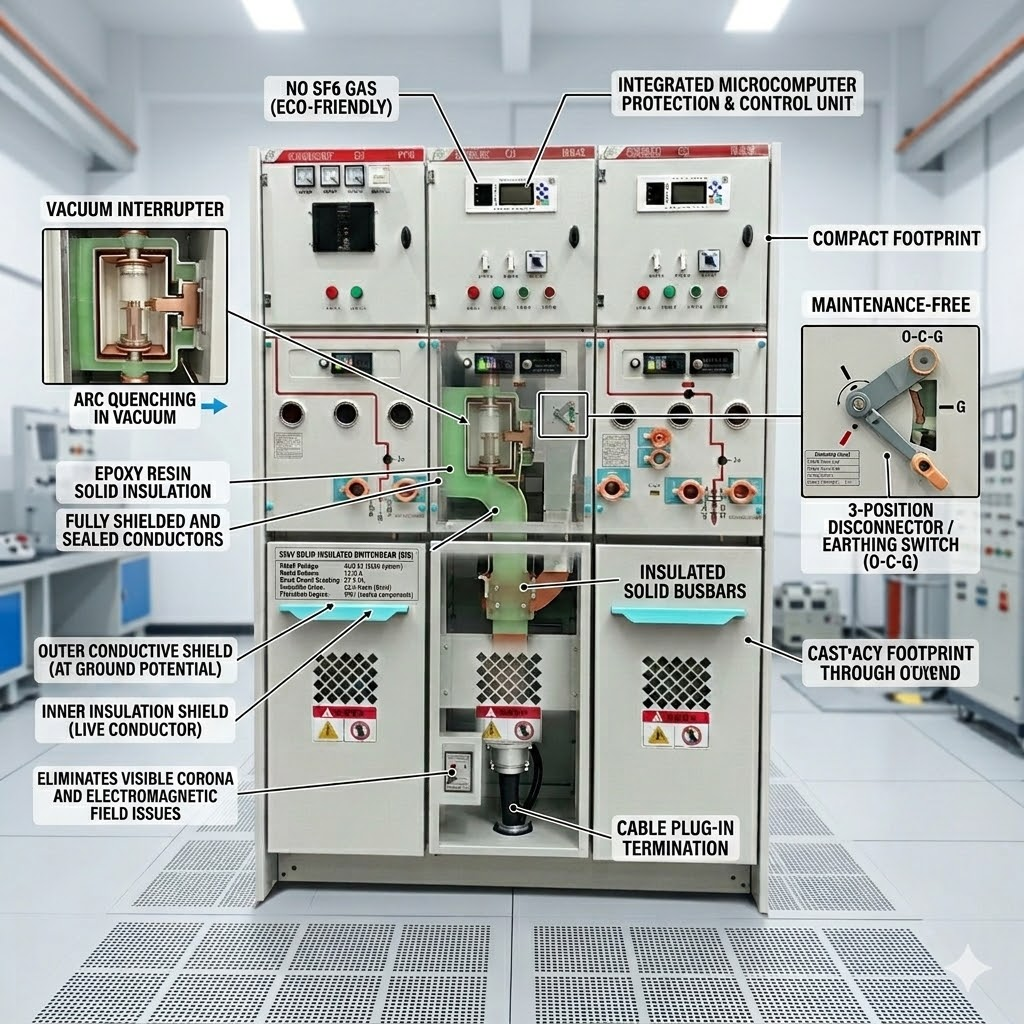
35kV Solid Insulated Switchgear: This technology directly encapsulates vacuum interrupters and high-voltage live parts within solid insulation materials like epoxy resin. This "embedded pole" design eliminates the impact of air humidity and pressure on electrical clearances, resulting in a structure 40%–60% smaller than traditional air cabinets, making it ideal for narrow urban spaces.
2. "Zero Maintenance" and Environmental Defense
Our 35kV customized cabinets utilize a "golden combination" of embedded poles + modular shielded connections:
Eliminating Leakage: Solid insulation technology completely removes the need for gas pressure monitoring, eliminating the risk of insulation failure caused by SF6 gas leaks.
Extreme Environment Protection: The interior is fully insulated with an IP67-rated total seal, isolating components from high-salt spray in coastal areas, thin air at high altitudes, or heavy dust in mines, ensuring stable operation for over 30 years.
In-Depth Comparison: 35kV Solid Insulated Switchgear vs. Traditional SF6 Switchgear
Dimension |
35kV Solid Insulated Switchgear (SIS) |
Traditional 35kV SF6 Switchgear (GIS) |
Insulation Medium |
Epoxy Resin (Solid Insulation) |
SF6 Gas (Sulfur Hexafluoride) |
Environmental Attribute |
Green & Zero Emission; completely free of greenhouse gases. |
Contains potent greenhouse gases; faces environmental regulatory limits. |
Maintenance Frequency |
Extremely Low; no gas monitoring; core parts are maintenance-free for life.
|
Moderate; requires periodic pressure checks, refilling, or leak handling. |
Operational Stability |
Extremely High; unaffected by altitude, condensation, or humidity. |
Good; however, pressure may fluctuate under extreme temperature differences. |
Customization Flexibility |
Modular design; supports various complex main wiring scheme customizations.
|
Relatively fixed structure; expansion is more difficult later on. |
Why Choose Our Customized 35kV High-Voltage Solid Insulated Switchgear?
1. Solving the "Environmental Flashover" Pain Point
In regions with high temperature fluctuations or humidity, 70% of high-voltage equipment failures stem from moisture-induced flashovers. Our solid insulated cabinets utilize Fully Shielded technology to completely wrap 35kV bare live parts, thoroughly eliminating the risk of tracking and phase-to-phase short circuits.
2. Intelligent Control Center
It is more than just a switchgear cabinet; it is a node in the smart grid. We offer customized integration of:
FTU/DTU Automation Terminals: Realizing remote opening/closing and distribution network self-healing.
Fiber Optic Online Monitoring: Real-time monitoring of internal temperatures and partial discharge status of embedded poles, with alerts sent directly to your phone.
3. Customized Solutions Meeting Global Standards
Whether you need single-way circuit breaker protection or complex ring network configurations (e.g., 2-in 4-out), we provide highly customized enclosure colors and internal configurations to ensure a perfect match with your existing system.
Frequently Asked Questions (FAQ)
Q1: How is the heat dissipation performance of the solid insulated cabinet?
A: We optimize the heat dissipation by using specific epoxy resin formulas and enhanced cabinet ventilation designs, ensuring that temperature rise indicators remain significantly better than national standards during continuous high-current operation.
Q2: Is the installation process complicated? Does it require on-site resin pouring?
A: It is a completely prefabricated "Plug-and-Play" structure. It uses standard European T-type cable connectors for docking, requiring no on-site hot work or complex procedures.
Q3: Does it require derating for use at altitudes above 3,000 meters?
A: Because the core insulation is provided by solid materials, the dielectric strength does not weaken with decreasing air pressure. Therefore, our 35kV SIS maintains extreme stability at high altitudes without the need for increased volume.
Q4: What is the lifespan of solid insulation materials? Do they age?
A: We use modified epoxy resin materials with high electrical strength and anti-aging properties, with a design life typically exceeding 30 years.
Q5: How does the solid insulated cabinet handle internal arc faults compared to gas-insulated units?
A: Our 35kV solid insulated switchgear is designed with independent phase-to-phase isolation, which inherently reduces the risk of phase-to-phase short circuits. In the rare event of an internal arc, the cabinet is equipped with structural pressure relief channels that safely direct energy away from the operator, meeting the highest IAC (Internal Arc Classification) safety standards.
Conclusion
As 35kV distribution systems move toward green, intelligent, and compact designs, Solid Insulated Switchgear is undoubtedly the future of power engineering. By optimizing space utilization and eliminating gas maintenance costs, it provides the most cost-effective protection for your long-term asset value.
Table of Contents
- Core Differences: The Evolution of Insulation Logic and Environmental Adaptability
- In-Depth Comparison: 35kV Solid Insulated Switchgear vs. Traditional SF6 Switchgear
- Why Choose Our Customized 35kV High-Voltage Solid Insulated Switchgear?
-
Frequently Asked Questions (FAQ)
- Q1: How is the heat dissipation performance of the solid insulated cabinet?
- Q2: Is the installation process complicated? Does it require on-site resin pouring?
- Q3: Does it require derating for use at altitudes above 3,000 meters?
- Q4: What is the lifespan of solid insulation materials? Do they age?
- Q5: How does the solid insulated cabinet handle internal arc faults compared to gas-insulated units?
- Conclusion