 EN
EN


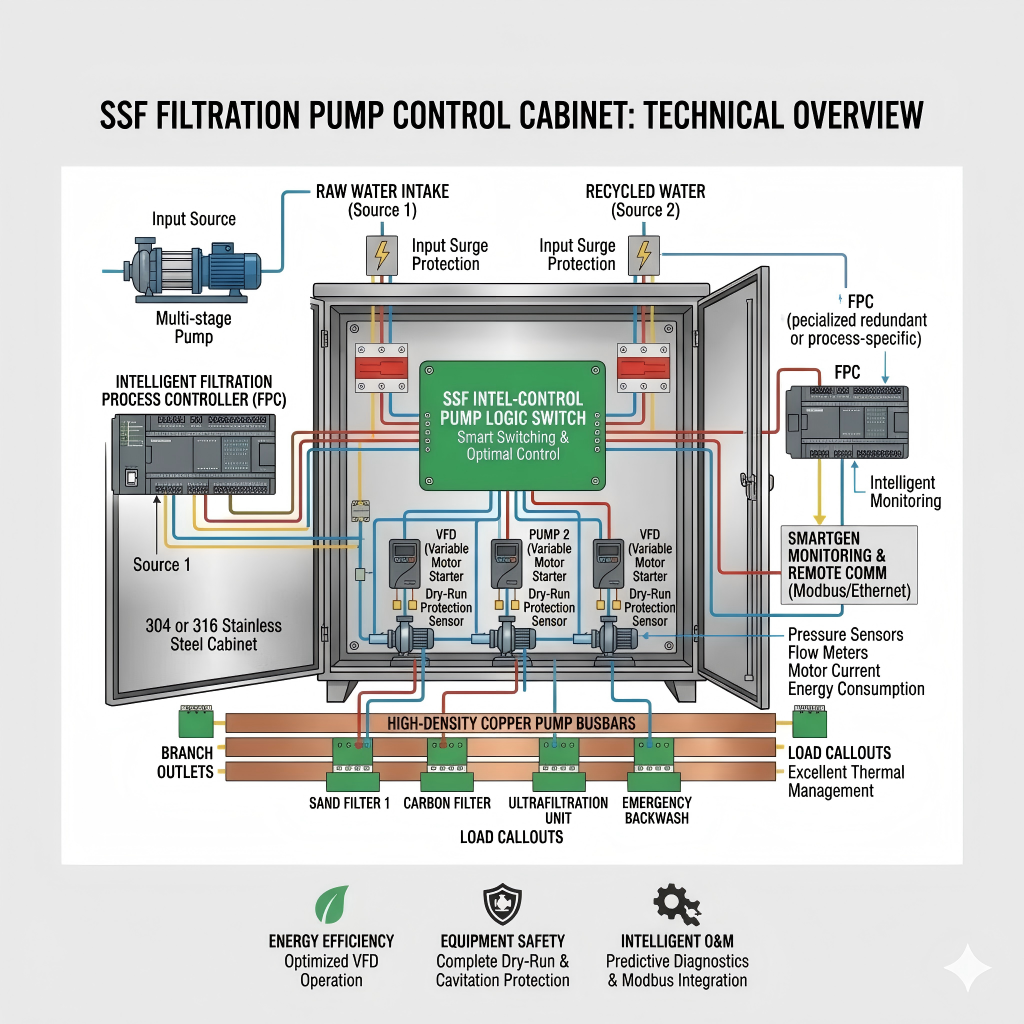
In modern industrial water treatment and precision filtration systems, the stable operation of pumps determines the success of the entire process. Whether it is industrial circulating water, Reverse Osmosis (RO) systems, or municipal wastewater treatment, a high-performance Filtration Pump Control Cabinet is more than just a distribution box—it is the "intelligent hub" that ensures efficient, energy-saving, and long-lasting system operation.
This article will take you deep into the core functions, design advantages, and how this equipment optimizes your water treatment workflow through cutting-edge technology.
Core Differences: Evolution from "Basic Distribution" to "Systemic Intelligent Control"
1. Material Defense and Environmental Adaptation
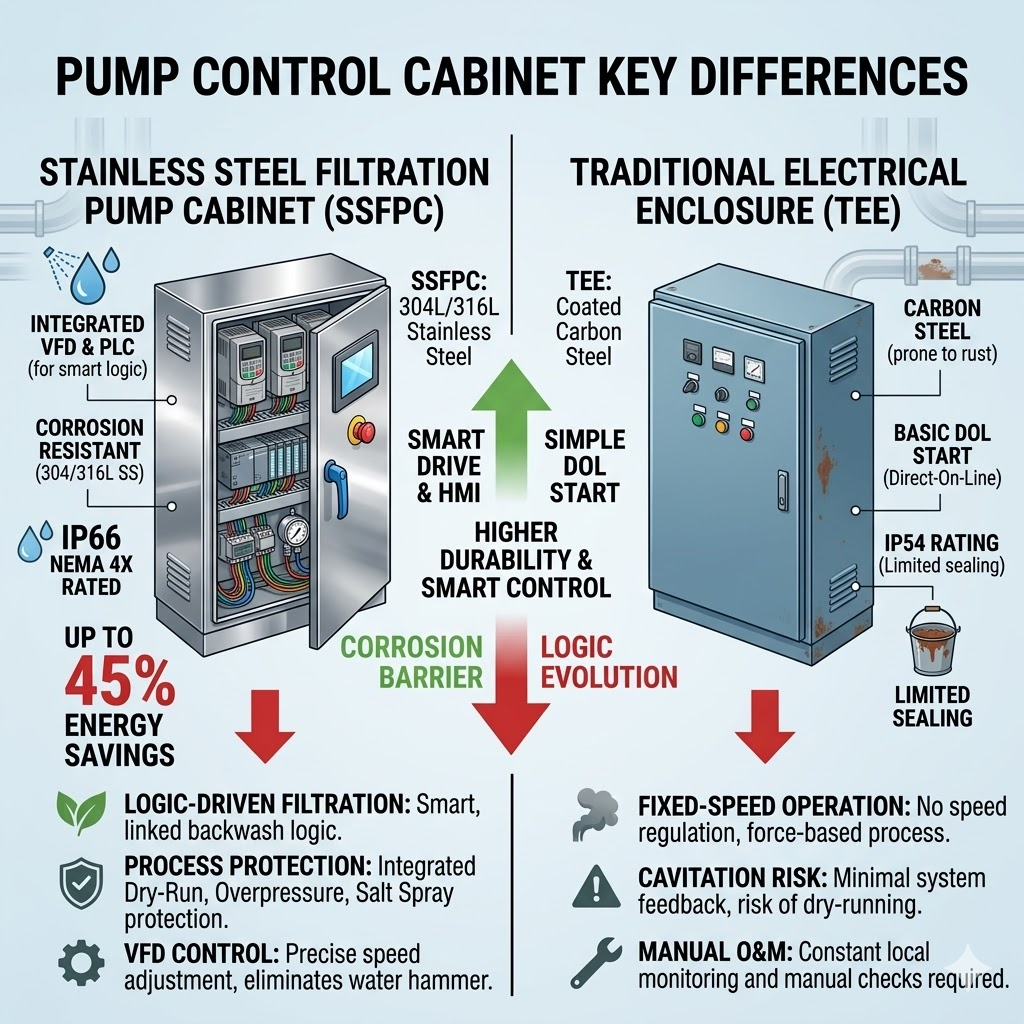
Regular Distribution Cabinets: These usually use powder-coated carbon steel. In high-humidity water treatment workshops, the coating can peel and rust within 2–3 years, threatening the safety of internal electrical components.
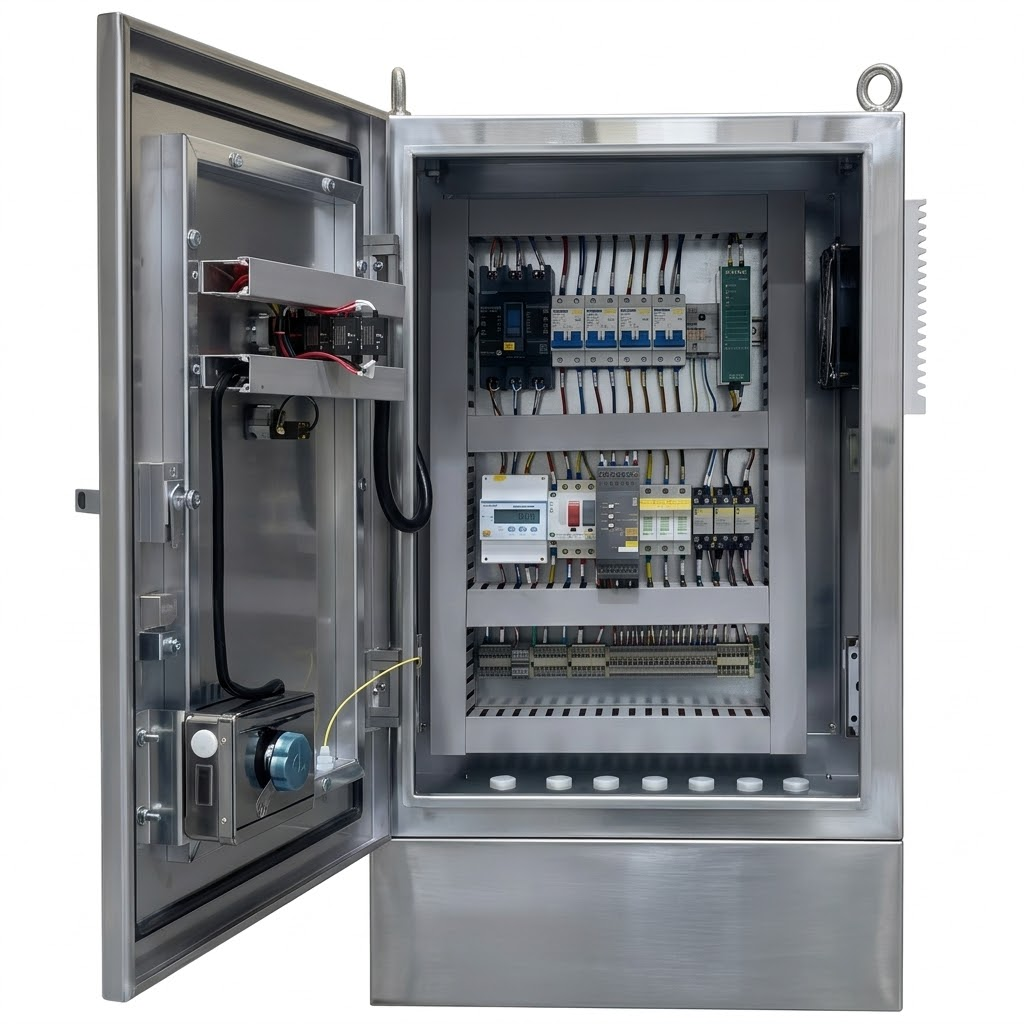
Stainless Steel Filtration Pump Control Cabinets: Custom-built for harsh environments. Made from 304 or 316L stainless steel, they offer superior oxidation and acid-alkali corrosion resistance.
IP66/NEMA 4X Protection: With a fully sealed design and high-grade gaskets, these cabinets effectively block water mist, dust, and chemical fumes.
2. "Soft Start + VFD" Logic Evolution
These control cabinets integrate ABB/Schneider soft starters or Variable Frequency Drives (VFD), marking a leap from "forceful switching" to "precise regulation":
Eliminating Water Hammer: Through the soft start function, the pump starting current is smooth, completely preventing pipe vibration and filtration membrane damage caused by instantaneous impact.
Demand-Based Regulation (VFD): The system automatically adjusts pump speed based on real-time pressure differential signals. Research shows that compared to fixed-speed operation, cabinets with integrated VFDs can reduce energy consumption by 25%–45%.
Deep Comparison: Stainless Steel Pump Control Cabinet vs. Traditional Industrial Enclosure
Comparison Dimension |
Stainless Steel Filtration Pump Cabinet |
Traditional Industrial Enclosure |
Enclosure Lifespan |
304/316L Stainless Steel; 20+ years |
Carbon steel; prone to corrosion in 3-5 years |
Pump Protection |
Integrated dry-run, overpressure, and backwash linkage |
Basic overload and short-circuit protection only |
Starting Method |
Soft Start or VFD regulation; smooth and reliable |
Mostly Direct-On-Line (DOL); high failure rates |
Intelligence/HMI |
Integrated touch screen for real-time monitoring |
Basic indicator lights only |
Why Choose Our Customized Stainless Steel Pump Control Cabinet?
1. Solving "Complex Process" Pain Points
In Reverse Osmosis (RO) or ultrafiltration systems, pressure changes are intense. Our cabinets feature built-in filtration logic that links with pressure sensors. If filter clogging reaches a threshold, the system automatically triggers an alarm or switches to a backup pump to prevent membrane rupture.
2. "1:1" Deep Engineering Customization
While the enclosures have standard sizes, we support full customization based on your site:
Component Preference: Choose freely from ABB, Schneider, Chint, or Mean Well electrical components.
Wiring Layout: Supports side entry, bottom entry, or top-mounted cooling fans to fit perfectly in narrow pump rooms.
3. High-Reliability Thermal Management
To handle heat generated by high-power pumps, we optimize airflow channels within the stainless steel cabinet. Combined with high-grade insulating supports, this effectively extends the Mean Time Between Failures (MTBF) of components, ensuring stable operation even in pump rooms exceeding 40°C.
FAQ: Frequently Asked Questions about Pump Control Cabinets
Q1: Can this cabinet handle environments with chlorine gas or strong alkalis?
A: Yes. For these environments, we recommend 316L stainless steel. It contains molybdenum, providing extreme resistance to pitting and crevice corrosion, making it the standard for chemical water treatment.
Q2: If the water supply suddenly cuts off, can the cabinet prevent the pump from burning out?
A: Yes. The cabinet integrates "Dry-Run Protection" logic. By detecting an abnormal drop in current (no-load) or linking with a level switch, it cuts power within 3 seconds to protect the mechanical seal.
Q3: Does the control cabinet support remote monitoring via smartphone?
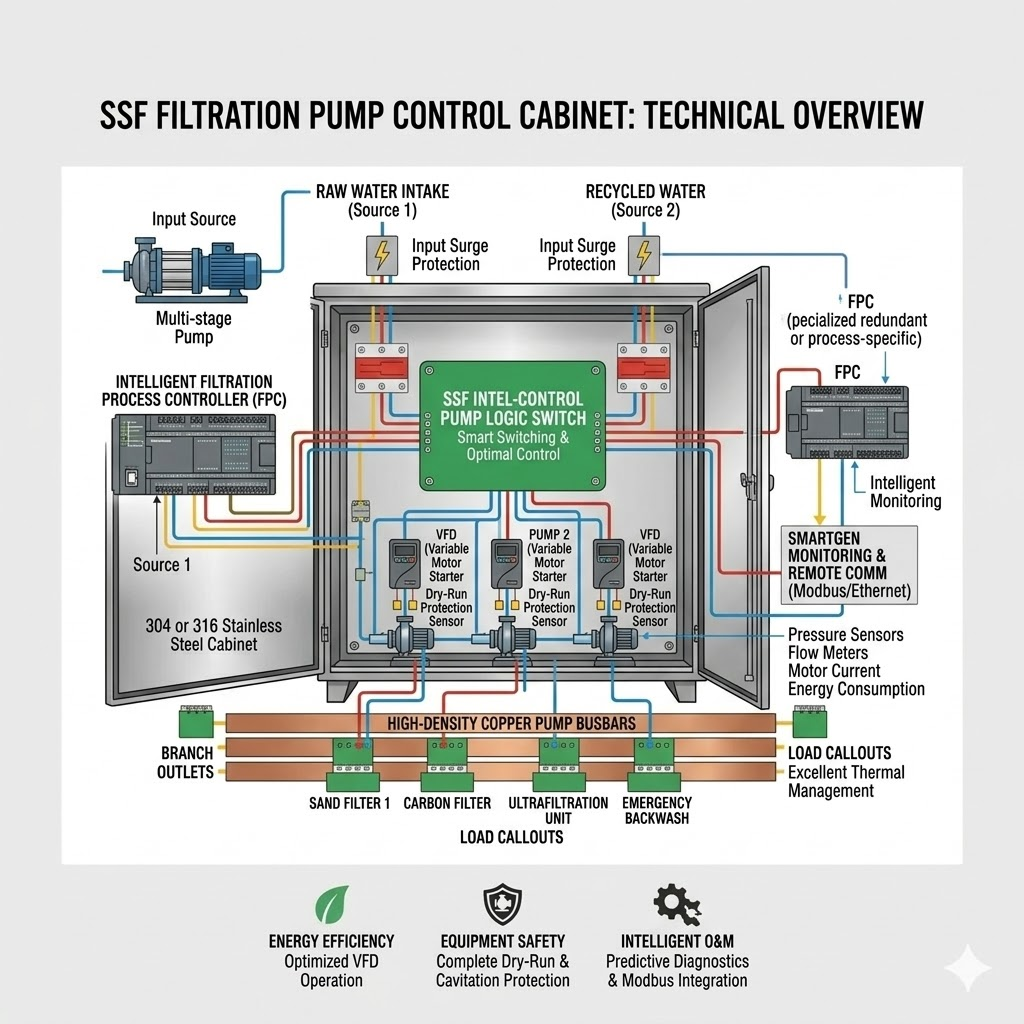
A: Yes. The built-in controller features RS485/Ethernet interfaces supporting Modbus protocols. You can integrate it into a SCADA system or use a cloud module to check energy, pressure, and alarm logs remotely.
Q4: Why choose a NEMA 4X / IP66 rated stainless steel enclosure?
A: NEMA 4X emphasizes corrosion resistance. In water treatment, chemical splashes and high humidity are constant; NEMA 4X ensures expensive VFDs and PLCs remain unaffected by the external environment.
Q5: Can I customize specific breaker brands or add extra branch circuits?
A: Absolutely. We support international brands like Schneider and ABB as well as top-tier domestic brands. The layout can be customized to include secondary distribution circuits for an integrated "Control + Distribution" solution.
Conclusion: Building a Solid Defense for Your Filtration System
Choosing a Stainless Steel Filtration Pump Control Cabinet is more than selecting equipment; it is building an intelligent defense for your process continuity. This equipment finds the perfect balance between extreme durability and precise management.
Table of Contents
- Core Differences: Evolution from "Basic Distribution" to "Systemic Intelligent Control"
- Deep Comparison: Stainless Steel Pump Control Cabinet vs. Traditional Industrial Enclosure
- Why Choose Our Customized Stainless Steel Pump Control Cabinet?
-
FAQ: Frequently Asked Questions about Pump Control Cabinets
- Q1: Can this cabinet handle environments with chlorine gas or strong alkalis?
- Q2: If the water supply suddenly cuts off, can the cabinet prevent the pump from burning out?
- Q3: Does the control cabinet support remote monitoring via smartphone?
- Q4: Why choose a NEMA 4X / IP66 rated stainless steel enclosure?
- Q5: Can I customize specific breaker brands or add extra branch circuits?
- Conclusion: Building a Solid Defense for Your Filtration System