 EN
EN


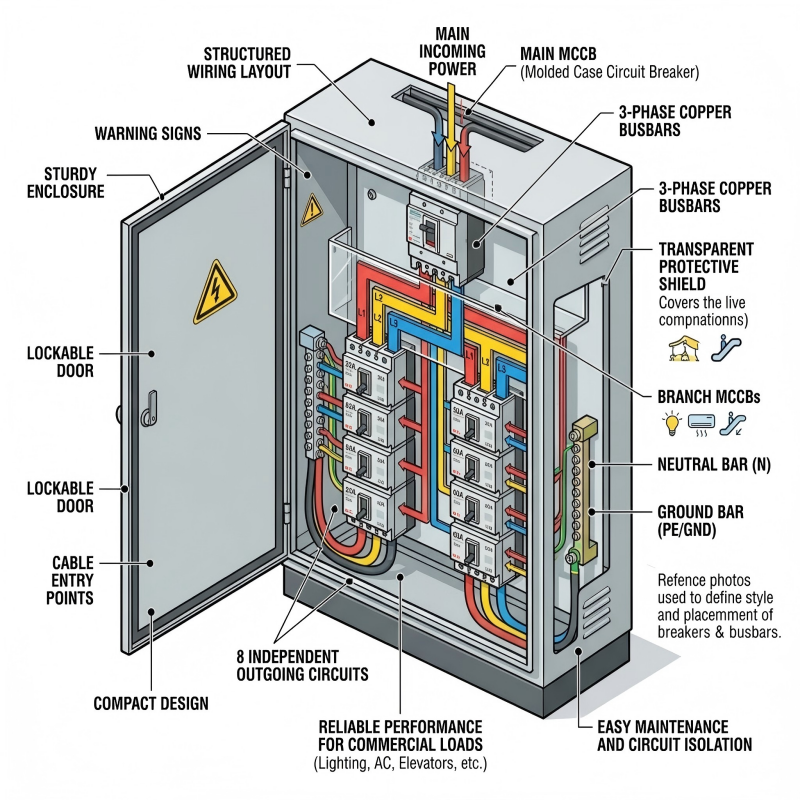
In the daily operations of modern commercial complexes, whether it is brightly lit indoor lighting, large central air conditioning systems maintaining a comfortable temperature, or escalators running around the clock, all rely on a massive and stable electrical supply. However, when dealing with the highly complex power usage scenarios inside a shopping mall, many facility managers focus entirely on front-end aesthetics while overlooking the core equipment hidden in the electrical rooms or riser shafts: the power distribution cabinet.
To ensure absolute electrical safety, precise load allocation, and highly efficient routine maintenance, the standardized 8-way power distribution cabinet has become an indispensable turnkey solution in modern commercial low-voltage distribution systems. It acts as the "central nervous system" of the mall's power grid, silently and safely routing bulk electrical energy to specific commercial zones behind the scenes.
Why Do Modern Shopping Malls Need Standardized Power Distribution Cabinets?
In a shopping mall's low-voltage grid, power coming from the main transformer cannot simply be wired directly to end-use equipment. Commercial power loads are highly localized, diverse, and subject to extreme peak-and-valley fluctuations:
Multi-Zone Independent Control Needs: Shopping malls are typically divided into food courts, retail sections, underground parking, and public corridors. Different zones have varying operating hours and power demands, requiring physical isolation and independent control through separate electrical circuits.
The Impact of Heavy-Duty Equipment: HVAC units, fresh air systems, massive water pumps, and escalators are typical "dynamic loads" with massive starting currents. Without a professional power distribution cabinet to buffer and protect the system, these start-ups can easily cause line overloads or voltage drops, disrupting sensitive POS registers or security systems.
Direct Risks of Poorly Managed Power Distribution: Relying on non-standard, improvised breaker boxes or haphazard wiring introduces severe electrical fire risks (due to cable heating and short circuits) and can lead to cascading power failures. If a single subsystem faults and trips the main breaker, it can plunge an entire floor into darkness, resulting in massive economic losses and customer panic.
This is exactly where a standardized multi-way power distribution cabinet (such as the classic 8-way output design) proves invaluable. By utilizing integrated circuit breakers and a highly organized conductive busbar system, it eliminates electrical hazards at the source.
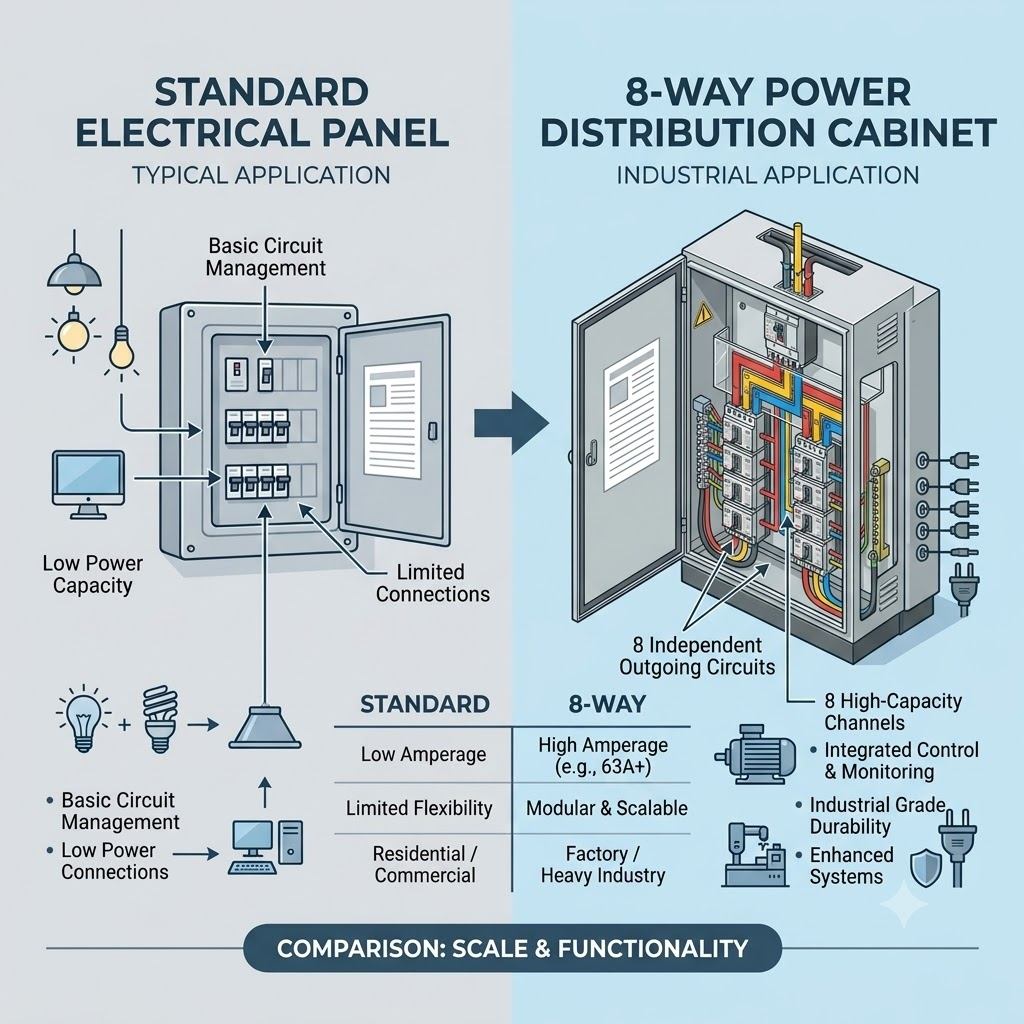
Core Differences:
Comparison: Ordinary distribution box vs.Standardized 8-Way Power Cabinet
Evaluation Metric |
Ordinary distribution box |
Standardized 8-Way Power Cabinet |
Wiring Layout |
Tangled cables, poor heat dissipation. |
Structured copper busbars, optimal cooling. |
Fault Impact |
Single fault causes total system blackout. |
Independent circuits isolate local faults. |
Maintenance |
Time-consuming and complex troubleshooting. |
Quick visual checks via transparent shields. |
Load Capacity |
Overheats under heavy equipment startups. |
Industrial MCCBs handle massive inrush surges. |
Safety Level |
Exposed live wires, high electrocution risk. |
Comprehensive grounding and insulating shields. |
System Longevity |
Rapid wire aging, difficult to expand. |
Highly durable components, scalable design. |
System Architecture and Operating Mechanism: The "Anatomy" of an 8-Way Cabinet
A well-engineered and neatly wired low-voltage power distribution cabinet is systematically assembled from several core electrical components, forming a strict logical and physical hierarchy:
Main Circuit Breaker: The "master switch" and first line of defense. It receives the total current from the main electrical room and cuts the power during severe, system-wide overloads or short circuits to protect the entire cabinet.
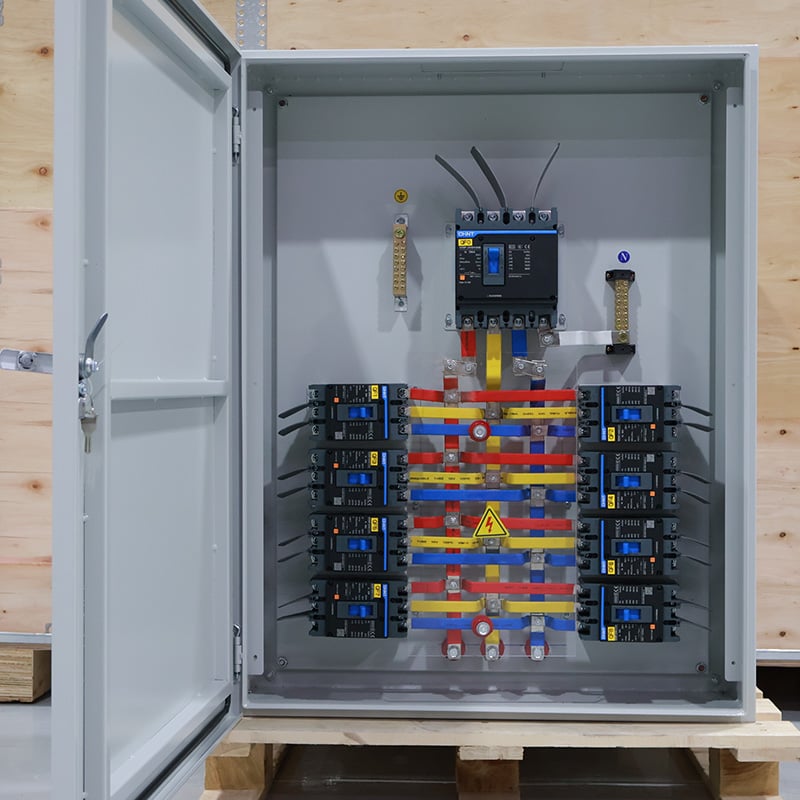
Three-Phase Busbar System: The "electrical highway" of the cabinet. High-quality cabinets discard messy cables in favor of high-purity red, yellow, and blue copper busbars for internal power transmission. Copper busbars have high conductivity and generate minimal heat, easily withstanding continuous heavy currents during a mall's peak hours.
8-Way Branch Circuit Breakers: The "executors." Connected to the main breaker via the busbars, these 8 breakers independently control 8 distinct electrical circuits (e.g., Circuit 1 for East Wing lighting, Circuit 2 for first-floor escalators, Circuit 3 for HVAC). Each provides localized short-circuit and overload protection.
Insulating Safety Shield: A transparent acrylic or polycarbonate shield is usually placed over exposed live copper busbars, complete with high-voltage warning labels. This provides a crucial physical barrier to protect electricians performing live visual inspections.
PE & N Busbars (Ground and Neutral): The cabinet features dedicated grounding (yellow-green) and neutral busbars. These maintain the balance of three-phase systems and rapidly direct dangerous leakage currents into the earth, ensuring the safety of mall staff and patrons.
FAQ
Q1: Why is an "8-way" output common in mall distribution cabinets? Is this number fixed?
A1: It is a standard modular configuration that perfectly balances the load separation needs of a typical mall zone without wasting valuable commercial real estate. The capacity is not fixed and can be customized to 4, 6, or 12 ways depending on the project scale.
Q2: What is the actual benefit of using "three-phase copper busbars" over traditional thick cables?
A2: Solid copper busbars handle massive commercial currents with superior heat dissipation, eliminating the "heat island effect" of bundled wires. Their rigid structure and bolted connections also prevent terminal loosening and arcing fire hazards.
Q3: How does the power cabinet handle the massive inrush current when escalators and central AC units turn on?
A3: It utilizes industrial-grade Molded Case Circuit Breakers (MCCBs) with specialized motor-protection curves. These handle momentary startup spikes safely without nuisance tripping while providing instantaneous isolation during real short circuits.
Q4: If one of the 8 circuits (like a restaurant kitchen) shorts out, will the rest of the mall lose power?
A4: No. Thanks to selective coordination, only the single branch breaker dedicated to that faulty circuit will trip. The main breaker and the other seven branches remain fully operational, confining the outage to a single shop.
Q5: How should the mall's facility management team maintain these cabinets?
A5: Teams must conduct regular visual inspections for signs of overheating, monitor for abnormal noise, keep the area dry, and periodically tighten all wiring terminals during scheduled downtime to prevent loose-connection fire risks.
Conclusion
Choosing between a standard electrical panel and an 8-way power distribution cabinet depends entirely on your power demands and operational environment. Standard panels offer a practical, low-capacity solution for everyday residential and commercial use. However, for industrial settings requiring heavy load management, the 8-way distribution cabinet stands out with its robust 3-phase busbars, high amperage capacity, and 8 independent outgoing circuits. Selecting the right equipment ensures optimal safety, easy maintenance, and future scalability. Assess your system's load requirements carefully to make an informed investment that guarantees long-term operational efficiency.
Table of Contents
- Why Do Modern Shopping Malls Need Standardized Power Distribution Cabinets?
- Core Differences:
- System Architecture and Operating Mechanism: The "Anatomy" of an 8-Way Cabinet
-
FAQ
- Q1: Why is an "8-way" output common in mall distribution cabinets? Is this number fixed?
- Q2: What is the actual benefit of using "three-phase copper busbars" over traditional thick cables?
- Q3: How does the power cabinet handle the massive inrush current when escalators and central AC units turn on?
- Q4: If one of the 8 circuits (like a restaurant kitchen) shorts out, will the rest of the mall lose power?
- Q5: How should the mall's facility management team maintain these cabinets?
- Conclusion