 EN
EN


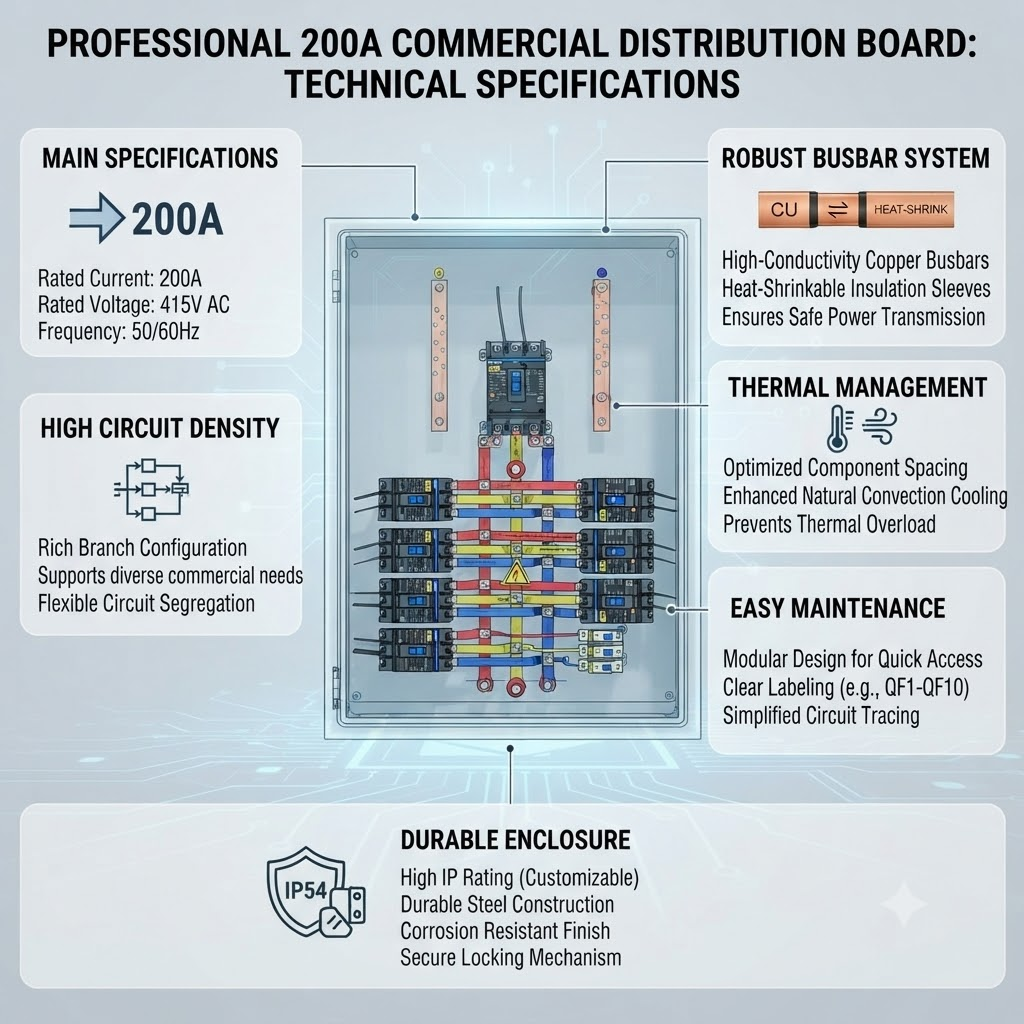
In modern commercial facilities—from bustling shopping centers to multi-purpose dining floors—stable power supply is the bedrock of operational reliability. For these high-load environments with complex equipment, a well-engineered and neatly structured centralized power distribution system is essential.
In the field of power distribution, the 200A distribution cabinet serves as a "power steward" for mid-to-large-scale shopping malls, flagship stores, and core mechanical/electrical zones. It is responsible for safely and orderly distributing electrical energy to various terminal equipment while providing critical protection and management functions.
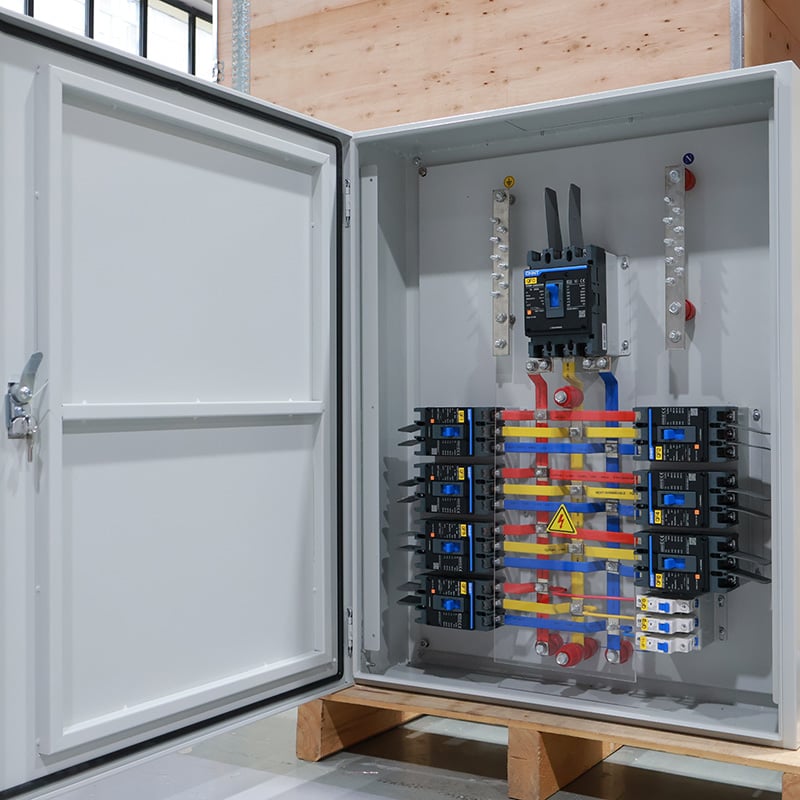
Commercial Power Distribution Advantages
As commercial real estate becomes increasingly multi-functional, a single floor often integrates lighting, HVAC (Heating, Ventilation, and Air Conditioning), commercial kitchen appliances, and various retail electronic devices. This mixed-use characteristic places extremely high demands on the power distribution system:
High Load and Inrush Current: Equipment such as central air conditioning units and cold storage systems in malls generate massive surge currents upon startup. A high-capacity distribution board (such as a 200A rating) can withstand these loads, ensuring that the main system does not trip due to frequent current fluctuations, thus guaranteeing the continuity of business operations.
Precise Multi-Circuit Management: Different types of businesses require independent power or lighting circuits. The centralized cabinet design allows engineering personnel to arrange individual circuits systematically, enabling independent protection and control for different zones. This greatly enhances the convenience and safety of later maintenance.
Safety and Compliance: Compared to disorganized wiring, a centralized cabinet structure—through rigid busbar connections and proper circuit breaker configurations—can effectively reduce the risk of line overheating and minimize electrical fire hazards. It is the inevitable choice for large commercial complexes to meet electrical safety standards.
Core Differences:
Comparison:Standard Distribution Cabinet vs. The 200A Commercial Cabinet
Feature |
Standard Distribution Cabinet |
Our 200A Commercial Cabinet |
Load Capacity |
Limited, prone to tripping |
High-capacity, stable handling |
Circuit Density |
Sparse, limited flexibility |
Dense, rich power branch options |
Internal Wiring |
Cluttered, high risk of heat |
Logical, optimized busbar layout |
Maintenance |
Complex, difficult to identify |
Organized, easy access/labeling |
Start-up Surge |
Often triggers protection |
Handles high inrush currents |
Environment |
Basic protection |
High-resilience, durable build |
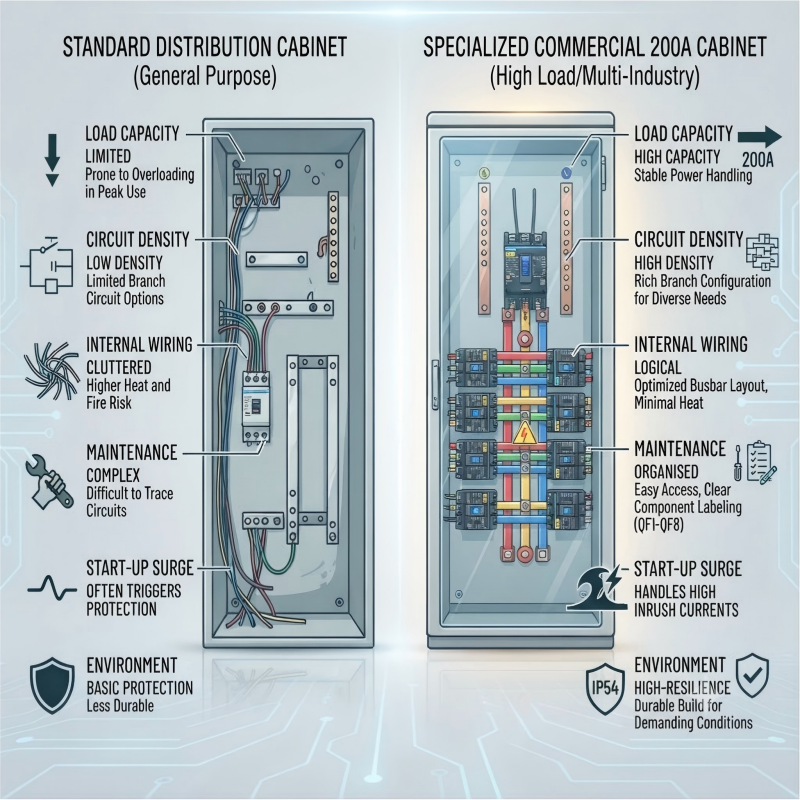
Core Architecture: Unpacking the Professional Logic
A high-performance 200A distribution board is not merely a box; it is a precisely engineered system designed for maximum efficiency:
Intelligent Protection Logic: The system features a cascaded protection mechanism. The main 200A breaker provides the primary safety threshold, while downstream breakers are calibrated to specific equipment power curves, ensuring that a fault in one kitchen or retail zone does not collapse the entire floor's power.
Precision-Milled Busbar Infrastructure: We utilize high-conductivity copper busbars with specialized heat-shrinkable insulation sleeves. This not only minimizes transmission resistance but also prevents accidental phase-to-phase shorts in high-vibration or high-heat commercial environments.
Modular Expansion Nodes: The interior layout is designed with "ready-to-plug" expansion zones. This allows facility managers to add new circuits for future equipment upgrades—such as new refrigeration units or POS systems—without the need to overhaul the entire cabinet wiring.
Thermal Management Geometry: The physical spacing between breakers is calculated to facilitate natural convective cooling, ensuring that even during peak summer usage, the internal temperature remains within the safe operating range for sensitive electrical components.
FAQ
Q1: Is the 200A rating for every branch circuit?
A: No, 200A is the total incoming capacity; branch ratings must match specific equipment loads.
Q2: How do I choose the right board for my load?
A: Assess current total consumption and add a 20% safety margin to accommodate future electrical growth.
Q3: How often is maintenance required?
A: Perform a full inspection twice annually to tighten connections, clear dust, and test breaker tripping.
Q4: Can I use this cabinet for both lighting and heavy machinery?
A: Yes, provided the branch circuits are properly segregated with appropriate breaker sizes to ensure that heavy-duty motor surges do not interfere with sensitive lighting circuits.
Q5: What are the risks of using a standard cabinet instead of a specialized commercial one?
A: Using an inadequate cabinet increases the risk of thermal overload, frequent downtime due to nuisance tripping, and potential fire hazards from improper wiring management.
Q6: Does this cabinet protect against power fluctuations?
A: While it distributes power, the robustness of its components ensures it remains stable under voltage swings, though dedicated surge protection devices (SPDs) should be added if the regional grid is highly unstable.
Q7: Is the installation process complex for a 200A board?
A: It requires professional electrical engineering expertise to ensure all busbar connections are torqued correctly and the incoming power source is adequately protected.
Conclusion
A 200A distribution board is more than just an electrical component; it is the "heart" that ensures the stable operation of modern commercial venues. Selecting a power distribution system that adheres to strict standards, features a logical structure, and utilizes high-quality components is the foundation for efficient power management and operational safety in any commercial real estate project.
Table of Contents
- Commercial Power Distribution Advantages
- Core Differences:
- Core Architecture: Unpacking the Professional Logic
-
FAQ
- Q1: Is the 200A rating for every branch circuit?
- Q2: How do I choose the right board for my load?
- Q3: How often is maintenance required?
- Q4: Can I use this cabinet for both lighting and heavy machinery?
- Q5: What are the risks of using a standard cabinet instead of a specialized commercial one?
- Q6: Does this cabinet protect against power fluctuations?
- Q7: Is the installation process complex for a 200A board?
- Conclusion