 EN
EN


In modern industrial manufacturing, factories across various sectors—such as mechanical processing, plastic injection molding, textiles, hardware, and food production—consume massive amounts of electricity daily. However, when faced with skyrocketing electricity bills, many factory managers overlook a hidden budget drain: reactive power and low power factor penalties.
To ensure grid stability and optimize electricity expenditures, the Low-Voltage Intelligent Reactive Power Capacitor Compensation Cabinet has become an indispensable turn-key electrical solution in modern industrial power distribution rooms. Particularly for large-scale power distribution systems, a high-capacity setup featuring a "Main Cabinet + Sub-cabinet" configuration acts as an intelligent "power balancer," continuously saving costs, improving power quality, and protecting production equipment.
Why Do Industrial Power Distribution Systems Need Reactive Power Compensation?
In an AC power grid, many industrial loads (such as electric motors, frequency inverters, transformers, and injection molding machines) absorb electrical energy that is fundamentally split into two components:
Active Power: The actual electrical energy converted into mechanical energy, heat, or light to drive equipment and perform useful work.
Reactive Power: The non-working electrical energy required to establish and maintain the alternating magnetic fields that allow inductive equipment to operate.
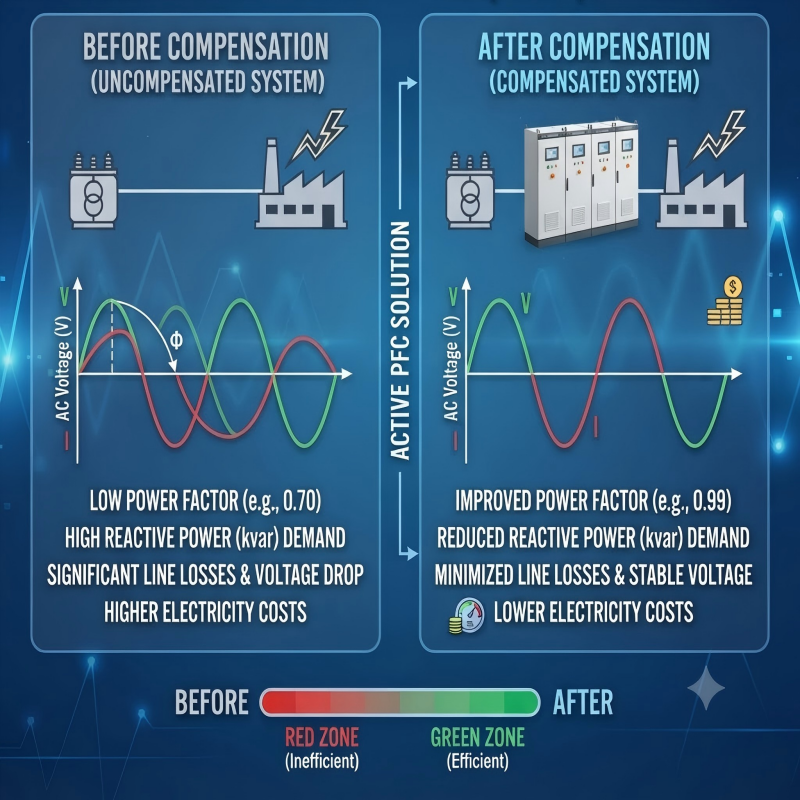
Although reactive power does not perform direct work, it occupies valuable capacity in transmission lines and transformers. When a factory's reactive power demand is excessively high, its Power Factor (PF)—the ratio of active power to total apparent power—drops significantly.
The direct risks of a low power factor to factories include:
Power Factor Penalties: Utility companies typically require industrial power factors to be maintained at 0.9 or 0.95 and above. Failing to meet this standard results in hefty penalty surcharges.
Line and Transformer Overloading: Large amounts of reactive current cause severe line heating, accelerate insulation aging, and waste the load capacity of main transformers.
Degraded Voltage Quality: Uncontrolled reactive currents cause significant voltage drops, compromising the operation of precision processing equipment at the end of production lines.
Core Differences:
Comparison:Before vs. After Implementing Capacitor Compensation
Evaluation Metric |
Uncompensated Grid (Raw Status) |
Compensated Grid (Optimized) |
Utility Bill |
High penalties due to low power factor. |
PF $\ge 0.95$, completely eliminating penalties. |
Transformer Capacity |
Constantly overloaded by high reactive power. |
Frees up capacity for future equipment expansion. |
Line Efficiency |
High currents cause overheating and energy loss. |
Reduced current extends cable lifespan and cuts losses. |
Voltage Stability |
Severe voltage drops during heavy equipment start-ups. |
Stabilizes end-of-line voltage for safe operation. |
System Architecture and Operational Mechanism of the "Main + Sub-Cabinet" Setup
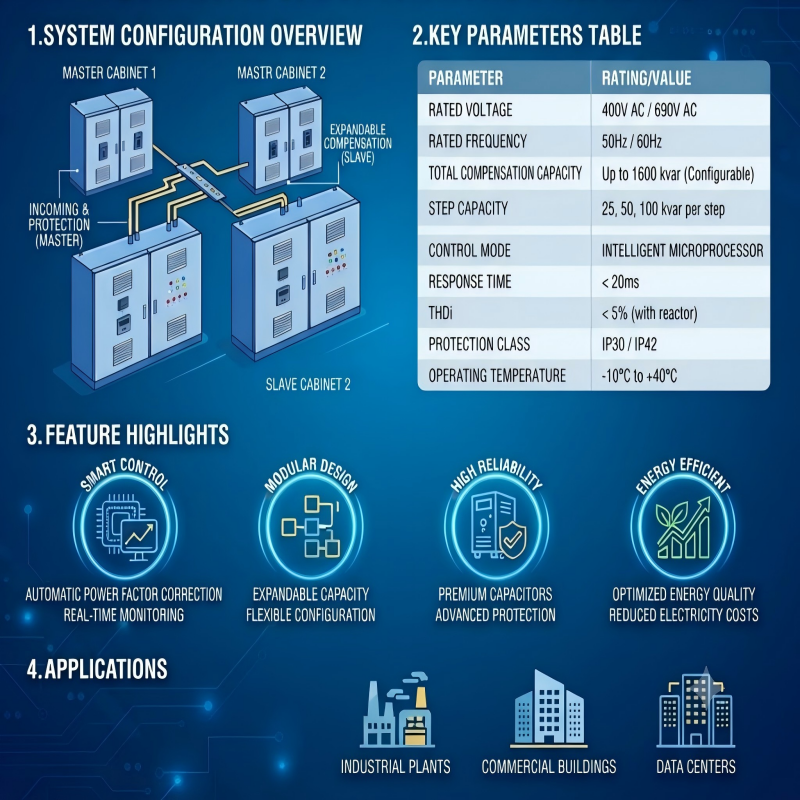
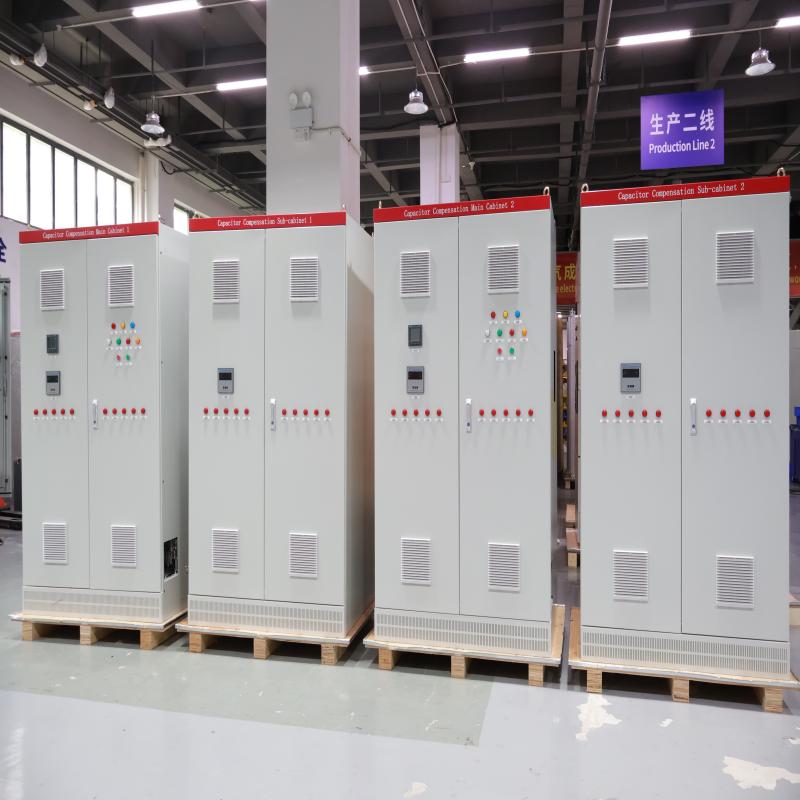
For massive industrial operations, a single standard cabinet is often insufficient to handle extreme reactive power demands. A highly efficient solution is the modular "Main Cabinet + Sub-cabinet" configuration. In large-scale deployments, facilities often utilize multiple groups—such as a 4-cabinet lineup consisting of two main cabinets and two sub-cabinets—to achieve massive, scalable compensation capacity seamlessly.
A well-engineered system systematically integrates several core electrical components to function as a unified, intelligent entity:
Intelligent Reactive Power Compensation Controller (The "Brain"): Located centrally in the main cabinet, this smart device monitors busbar voltage and current signals in real time. It dynamically calculates the current power factor and the exact reactive capacity required, issuing precise switching commands to the entire system.
Main Circuit Breaker & Branch Protection: The main cabinet houses the primary circuit breaker, providing crucial incoming isolation, overload, and short-circuit protection for the whole setup. Meanwhile, branch miniature circuit breakers (or fuses) deliver independent overcurrent and short-circuit protection for each specific capacitor branch across the cabinets.
Switching Components (The "Executors"): Acting on instructions from the controller, these components—either specialized contactors or rapid-response thyristors—frequently connect or disconnect the capacitor banks to and from the grid.
Power Capacitor Banks (The "Power Source"): Distributed densely across the sub-cabinets to expand the compensation loop, these banks serve as the core source of reactive power compensation. They actively balance out the inductive loads from factory machinery by providing essential capacitive current.
Series Reactors (The "Shield"): Often connected in series with the capacitors, these highly recommended components suppress high-frequency harmonics in the grid, preventing catastrophic capacitor damage caused by electrical resonance.
Operational Mechanism & Dynamic Control: In actual operation, industrial production lines experience constant and unpredictable load fluctuations. When heavy machinery like large injection molding machines or heavy-duty motors start up, the intelligent controller instantly detects the sudden drop in the power factor. It immediately directs the switching components to switch "in" an appropriate capacity of capacitor banks from the available main and sub-cabinets.
Conversely, when equipment shuts down and the reactive demand decreases, the controller rapidly commands the system to switch these banks "out". This rapid response prevents reactive power from feeding back into the utility grid, a dangerous condition known as over-compensation. Advanced intelligent systems also utilize automated step rotation, ensuring that all capacitor banks wear evenly over time. Through this dynamic, closed-loop control, the factory's overall energy effici
FAQ
Q1: Why use a "Main + Sub-cabinet" modular setup?
A: Large plants need massive capacity beyond a single enclosure. This design separates controls from power capacitors, improving cooling and simplifying future upgrades.
Q2: How is harmonic interference resolved in PFC systems?
A: Non-linear loads inject harmonics that can destroy standard capacitors. Adding series tuning reactors blocks these harmonics and protects the equipment.
Q3: Should I use contactors or thyristor switches?
A: Use contactors for stable loads. For rapidly fluctuating loads, use thyristors for safe, millisecond, and spark-free switching.
Q4: Will compensation reduce my active energy meter readings?
A: No, it does not lower active power consumption. Savings come entirely from eliminating utility penalties, lowering line losses, and optimizing transformer output.
Q5: What routine maintenance do compensation cabinets require?
A: Key tasks include checking ventilation, inspecting for capacitor bulging, tightening loose wiring terminals, and measuring branch currents regularly.
Conclusion
In short, low voltage capacitor compensation cabinets serve as core power optimization equipment for industrial plants struggling with low power factor and high electricity expenses; the scalable main and sub-cabinet configuration with intelligent controllers, capacitor banks and series reactors dynamically adjusts reactive power, lifts power factor to above 0.95 to abolish utility penalties, cuts line energy loss, eases transformer overload and stabilizes equipment terminal voltage, while matched contactor or thyristor switches adapt to different load fluctuation conditions and harmonic suppression reactors protect internal components, and though it cannot reduce active power use, this turnkey power factor correction solution brings lasting cost savings and reliable grid operation with basic routine maintenance.