 EN
EN


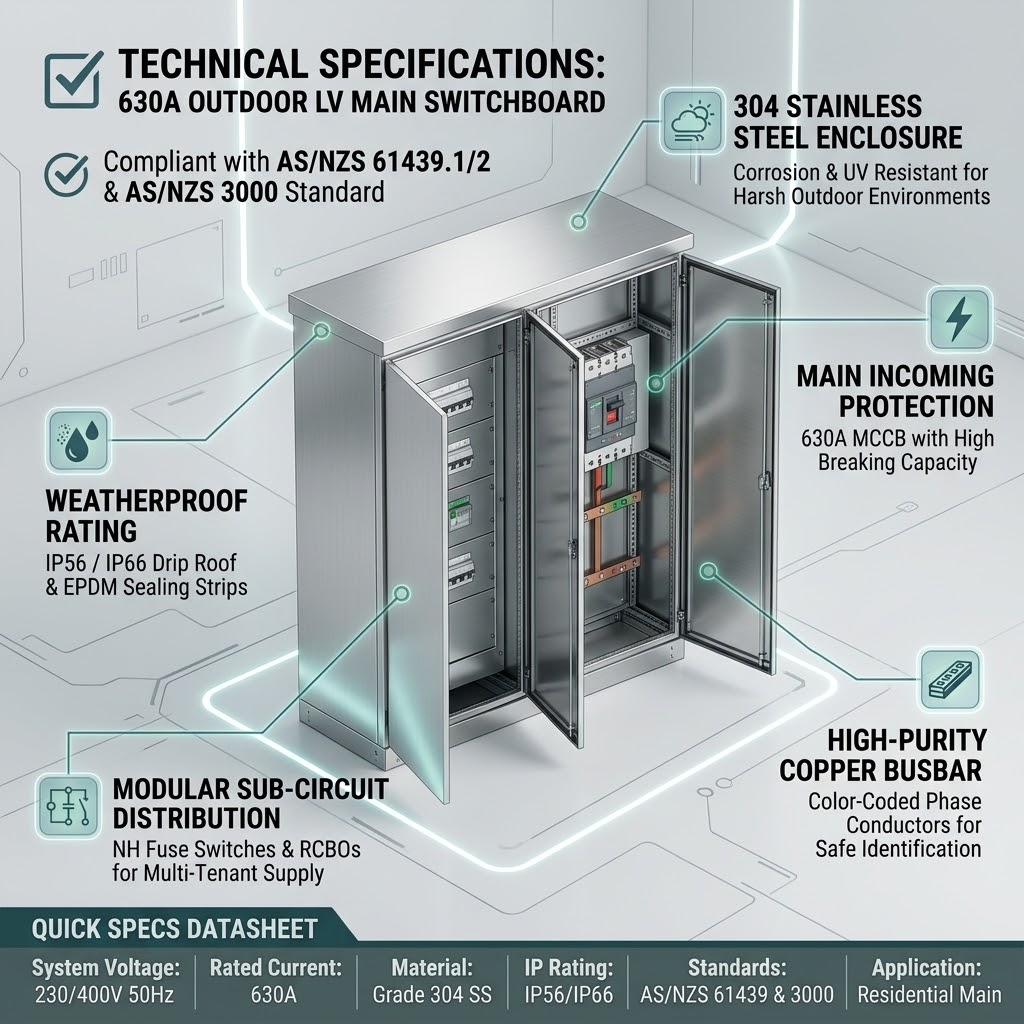
In Australian residential developments and multi-dwelling projects, the low voltage main switchgear serves as the primary distribution hub connecting the utility grid to downstream sub-distribution systems. Operating as the core power distribution assembly, a 630A outdoor low voltage main switchgear handles main power intake, system protection, and multi-circuit power routing. Designed to withstand harsh outdoor conditions while providing continuous high-current service, these assemblies must adhere strictly to Australian electrical safety codes and utility requirements.
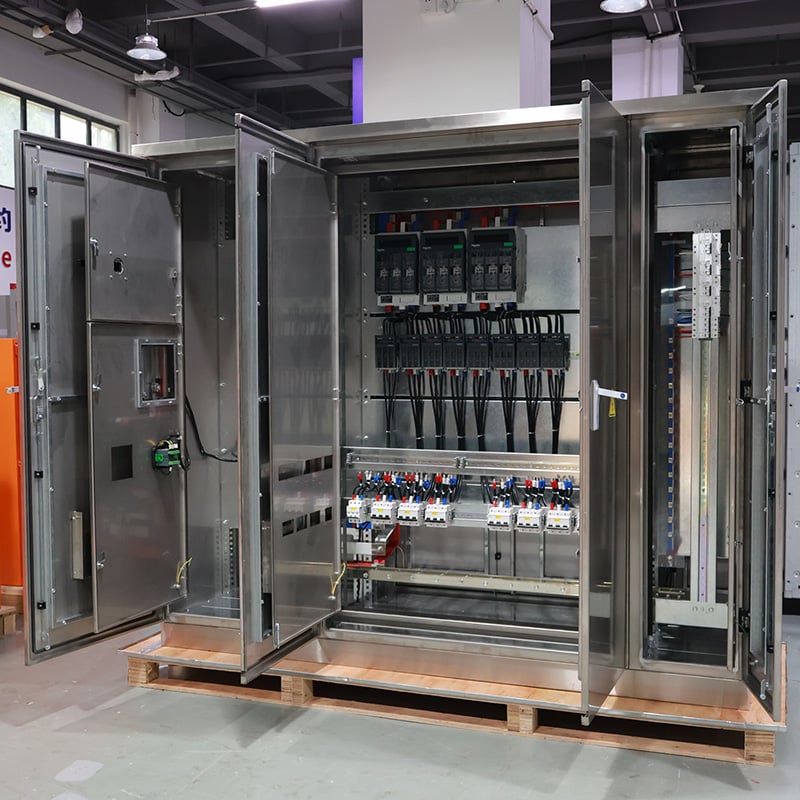
Key Takeaways
Standard Compliance: Designed and verified to meet AS/NZS 61439.1/2 (low-voltage switchgear and controlgear assemblies) and AS/NZS 3000 (Australian/New Zealand Wiring Rules) for seamless local authority inspection and approval.
Electrical Parameters: Optimized for Australian 230/400V, 50Hz three-phase supply networks with a rated main busbar capacity of 630A.
Enclosure Durability: Built from 304 stainless steel to ensure high corrosion resistance, UV resistance, and weather protection (typically rated IP56 to IP66).
System Functionality: Integrates main isolation, overload/short-circuit protection, copper busbar distribution, sub-circuit fuse/breaker protection, metering quarters, and surge protection devices (SPD).
Technical Architecture & Australian Standard Requirements
1. Regulatory Standards & Design Verification
Deploying main switchgears in Australia mandates strict compliance with local regulatory frameworks:
AS/NZS 61439-1/2: Replaces older assembly standards to require rigorous design verification (formerly type testing) covering temperature rise limits, short-time withstand current ($I_{cw}$), dielectric strength, and structural integrity.
AS/NZS 3000 (Wiring Rules): The fundamental electrical installation code in Australia. It specifies main switch placement, isolation switch visibility, MEN (Multiple Earthed Neutral) earthing links, and neutral/earth busbar arrangements.
2. Enclosure Construction & Weatherproofing
Outdoor installations across Australian coastal and urban areas face high humidity, intense solar radiation, and airborne salt:
304 Stainless Steel (SS304): Unlike standard powder-coated carbon steel, 304 stainless steel prevents rust and structural degradation caused by scratched surface coatings, extending the operational life of outdoor switchgears.
Compartmentalized Multi-Door Access: Segregates incoming utility supplies, main breaker sections, busbar chambers, and outgoing distribution circuits into distinct compartments for safe operation and maintenance.
Outdoor Weather Seals & Sunshades: Features sloped drip hoods, rain channels, and durable EPDM gaskets to maintain high ingress protection against driving rain and dust.
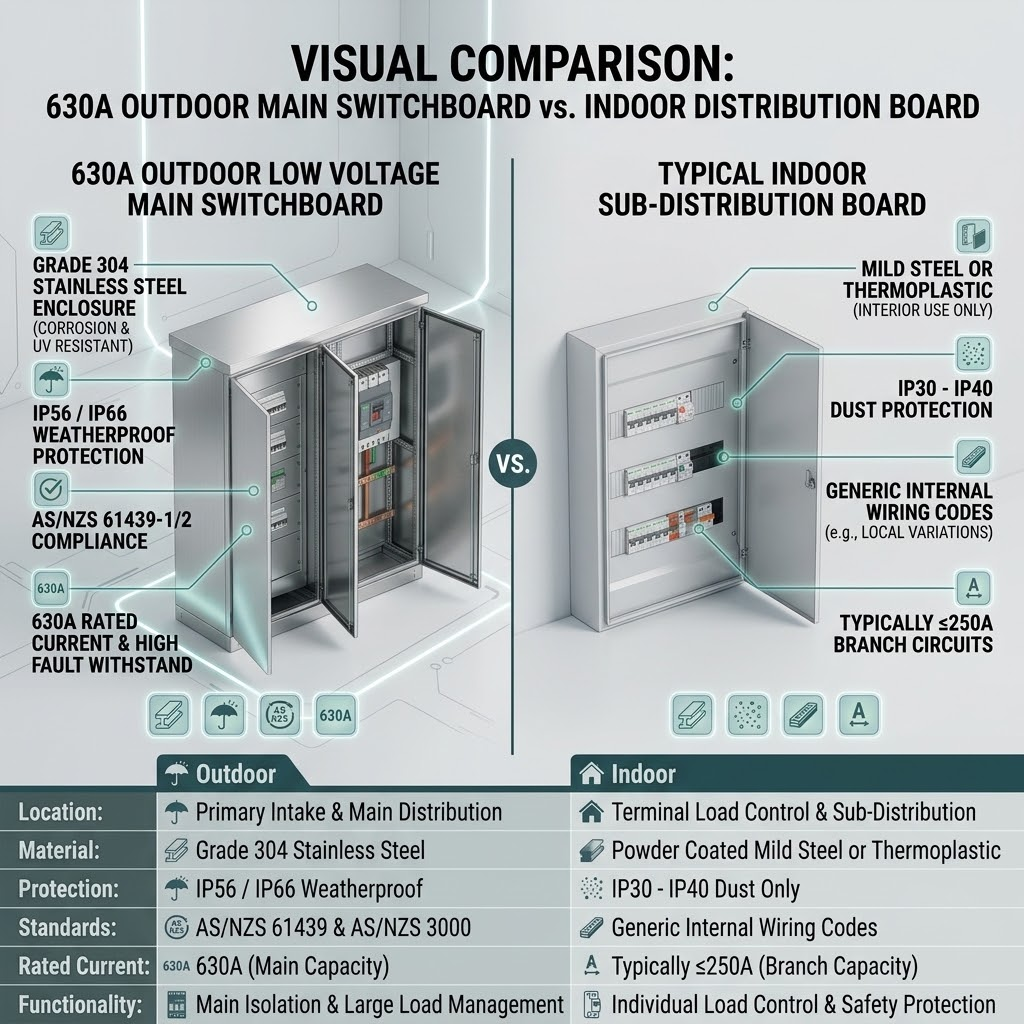
Core Differences:
630A Outdoor Main switchgear vs. Standard Indoor Sub-Distribution Board
Comparison Dimension |
630A Outdoor LV Main switchgear (304 SS / AS/NZS) |
Standard Indoor LV Sub-Distribution Board |
Application |
Primary intake & main power distribution for residential developments |
Terminal power control for individual apartment floors or indoor zones |
Enclosure Material |
Grade 304 Stainless Steel (SS304) with optional protective coating |
Cold-rolled sheet steel with indoor coating or thermoplastic |
Ingress & Weathering |
IP56-IP66 rating; rainproof, dust-tight, salt-spray & UV resistant |
IP30-IP40 rating; indoor use only, no weather seals |
Compliance Standards |
Mandatory AS/NZS 61439.1/2 & AS/NZS 3000 verification |
Standard IEC / local indoor distribution panel guidelines |
Current Rating |
630A main capacity with high short-circuit withstand strength |
Typically≤125A–250A with moderate fault-interrupting ratin |
Functional Integration |
Integrates main MCCB/ACB, NH fuse switches, metering & surge protection |
Houses basic miniature circuit breakers (MCBs) and RCBOs |
Safety Isolation |
Multi-door compartmentalization with locked isolation access |
Single-door non-segregated enclosure layout |
Internal Architecture and Core Components
Main switchgears for multi-family residential complexes require robust internal power distribution components:
Main Incoming & Isolation Zone:Equipped with a 630A Molded Case Circuit Breaker (MCCB) or Air Circuit Breaker (ACB) featuring adjustable long-time, short-time, and instantaneous trip settings. Includes a clearly marked main isolation switch to satisfy utility emergency disconnect rules.
Busbar System: Utilizes T2 tinned copper busbars sized for 630A continuous full-load rating and high fault currents.Phase identification follows Australian standard color coding (Red - Active 1, White - Active 2, Blue - Active 3, Black - Neutral).
Sub-Circuit Distribution:Branch circuits use NH fuse switch disconnectors or sub-MCCBs to feed downstream residential distribution boards.Outgoing circuits supplying general loads incorporate Residual Current Breakers with Overcurrent protection (RCBOs) to meet personnel safety requirements.
Thermal & Moisture Management:To counteract extreme ambient temperature swings, enclosures include pressure-equalizing ventilation plugs, anti-condensation heaters, and internal thermostats to prevent internal condensation and tracking arcs.
FAQ
Q1: What compliance documentation is required for passing inspection on a 630A main switchgear in Australia?
A1: To clear local electrical inspection and utility connection, the installer must present AS/NZS 61439 design verification documentation (covering temperature rise limits and short-circuit withstand capability), an AS/NZS 3000 Certificate of Compliance (CoC), and certified IP rating test reports (e.g., IP56 or IP66).
Q2: Why is 304 stainless steel preferred over powder-coated mild steel for Australian outdoor switchgears?
A2: A vast proportion of Australian residential developments are situated in coastal regions with high atmospheric salt and humidity. Mild steel enclosures tend to corrode within a few years once the outer paint layer experiences thermal stress or physical scratches. Grade 304 stainless steel forms a resilient chromium oxide film, drastically reducing maintenance costs over the assembly's lifecycle.
Q3: How does a 630A outdoor switchgear maintain rated current capacity during hot summer months?
A3: Under direct sunlight and ambient temperatures exceeding 40°C, electrical components experience thermal derating. Compliance with AS/NZS 61439 requires derating calculations during the design phase, which involves oversizing copper busbars, adding solar heat shields to the roof, incorporating natural convection air paths, and selecting circuit breakers rated for elevated temperature operation.
Q4: How is the MEN (Multiple Earthed Neutral) connection configured within the main switchgear?
A4: In accordance with AS/NZS 3000, the MEN link is established at the main switchgear by connecting the main neutral bar directly to the protective earth (PE) bar via a removable green/yellow insulated conductor or copper bridge. This ensures a low-impedance path for earth fault currents to quickly trigger protective devices.
Q5: What are the advantages of using NH fuse switch disconnectors versus MCCBs for outgoing sub-mains?
A5: NH fuse switch disconnectors provide extremely high short-circuit breaking capacity (up to 120kA), excellent current-limiting capabilities, and cost efficiency for dedicated feeder lines. MCCBs are selected when adjustable trip parameters, trip indication, or rapid manual resetability without replacing fuse links are required by the site specification.
Conclusion
Selecting an adequately verified 630A outdoor low voltage main switchgear is essential to building safe, long-lasting power infrastructure for residential communities. Combining a weather-resistant 304 stainless steel enclosure with strict compliance to AS/NZS 61439 and AS/NZS 3000 standards guarantees full regulatory alignment, superior protection against harsh environments, and uninterrupted power delivery across the property.
Table of Contents
- Key Takeaways
- Technical Architecture & Australian Standard Requirements
- Core Differences:
- Internal Architecture and Core Components
-
FAQ
- Q1: What compliance documentation is required for passing inspection on a 630A main switchgear in Australia?
- Q2: Why is 304 stainless steel preferred over powder-coated mild steel for Australian outdoor switchgears?
- Q3: How does a 630A outdoor switchgear maintain rated current capacity during hot summer months?
- Q4: How is the MEN (Multiple Earthed Neutral) connection configured within the main switchgear?
- Q5: What are the advantages of using NH fuse switch disconnectors versus MCCBs for outgoing sub-mains?
- Conclusion