 EN
EN


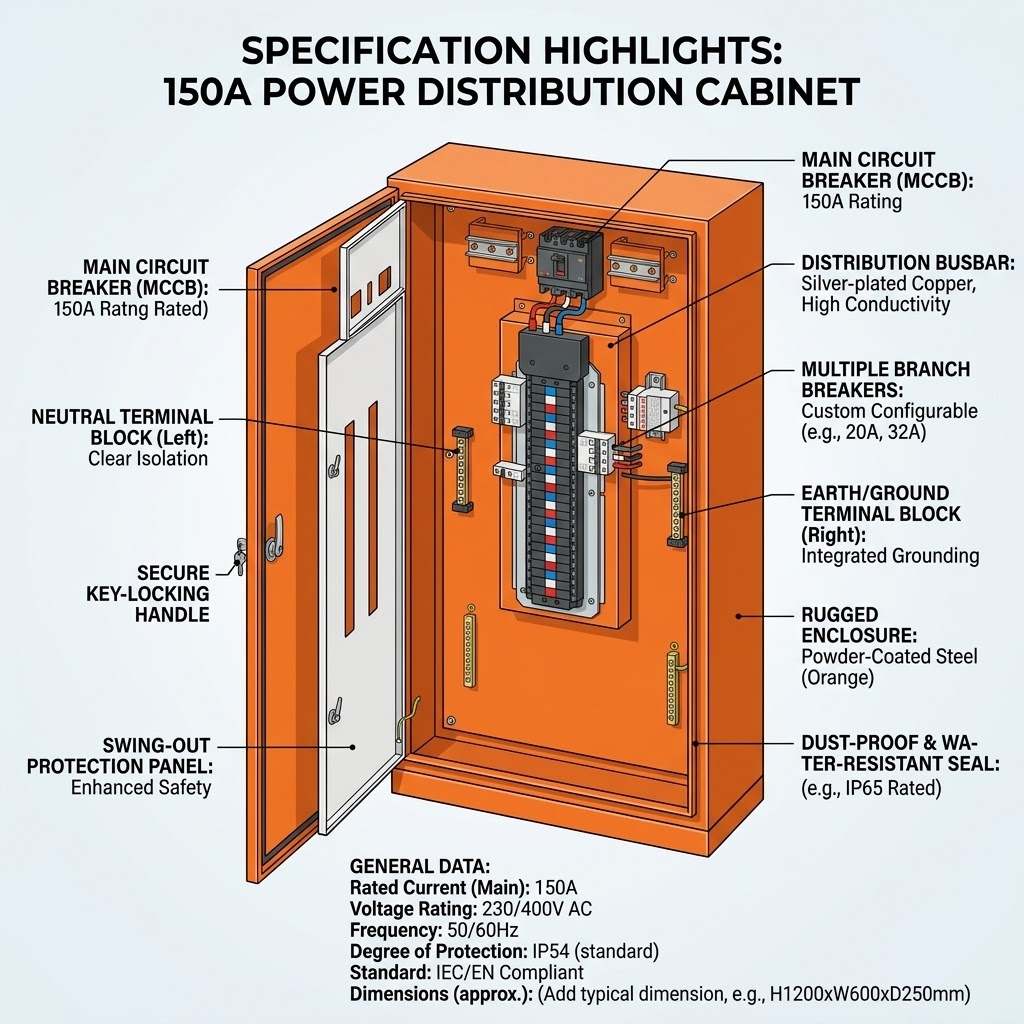
In modern residential electrical engineering, the widespread adoption of rooftop solar PV systems, high-power EV chargers, induction cooking, and centralized HVAC units has permanently transformed household energy profiles. Where a simple single-phase 63A or 80A main service entrance was once sufficient for standard lighting and power outlets, contemporary homes operate more like dynamic microgrids. Managing these complex power flows requires robust energy management equipment that can handle higher currents, distribute electricity safely, and comply with strict national regulations.
Acting as the vital bridge between the primary outdoor switchboard and internal residential circuits, the 150A indoor sub-main distribution board (sub-board) plays a central role in maintaining continuous power stability, ensuring fault containment, and protecting end-users. This guide offers an in-depth examination of 150A distribution boards engineered specifically for the Australian and New Zealand markets, examining system architecture, key design specifications, regulatory compliance, and installation best practices.
Architecture and Standards in Australian Residential Electrical Systems
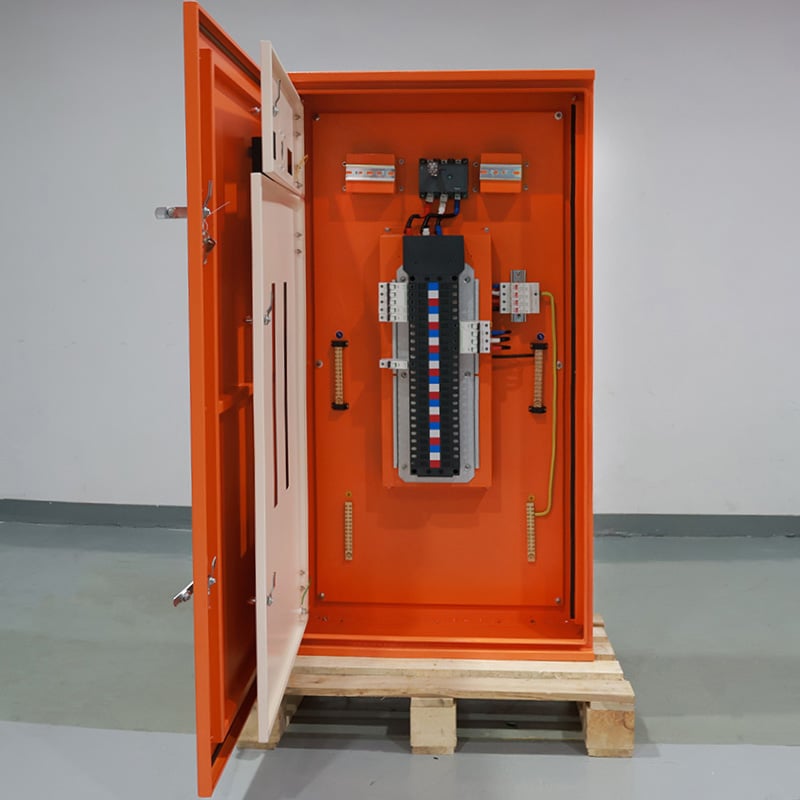
Residential electrical infrastructure in Australia relies on a multi-tier distribution network designed to isolate faults locally, simplify metering, and provide multi-stage protection. Power enters the property via utility mains, connecting first to an outdoor main switchboard (MSB) that houses the primary revenue meter, main isolation switch, and service protection fuses.
From the outdoor main switchboard, dedicated feeder cables run into the building to feed one or more indoor sub-main distribution boards. These sub-boards break down the heavy incoming feeder capacity into smaller, manageable branch circuits for lighting, power points, fixed appliances, and renewable energy devices.
To ensure seamless authority inspections, network operator acceptance, and maximum operational safety, the design, component selection, and assembly of a 150A sub-board must strictly comply with two foundational standards:
AS/NZS 3000 (The Wiring Rules): This mandatory standard governs the installation environment, wiring layout, cross-sectional area of conductors, earthing arrangements (including the Multiple Earthed Neutral, or MEN, system), and mandatory safety device configurations. It dictates that all sub-main circuits must feature adequate fault protection, clear labeling, and dedicated isolation devices.
AS/NZS 61439 (Low-voltage Switchgear and Controlgear Assemblies): Replacing the older AS/NZS 3439 series, this standard mandates strict design verification for complete distribution assemblies. Manufacturers must verify structural integrity, thermal performance, temperature-rise limits under full load, short-circuit withstand capabilities, dielectric strength, and creepage/clearance distances to guarantee that the switchboard operates safely under demanding real-world conditions.
Core Differences:
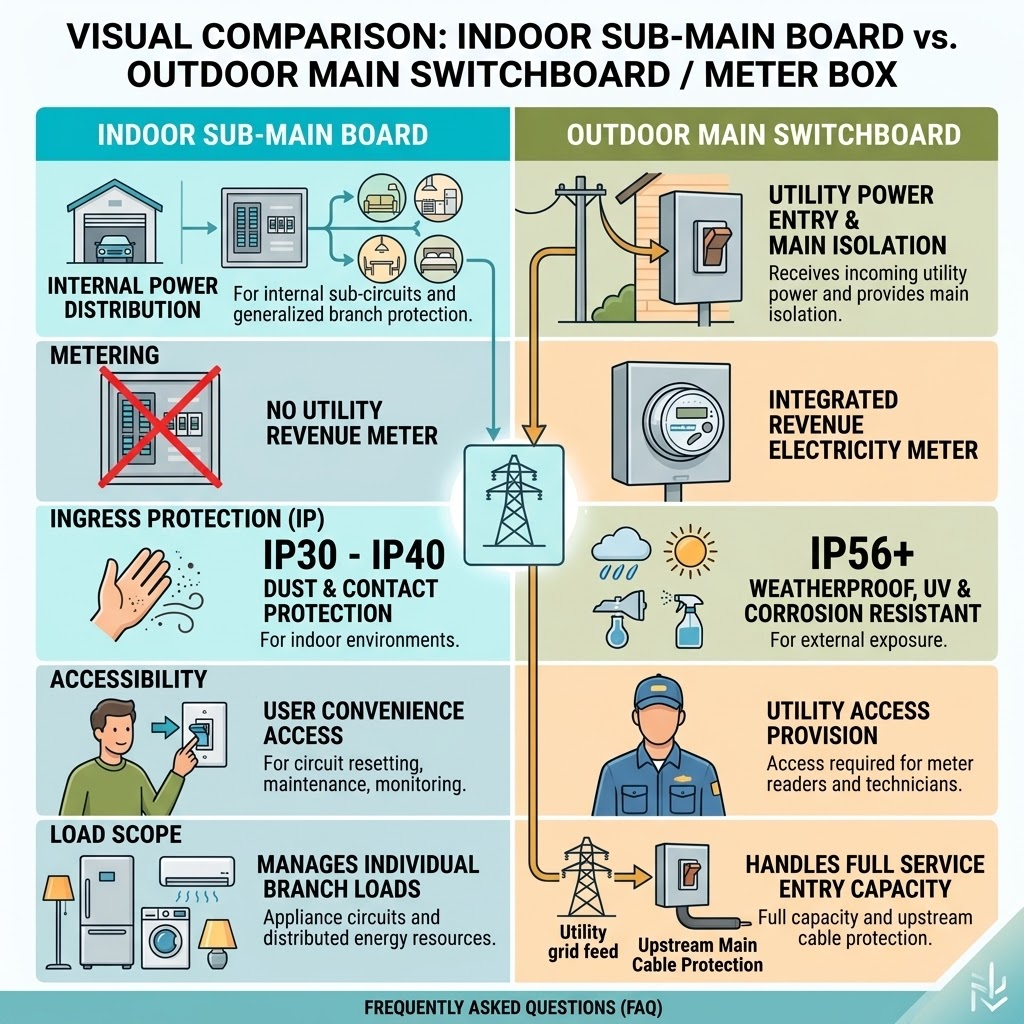
Comparison: Indoor Sub-main Board vs. Outdoor Main Switchboard
Comparison Point |
Indoor Sub-main Distribution Board |
Outdoor Main Switchboard / Meter Box |
Primary Function |
Distributes power to internal sub-circuits and provides localized branch protection |
Receives incoming utility power, houses revenue metering, and provides main isolation |
Installation Location |
Indoors (garages, utility rooms, or hallways; flush or surface mounted) |
External walls or property boundary enclosures |
Metering Equipment |
Does not contain utility revenue meters |
Integrates utility company revenue electricity meters |
Ingress Protection (IP) |
Typically IP30 to IP40 (focused on dust and direct-contact protection) |
Typically IP56 or higher (weatherproof, UV-resistant, and corrosion-resistant) |
Operational Accessibility |
Located indoors for convenient circuit resetting, maintenance, and monitoring |
Requires access provision for utility meter readers and service technicians |
Load Management Scope |
Manages individual branch loads, appliance circuits, and distributed energy resources |
Handles full service entry capacity and upstream main cable protection |
Key Design Considerations for 150A Residential Sub-Boards
Designing a 150A indoor sub-board requires a careful balance between spatial footprint, thermal management, and electrical capacity. Because these enclosures are installed inside living spaces, garages, or utility cupboards, they must offer clean aesthetics while incorporating heavy-duty internal components.
1. Thermal Dissipation and Temperature-Rise Verification
A 150A continuous load generates substantial heat inside a sealed enclosure. Under AS/NZS 61439, manufacturers must calculate or test the internal temperature rise to prevent insulation degradation, nuisance tripping of circuit breakers, and thermal breakdown of busbars. Adequate internal volume, ventilation slots (where IP ratings allow), and appropriately sized copper busbars are critical to maintaining internal operating temperatures within allowable limits.
2. Busbar Systems and Neutral/Earth Bars
The heart of any 150A sub-board is its busbar assembly. To reliably convey up to 150A per phase, high-conductivity, electro-tinned copper busbars are utilized. These busbar systems must feature high short-circuit withstand ratings to resist electromagnetic forces during fault conditions. Furthermore, the enclosure must provide dedicated, clearly identified Neutral and Earth terminal bars with sufficient connection tunnels to accommodate all outgoing branch circuits and equipotential bonding conductors.
3. Modular Space and DIN-Rail Capacity
Modern electrical designs demand extra modular space (usable poles or ways). A standard residential sub-board must accommodate a high density of protective devices. Providing generous DIN-rail capacity allows electrical contractors to organize circuits logically, maintain required bending radiuses for heavy-gauge internal cabling, and reserve blank poles for future circuit additions.
4. Safety Accessories and User Interface Features
To protect occupants and service technicians from direct contact with live parts, sub-boards incorporate escutcheon plates (dead-front covers) that expose only the operating toggles of switchgear. Neutral and Active links must be fully insulated, and clear door-locking mechanisms or padlocking provisions are often included to prevent unauthorized access.
Multi-Load Integration: Solar PV, EV Chargers, and Smart Loads
The integration of distributed energy resources (DERs) has drastically altered how distribution boards are configured. A modern 150A indoor sub-board does not merely supply power to passive appliances; it manages multi-directional power flows:
Rooftop Solar PV Integration: Inverter output circuits feed power back into the sub-board. Busbars must be rated to handle the combined current from both the grid supply and the solar inverter. Protection switches must be bidirectional to break fault currents safely regardless of flow direction.
Electric Vehicle (EV) Charging Infrastructure: EV chargers draw heavy, continuous loads for extended hours. Dedicated high-capacity circuit protection—often requiring Type A or Type B RCD protection to detect smooth DC leakage currents—must be integrated directly into the sub-board.
Energy Storage Systems (ESS) & HVAC: Battery inverters and large inverter-driven air conditioning units require dedicated sub-circuits equipped with motor-rated circuit breakers or specialized RCBOs designed to handle high inrush currents without false tripping.
FAQ
Q1: Why do modern Australian residential projects require a 150A rated sub-main distribution board?
A1:A 150A board provides high electrical capacity to handle modern peak loads like EV chargers and solar inverters without tripping, allowing seamless future expansion.
Q2: What is the AS/NZS 61439 standard, and how does it affect distribution board design?
A2: It is a mandatory standard ensuring distribution boards undergo verified testing for temperature limits, structural strength, short-circuit resistance, and electrical safety under continuous load.
Q3: Can a 150A indoor sub-board directly integrate solar PV and EV charging circuits?
A3: Yes, built-in DIN rails and heavy-duty busbars easily integrate solar inverters and EV chargers when paired with proper bidirectional MCBs and Type A or B RCBOs.
Q4: What are the installation environment requirements for indoor distribution boards?
A4: AS/NZS 3000 requires installation in dry, accessible indoor spaces with adequate clearance, prohibiting damp areas like bathrooms or positions directly adjacent to flammable materials.
Q5: Does a sub-main distribution board require a dedicated main isolating switch?
A5: Key maintenance includes checking bolted joints for hot spots, verifying busbar connection tightness, clearing dust from ventilation slots, and testing circuit breaker calibrations.
Conclusion
Selecting a fully compliant 150A indoor sub-main distribution board is essential for powering modern Australian homes reliably and safely. By adhering strictly to AS/NZS 3000 and AS/NZS 61439 standards, electrical contractors ensure seamless authority inspections, optimal circuit protection, and high energy efficiency. As residential power demands continue to evolve with solar and EV technologies, investing in a robust, high-capacity sub-board guarantees long-term performance, easy maintenance, and future-proof electrical infrastructure.
Table of Contents
- Architecture and Standards in Australian Residential Electrical Systems
- Core Differences:
- Key Design Considerations for 150A Residential Sub-Boards
- Multi-Load Integration: Solar PV, EV Chargers, and Smart Loads
-
FAQ
- Q1: Why do modern Australian residential projects require a 150A rated sub-main distribution board?
- Q2: What is the AS/NZS 61439 standard, and how does it affect distribution board design?
- Q3: Can a 150A indoor sub-board directly integrate solar PV and EV charging circuits?
- Q4: What are the installation environment requirements for indoor distribution boards?
- Q5: Does a sub-main distribution board require a dedicated main isolating switch?
- Conclusion