 EN
EN


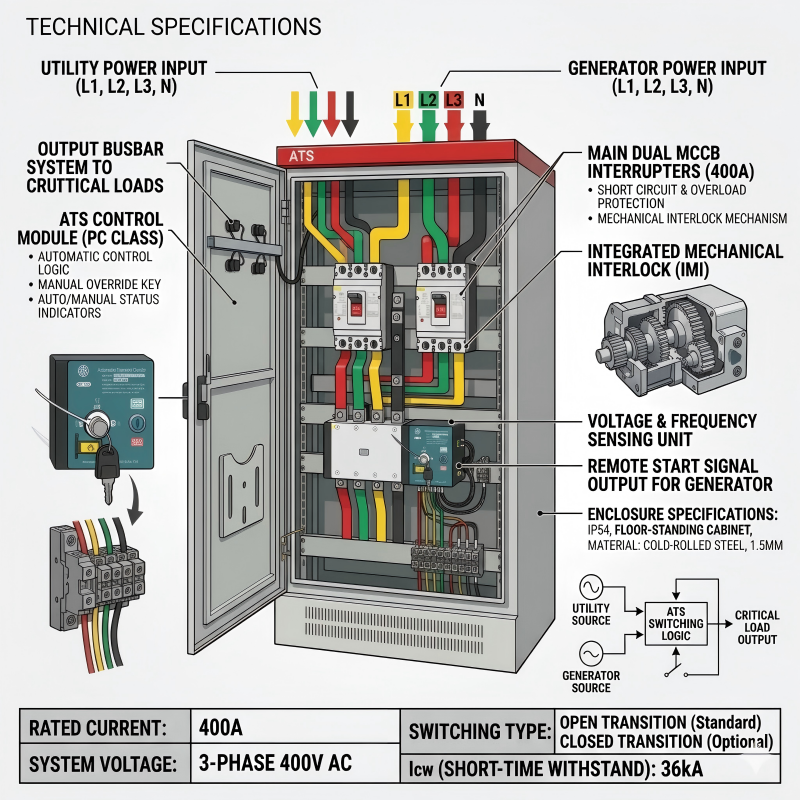
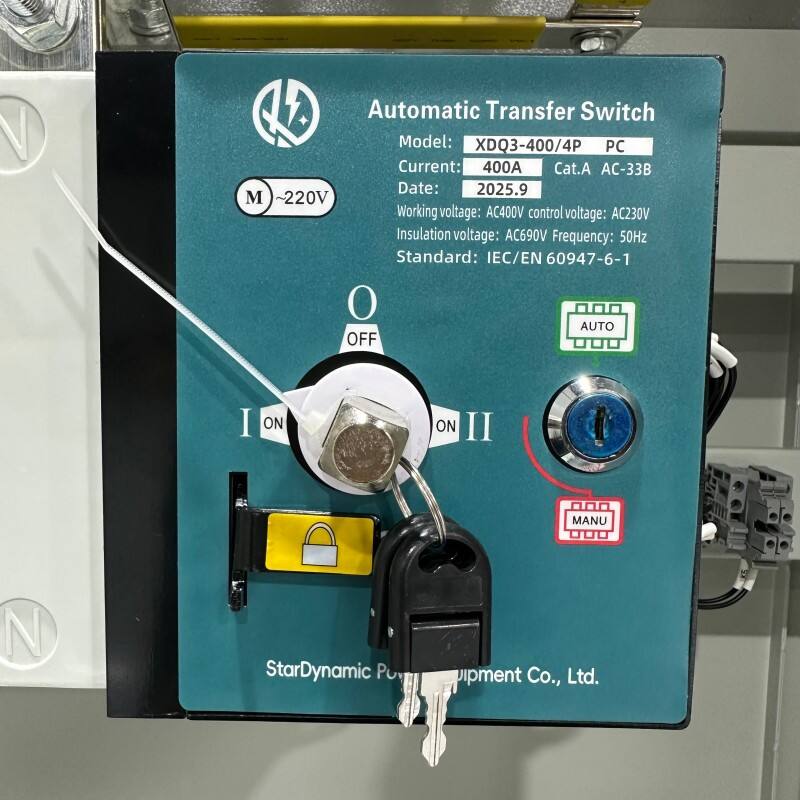
In modern industrial operations, power continuity directly dictates production efficiency and equipment safety. If the electrical system of a factory or building were an orchestra, the 400A Automatic Transfer Switch (ATS) Power Distribution Cabinet would be its composed and reliable commander.
For high-demand industrial infrastructure, the quality of the ATS power distribution system not only concerns electrical safety but also directly determines the operational stability of the entire facility's energy network. From a professional scientific perspective, this article provides an in-depth comparative analysis of the core design logic of a 400A Automatic Transfer Switch (ATS) complete control panel.
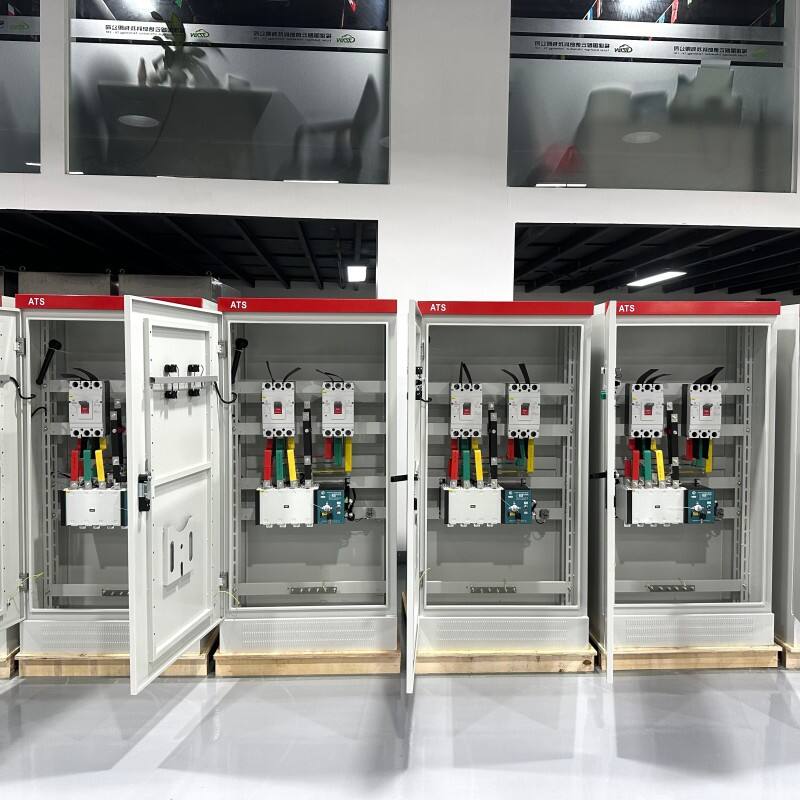
The 400A ATS Panel: The Core Hub for Industrial Continuity
Before diving into the technical specifications, it is essential to understand why the 400A rating is considered the "gold standard" for industrial power supply.
1. The "Intelligent Brain" for Dual Power Sources:
An ATS (Automatic Transfer Switch) is more than a switch; it is a precision monitoring and execution system. Positioned at the convergence of the utility grid and a backup source (like a generator), its core value lies in "zero manual intervention." When the main circuit experiences voltage drops, phase loss, or blackouts, the ATS acts like a neural reflex—instantly mobilizing backup power to save the facility from catastrophic downtime.
2. Precision Coverage for Industrial Loads:
In a three-phase 400V system, a 400A rating allows for the steady management of approximately 200kW to 260kW of active power. This specification is strategically designed to cover the load requirements of medium-sized production lines, critical hospital surgical departments, and mid-scale data centers. Unlike small residential switches, it features high Short-Time Withstand Current (Icw) and superior breaking capacity to handle the electromagnetic surges common in industrial environments.
3. Proactive Electrical Protection:
Modern 400A ATS cabinets do not just wait for a blackout. They analyze grid frequency and waveforms in real-time. By identifying "unhealthy power" (even if the lights are still on), the system can issue early warnings or trigger a switch to prevent sensitive PLC systems or frequency inverters from being damaged by low-quality electricity
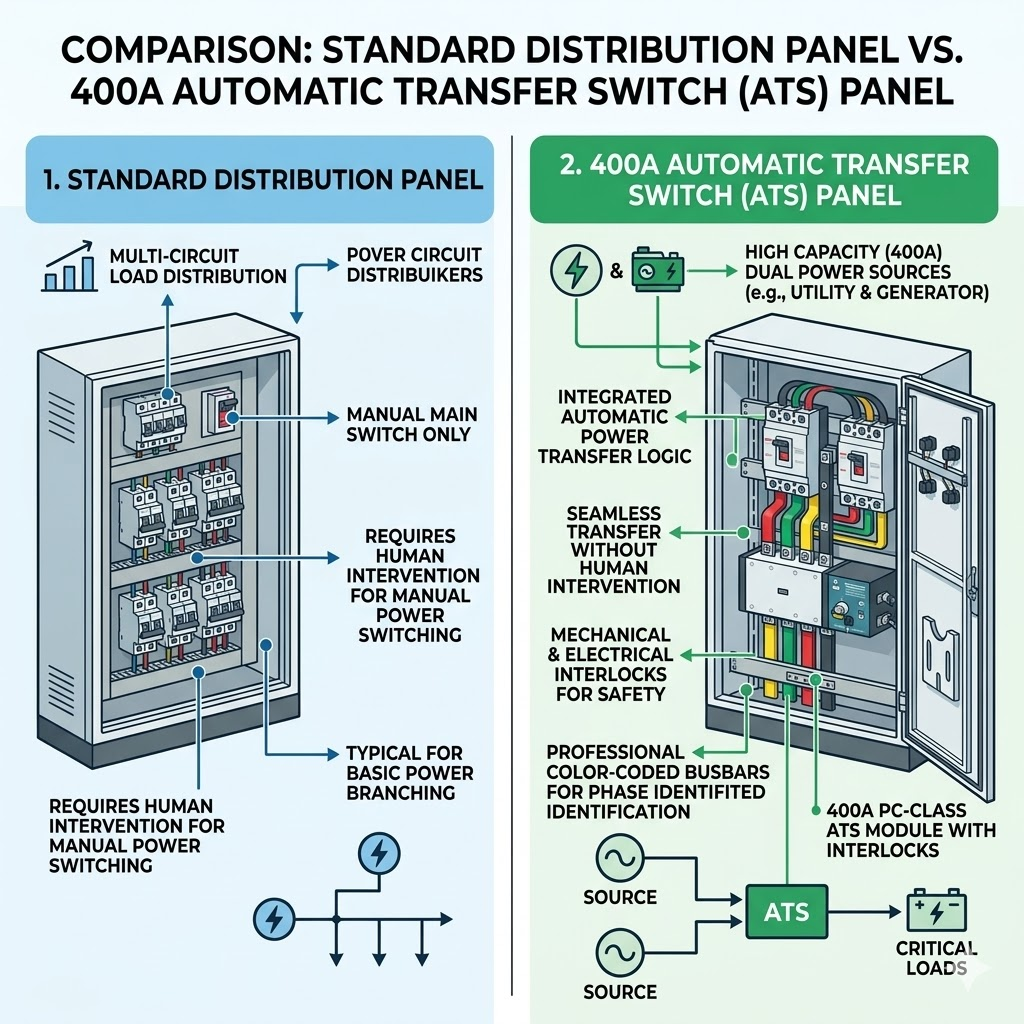
Key Comparison: Standard Panel vs. 400A ATS Panel
The table below highlights the core differences in ensuring production continuity:
Feature |
Standard Distribution Panel |
400A ATS Distribution Cabinet |
Power Inputs |
Supports only a single utility input |
Supports Dual Inputs (Utility + Generator) |
Switching Logic |
Requires manual manual operation |
Smart monitoring with auto-sensing switch |
Safety Mechanism |
Basic circuit breaker protection |
Dual Mechanical + Electrical Interlocks |
External Linkage |
No external device management |
Auto start/stop control for generators |
Primary Goal |
Basic power distribution/branching |
Guaranteed continuity for critical loads |
Technical Insight: The Automated Operational Sequence
The workflow of a 400A ATS cabinet follows a rigorous electrical algorithm to ensure absolute safety and equipment stability during power transitions:
1. Multi-Parameter Precision Sensing:
The system monitors the utility source for more than just total failure. It identifies "sub-healthy" power states. If the primary source experiences a voltage drop (typically below 80% of rated voltage), frequency shift, or phase imbalance, the logic engine immediately deems the source unreliable.
2. Command Execution & Generator Warm-up:
Once a fault is confirmed, the controller closes a dry contact to send a Remote Start signal to the generator. The system enters a brief "waiting period" to allow the generator to reach its stable RPM and voltage threshold (usually 90% of rated voltage), ensuring the backup power is "strong" enough to take on the 400A load.
3. Zero-Overlap Mechanical Transfer:
This is the critical physical process. The ATS actuator disconnects the primary source, pauses for a tunable "dwell time" (to allow residual inductive EMF to dissipate), then rapidly closes on the backup source. The Mechanical Interlock physically prevents both sources from ever being connected at once, eliminating the risk of a cabinet explosion caused by short circuits.
4. Smart Restoration & Cooling Phase:
When utility power returns, the system enters a "confirmation delay" to ensure stability before switching back. The generator does not shut off immediately; it enters a 3-5 minute cooling phase at idle to dissipate heat from the combustion chamber and windings, significantly extending the lifespan of the equipment.
FAQS
Q1: How much load can a 400A ATS panel realistically handle?
A1:It is recommended to keep continuous running loads at about 80% of the rating (160kW-200kW) to accommodate inrush currents from motor startups.
Q2: Will there be a power dip during the transfer?
A2: Yes. There is a millisecond-level physical switch interval. For precision electronics, a UPS (Uninterruptible Power Supply) should be used downstream.
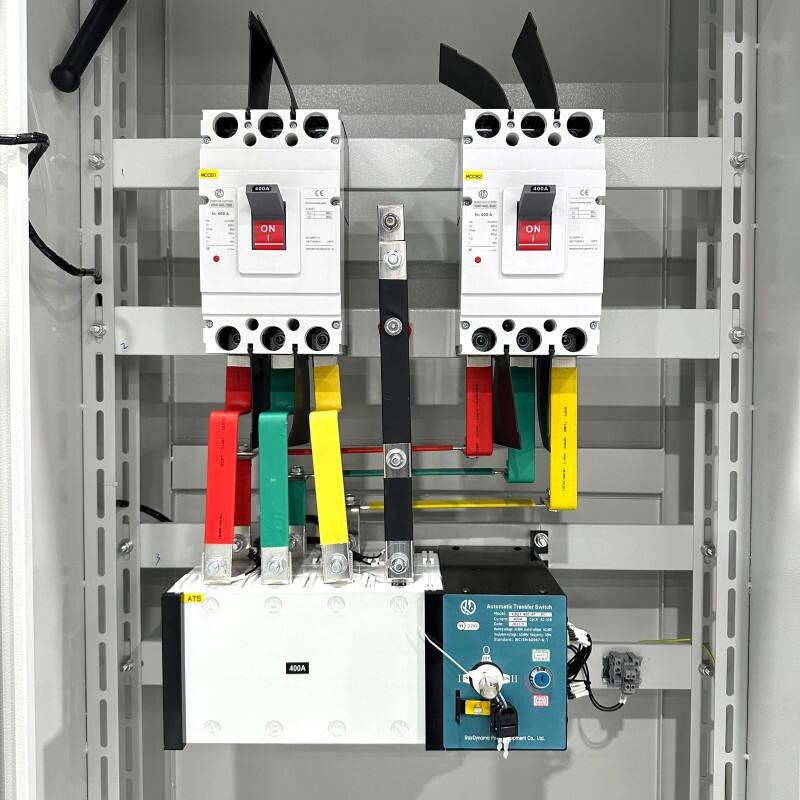
Q3: Why is color-coded busbar management so important?
A3: Standardized colors (Yellow/Green/Red/Black) ensure correct phase sequences, preventing motors from reversing or equipment from burning out due to swapped phases.
Q4: Must the generator be purchased specifically for the ATS?
A4: The generator must have a self-start interface (ATS controller compatible) to receive commands; otherwise, the automation feature is lost.
Q5: How should a floor-standing 400A ATS be maintained?
A5: Perform a load-transfer test quarterly and use infrared thermography to check connection points for any abnormal heat due to loose busbar bolts.
Conclusion
The 400A Automatic Transfer Switch (ATS) Power Distribution Cabinet is the "lifeline" of industrial power resilience. By integrating high-performance circuit protection, standardized busbar craftsmanship, and sophisticated control logic, it creates a robust barrier for critical infrastructure. When selecting a power solution, prioritizing industrial-grade components and rigorous interlocking is the only way to ensure 24/7 uninterrupted operation.